Brittany Flag: Gwenn ha Du Stripes, Ermine & History
Why does the flag of Brittany have nine black-and-white stripes and ermine symbols? Meet Morvan Marchal, learn the history of the Gwenn ha Du and distinguish it from older ducal flags.
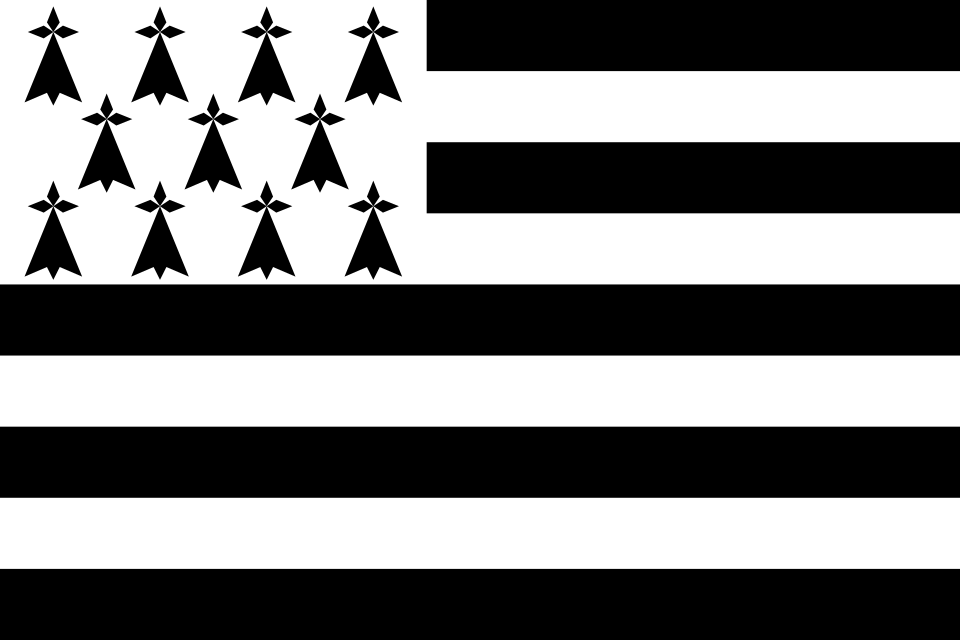
From Rennes and Brest to coastal festivals, the flag of Brittany is one of France’s most familiar regional banners. Its Breton name, Gwenn ha Du, literally means “white and black.” The flag is visually simple at a distance but has a detailed history involving medieval duchy symbols and a designer working in the 1920s.
A frequent misconception is that the exact black-and-white striped design was flown by medieval dukes for centuries. The ermine belongs to older Breton heraldry, but the modern striped composition was created much later by Morvan Marchal. The Région Bretagne website and the scholarly history portal Becedia explain that distinction.
Brittany is a region of France; its flag does not replace the French blue-white-red national tricolour. It can be displayed as a local cultural symbol in a variety of civic contexts.
Gwenn ha Du at a glance: stripes and canton
The flag has nine narrow horizontal black-and-white stripes, usually starting and ending with black. Its upper hoist corner is white with small black ermine-tail marks, commonly eleven arranged in rows. The exact number of ermine marks has varied historically, unlike the nine-band arrangement of the standard modern pattern.
| Feature | Details |
|---|---|
| Region | Brittany (Bretagne/Breizh), France |
| Breton name | Gwenn ha Du — literally white and black |
| Stripes | Nine horizontal, five black and four white |
| Canton | White field with black stylized ermine-tail marks |
| Common ermine count | Eleven (different historic variants exist) |
| Modern designer | Morvan Marchal |
| Creation | Between 1923 and 1925 |
| Primary visual inspiration | Breton ducal ermine and modern striped banners |
Why are there nine stripes on Brittany’s flag?
The conventional interpretation is that the nine horizontal stripes represent the nine historic bishoprics of Brittany. The five black stripes correspond to the five traditionally Gallo-speaking bishoprics in Upper Brittany: Rennes, Nantes, Dol, Saint-Malo and Saint-Brieuc.
The four white stripes correspond to four western, traditionally Breton-speaking bishoprics: Léon, Trégor, Cornouaille and Vannes. This is a symbolic description of historical cultural geography. It is not the same as the number of modern administrative departments or a declaration about the first language of every present-day resident.
Because the stripes alternate, five black stripes and four white stripes produce nine visible horizontal bands. The familiar pattern starts with black at the top and ends with black at the bottom. Counting only the white bands or saying there are nine of each color would be incorrect.
Why is Nantes included in the historical explanation?
Nantes belonged to historic Brittany and appears in the traditional nine-bishopric interpretation, although today’s administrative Région Bretagne does not include the Loire-Atlantique department. That is why a flag design inspired by historical Brittany may refer to more territory than the current regional council’s official map.
What are the black symbols in the corner?
The small black shapes in the white canton are called ermine spots or ermine-tail marks. They are stylized heraldic symbols of ermine fur, long associated with the dukes of Brittany. They are not anchors, birds, pine trees or pawprints, even if a tiny reproduction makes them difficult to recognize.
In medieval European heraldry, an ermine field was a white background sprinkled with black tail-shaped marks. Breton ducal arms and later regional designs used that visual vocabulary. Marchal’s flag incorporated it into a new layout resembling modern rectangular flags with a canton.
The familiar contemporary Gwenn ha Du commonly has eleven spots, often in an arrangement of four, three and four. However, expert accounts note that the number varied in historical versions and that the choice should not automatically be equated with nine bishoprics or eleven named provinces. The stripes are the element with the recognized nine-territory symbolism.
Do not make a worksheet that requires students to memorize an invented meaning for every individual ermine mark. It is more historically reliable to identify the ermine as a shared heraldic emblem.
Who created the Gwenn ha Du flag?
Morvan Marchal (1900–1963) was a Breton architect and activist associated with regionalist movements. Between 1923 and 1925, he developed a modern flag using black-and-white Breton heraldry in a new striped composition.
The design drew partly on the visual organization of the American Stars and Stripes, with a patterned canton at the hoist and a set of horizontal bands. In place of the United States’ white stars, Marchal used Breton ermine marks; in place of red-and-white stripes, he used black and white.
The regional council’s historical page describes the Gwenn ha Du as created in 1925, while specialist accounts describe development from 1923 to 1925. These dates are compatible when “created” refers to a public version rather than a single moment of conception. It would be misleading to claim that the exact striped flag dates to the Middle Ages.
Marchal’s political biography belongs to the complex and contested history of Breton nationalism in the twentieth century. The flag’s subsequent public acceptance is much broader than the views of one individual designer and does not establish one uniform political outlook among contemporary users.
How does it relate to the older Breton ermine flag?
The old dukes of Brittany used white ermine heraldry long before the modern Gwenn ha Du existed. The traditional ermine flag has a white background scattered with black ermine spots. Another historic Breton banner, the Kroaz Du, uses a black cross on white.
The modern Gwenn ha Du is different from both. Marchal combined the recognizable ermine theme with a contemporary striped design in a way that made it easy to fly, print and display at public events.
Because these symbols share Breton heritage, a museum exhibition may display them together. They should still be captioned with their own names and approximate periods. A medieval Breton duchy scene illustrated with an exact modern nine-stripe Gwenn ha Du may be anachronistic unless the flag is clearly labeled as a modern symbol.
What has survived across the centuries is the black-and-white ermine symbolism, not an unchanging pattern of nine stripes throughout all Breton history.
When did the Breton flag become widely used?
Created in the 1920s, the Gwenn ha Du appeared in regionalist and cultural settings and gradually became recognized by a much larger Breton public. In 1937 it was used to represent Brittany at the Paris International Exposition’s Breton pavilion, an important public milestone identified by historical specialists.
Over the second half of the twentieth century its meaning expanded from a flag associated with specific movements to a common expression of regional belonging. It is now seen at concerts, festivals, sporting events, public buildings and celebrations of Breton culture.
Région Bretagne uses the banner as a recognizable regional emblem. Its widespread use does not make it the sovereign national flag of an independent state. It is best identified as the modern cultural and regional flag of Brittany, alongside the national French flag.
Brittany flag vs. the United States and other regional flags
The resemblance to the American flag is intentional at the level of layout: horizontal bands plus a decorated canton. But Brittany uses only black and white, nine stripes, and ermine rather than a blue canton filled with fifty white stars. These visual differences make the two designs easy to distinguish in a quiz.
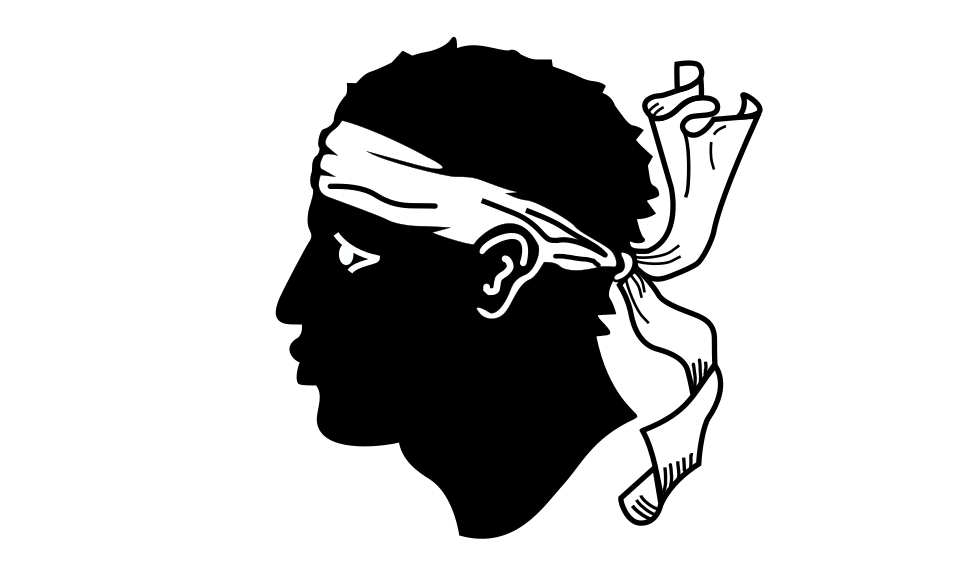
The nearby Corsican flag is white with one black Moor’s Head; it does not feature alternating stripes. The Basque Ikurriña instead uses red, green and white crosses. Similar regional pride does not imply that the symbols or political traditions are the same.
Another useful comparison is with the monochrome flag of Cornwall, which bears a white upright cross on black. The Gwenn ha Du has no full-length white cross; its strongest features are stripes and canton marks.
How to draw and recognize the Brittany flag
Begin with a rectangle and divide it into nine equal horizontal bands. Starting at the top, color every other band black, leaving the remaining bands white. This produces five black and four white stripes.
Add a white rectangle in the upper corner nearest the flagpole. Fill it with small black ermine-tail marks, arranged like stylized clusters rather than stars. The common modern design has eleven marks, but check a trustworthy reference before claiming a historically exact arrangement for a particular period.
To make the exercise educational, ask why a black-and-white flag can represent a region that also uses the blue-white-red French national flag. The answer is that regional identity and national citizenship can be expressed with different symbols, even within the same country.
Frequently asked questions
What is Brittany’s flag called?
Gwenn ha Du, Breton for white and black.
How many stripes are on the Breton flag?
Nine: five black and four white.
Why are there nine stripes?
They are traditionally interpreted as the nine historical bishoprics of Brittany, with five in Upper Brittany and four in Lower Brittany.
What are the black spots on the Brittany flag?
Stylized ermine-tail marks from Breton ducal heraldry.
Are there exactly eleven ermine spots?
Eleven is common on the modern form, but historical variations use different numbers; the spots do not each have a reliably prescribed separate meaning.
Who designed the Gwenn ha Du?
Breton architect Morvan Marchal, between 1923 and 1925.
Is it a medieval flag?
No. Its ermine motif is medieval, but the striped modern design dates to the 1920s.
Is Brittany an independent country?
Brittany is a region of France, with a distinct cultural identity and regional flag.
Why is the flag similar to the American flag?
Marchal used the modern striped-and-canton composition as an influence, replacing American stars and colors with Breton ermine and black-and-white stripes.
Historical sources and artwork credits
Région Bretagne — traditions and Gwenn ha Du
Becedia / Bretagne Culture Diversité — Gwenn ha Du history
Becedia — Le Gwenn-ha-Du est-il un drapeau traditionnel?
Breton departmental museum — early Gwenn ha Du objects
Wikimedia Commons — Gwenn ha Du
Breton flag public-domain artwork from Wikimedia Commons. A Corsican comparison image is sourced from Commons; both have been rasterized to PNG. Check each source file page for its full attribution and reuse notice.
The image files are PNG renderings of the linked Wikimedia Commons vectors and are used for identification. Follow credited source-file licenses when reusing the images. Regional symbolism and legal status checked November 2026.