Sardinia Flag: Four Moors, Cross & Blindfolds Explained
Why are four Moor heads on Sardinia’s flag, and why are their headbands above the eyes today? Compare the current and historic designs and trace the island’s medieval heraldry.
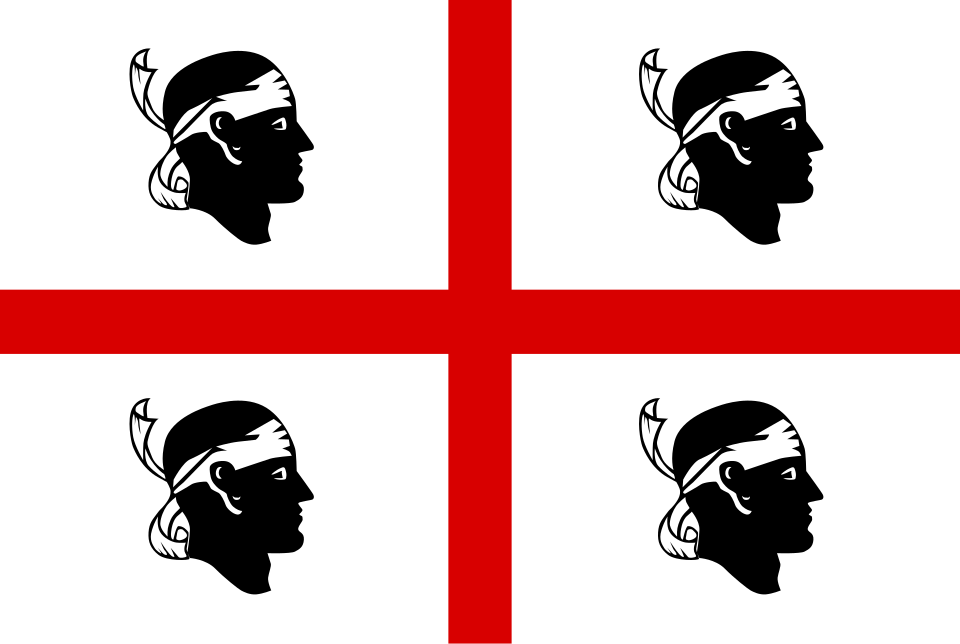
The Sardinian flag is among the most visually unusual regional flags in Europe. Called Sa bandera de sos bator moros or the Quattro Mori, it combines a red cross with four dark human profiles. You may see it across Sardinia, at regional celebrations and on ferry terminals, and the design also appears in older heraldic sources.
There is an important distinction between the flag’s medieval roots and its contemporary legal form. Some versions show the four heads facing one way, with cloth bands across their eyes. On the legally standardized version associated with the 1999 reform, the heads face the other way and the bands sit on the forehead. The older visual tradition is still visible in many reproductions.
Our guide focuses on those documented changes and what the four figures represent, without presenting a modern legend about their origin as historical certainty. Sardinia is an autonomous region of Italy, not a sovereign country with a separate national flag.
Sardinia Four Moors flag: key facts and visual features
The current flag is a white field divided by a red upright cross. Each quarter contains a dark Moor head with a pale band at the forehead. A historical version with the band across the eyes and differently oriented profiles remains widely known.
| Flag detail | What to know |
|---|---|
| Region | Autonomous Region of Sardinia, Italy |
| Nickname | Quattro Mori / Four Moors |
| Field | White, red upright cross, four black Moor heads |
| Modern legal standard | Regional Law No. 10, April 15, 1999 |
| Older regional symbols | 1950 regional arms and 1952 formal recognition |
| Common confusion | Headbands across eyes vs. forehead; direction the faces turn |
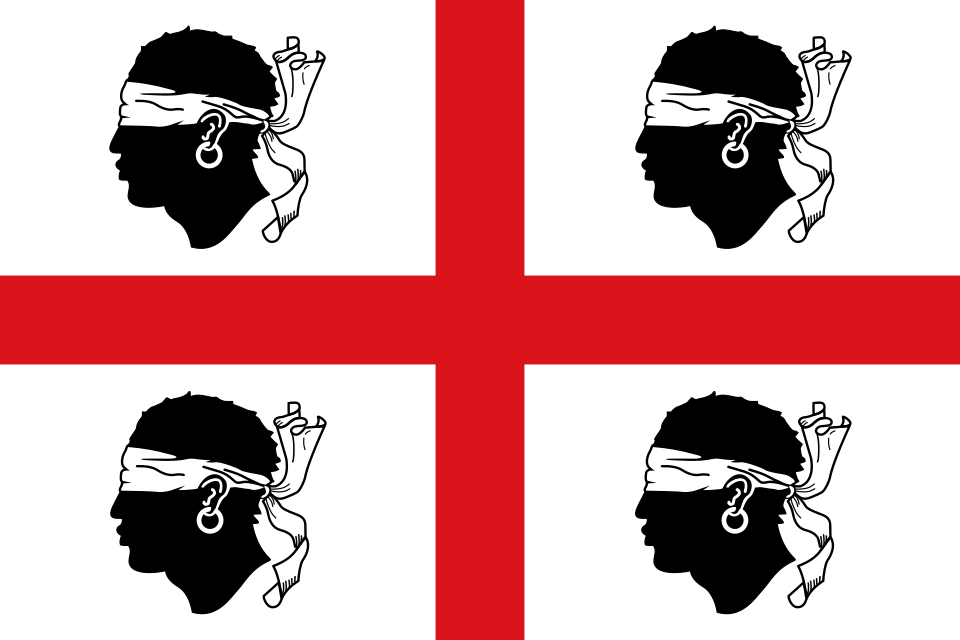
What do the four Moor heads on Sardinia’s flag represent?
The four heads are called the Four Moors, a heraldic emblem associated for centuries with the Crown of Aragon and the island of Sardinia. The image has been described in connection with medieval conflicts involving Christian and Muslim powers in Iberia. It became an emblem of Sardinia through complex dynastic and administrative history rather than through a single verified event on the island itself.
The exact origin of the four heads is debated. Popular stories refer to four defeated rulers, four victories or a battle associated with Saint George or the Aragonese kings. Those accounts can be part of the tradition, but they should not be presented as an uncontested eyewitness explanation for why the modern Sardinian flag contains precisely four profiles.
Today the regional government treats the emblem as a strong expression of Sardinian identity. Its origins are historical and heraldic, while its present usage is civic. It is appropriate to explain the older imagery without attributing one uniform modern political view to all Sardinians who fly the flag.
Why is there a red cross on a white background?
The cross resembles the red Saint George’s cross seen in European and Mediterranean heraldry. The four heads occupy the quadrants produced by that cross, which organizes the flag into an easily recognizable composition.
In heraldic terms the combination links the emblem to earlier royal and regional coats of arms. Sardinia’s flag should not be mistaken for England’s national cross flag simply because both use a red upright cross on white. England’s flag lacks four Moor heads, while the Sardinian design has the historical head emblems as its defining feature.
The cross is often described as an inheritance of medieval Christian heraldic traditions. It does not establish that the modern region operates under medieval law or that the flag is a statement about the religious beliefs of individual Sardinians.
Why did the Moor heads’ blindfolds change?
Some older versions depicted the four heads with bands crossing the eyes, often called blindfolds. In the current official-style version the band lies across each forehead and the eyes remain visible. The faces also point in a different direction relative to many pre-1999 images.
Sardinia’s 1999 legislation formalized the regional flag with a more specific design, ending decades in which several visual forms circulated. The region’s current institutional identity materials refer back to that legal framework and to the earlier regional arms adopted after Italian autonomy.
The explanation sometimes given is that the newer artwork emphasizes free, open-eyed figures rather than captives. That is an interpretation of the design change, not a substitute for the wording of the law. In a school presentation, distinguish what is visually verifiable—bands above the eyes and orientation—from a claim about the private intentions of every historical designer.
If you compare a textile purchased in the 1980s with a recent official regional flag, it is possible to see different headband placement without either photograph being mislabeled. One shows an older version and the other the modern standardized one.
Historical origins: Aragonese emblems and Sardinian identity
The Four Moors symbol circulated for centuries in heraldic imagery connected with the Aragonese crown. Sardinia’s period under Aragonese and later Spanish rule explains why similar motifs appear in Iberian and island histories. It would be inaccurate to say that an individual Sardinian town invented the exact modern flag design in 1999; the emblem is considerably older.
The documentary history is not the same as the legends surrounding the four heads. Medieval heraldic changes are often reconstructed from seals, coins, coats of arms and later records. One of the best ways to evaluate a claim is to ask whether it identifies a dated surviving document rather than relying only on a memorable story of a battlefield.
The symbol continued to change visually over time, which is why profile direction, headbands, and small artistic details vary in historical documents. Sardinia eventually adopted and standardized regional institutional emblems within the Italian constitutional framework.
When did Sardinia officially adopt its current flag?
The regional government’s identity and symbolism pages refer to a history of institutional formalization. A Sardinian regional decision in 1950 supported the Four Moors coat of arms, and a presidential decree in 1952 confirmed a coat of arms and gonfalon. Regional Law No. 10 of April 15, 1999 established the region’s present flag arrangements.
It is important not to confuse the date of legal adoption with the age of the emblem. The Four Moors design appeared centuries before the 1999 law. That legislation clarified how the regional banner would be identified and used rather than inventing the entire symbol from scratch.
Official regional material is the best source when identifying the current design and the status of different historical forms. Decorative versions on souvenirs may reverse the flag or add regional words; those are not necessarily accurate versions of the official standardized banner.
Sardinia vs. Sicily and Corsica: similar-looking symbols?
Sardinia’s closest well-known visual comparison is the Corsican Moor’s Head flag. Corsica uses a single dark head on a white field, typically with a white band on the forehead, and without Sardinia’s big red cross. Sardinia instead has four heads and a red cross dividing the white background.
The nearby island of Sicily has a very different banner: diagonal yellow and red with a three-legged Trinacria and Gorgon head. Although all three designs feature Mediterranean symbolism and human or human-like faces, their official forms are distinct and easy to separate.
Italy’s green-white-red national flag and Sardinia’s regional Four Moors flag can appear together. That does not imply that Sardinia is a separate sovereign state; regional flags are a normal part of Italian local identity.
How to identify the Sardinian flag correctly
Count the heads. Four heads arranged around a large red cross identify Sardinia; a lone head on a white field usually indicates Corsica. Look next at the bands on the forehead or over the eyes. The location can help you identify a current legal-style rendition versus a historical or decorative version.
The heads themselves should be shown in a neutral, factual way. The term “Moors” reflects the long-established heraldic name, not a precise description of the identities of four real people. Avoid captions claiming to know their names or ancestry unless an independent historical source confirms the interpretation.
For a quiz, ask readers to distinguish between the Sicily Trinacria flag, Sardinia’s four heads, and Italy’s tricolour. This activity uses concrete design differences rather than unverified medieval stories.
Frequently asked questions
How many Moors are on Sardinia’s flag?
Four: one dark head in each quarter of the white flag divided by a red cross.
Why is the Sardinia flag called the Four Moors?
The four human profiles are a historic heraldic device commonly called Quattro Mori in Italian.
Is there a red cross on the Sardinia flag?
Yes. The current regional flag has a large red upright cross dividing the white background into four quarters.
Are the Moors blindfolded on the current flag?
Modern official versions place the white bands on the foreheads, leaving the eyes visible. Historic versions often placed bands over the eyes.
When was the current Sardinia flag adopted?
The present regional flag framework was adopted under Regional Law No. 10 of April 15, 1999.
Is the Sardinian flag the same as Corsica’s flag?
No. Sardinia has a red cross and four Moor heads; Corsica has one Moor head on a plain white background.
Is Sardinia’s flag the same as Sicily’s?
No. Sicily shows the Trinacria on diagonal red and yellow, while Sardinia displays the Four Moors and a red cross on white.
Do the four heads represent four named kings?
Several medieval legends offer explanations, but identifying four specific real rulers as a proven origin goes beyond the secure evidence.
What does the Sardinia flag represent today?
It is the official symbol of the autonomous region and a widely recognized emblem of Sardinian cultural identity.
Sources and flag image credits
Regione Sardegna — Identità visiva e quattro mori
Regione Sardegna — Legge Regionale 15 aprile 1999, n. 10
Consiglio regionale della Sardegna — 1999 debate
Wikimedia Commons — current Sardinia flag
Wikimedia Commons — 1950–1999 historical version
Main flag vector by Xander89 based on icnussa, rendered from SVG to PNG, Wikimedia Commons, CC BY-SA 3.0. Adaptation: SVG rasterized as PNG; no deliberate design modification.
Historical comparison image from Wikimedia Commons (1950–1999 rendition). Follow its file-page licensing and attribution requirements for further reuse. The article provides historic comparison, not a statement that the older image is the current regional standard.
Images are educational renderings of the linked Wikimedia Commons files; official emblems may have use rules independent of copyright. Flag details checked November 2026.