Basque Country Flag: Ikurriña Colors, Crosses & History
What do the red, green and white colors of the Ikurriña mean? Learn why it contains two crosses, who designed it in 1894, and when it became the Basque Country’s official flag.
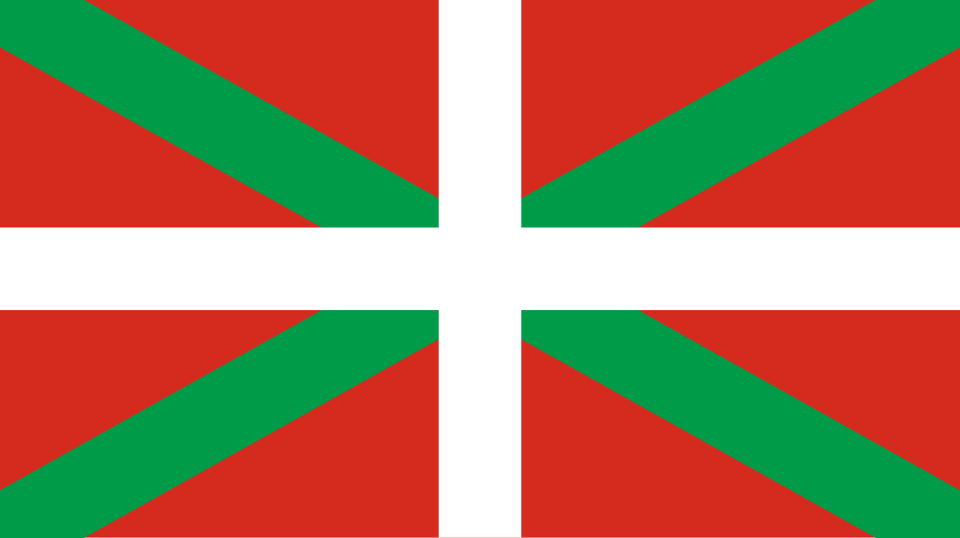
The Basque Country’s flag is immediately recognizable: red underneath two crossing shapes in white and green. It is often called the Ikurriña or Ikurrina. The design is seen throughout the Basque Autonomous Community in Spain and is widely used by Basque communities in other places, including areas of the wider historical Basque cultural region.
It is important to distinguish the Basque Autonomous Community (Euskadi), which has legal recognition under Spanish law, from the broader linguistic and cultural idea of Euskal Herria, which spans communities on both sides of the Spain–France border. The flag has a cultural role beyond the legal boundaries of the autonomous community.
The Basque Government’s official pages explain the creators, meanings and flag specification, making them the primary sources for the design rather than speculative color charts circulating online. The Spanish national flag is red-yellow-red and does not share the Ikurriña’s crossed design.
Basque Ikurriña flag: design and legal status
The Ikurriña places a green diagonal cross (saltire) over a red background, then a white upright cross in the middle. Official Euskadi guidance identifies the arrangement and traces the flag to the Arana brothers in 1894.
| Feature | Details |
|---|---|
| Region | Basque Autonomous Community (Euskadi), Spain |
| Flag name | Ikurriña / Ikurrina |
| Colors | Red background; green saltire; white upright cross |
| Creators | Luis and Sabino Arana Goiri |
| Origin | 1894, initially designed for Biscay |
| First official adoption | October 1936 by the Basque Government |
| Current legal reference | 1979 Statute of Autonomy, Article 5 |
| Official proportions | Height about 56% of width under technical specification |
What do the Ikurriña red, green and white mean?
Official Basque descriptions link the red field to the old emblem of Biscay (Bizkaia), which the Arana brothers originally sought to represent. The green diagonal cross is associated with Saint Andrew and the traditional tree of Guernica (Gernika), while the white upright cross reflects the Christian religious context of the designers’ symbolism.
Those interpretations belong to the flag’s historical creation. The Ikurriña now also serves as a broad civic and cultural symbol for Basque people whose views and beliefs differ. It is inappropriate to infer an individual observer’s religion or political ideology merely because they display an official regional flag.
The flag’s design is defined by the overlay of two different crosses, not by horizontal stripes. The red, green and white colors also appear on Basque sporting and festival material. However, a commercial motif using those colors is not necessarily a correct official flag: the white upright cross and green saltire need their proper placement.
Why is green linked with the tree of Gernika?
The Gernika oak is an important emblem in Basque historical institutions and traditions. It represents the continuity of local assemblies and liberties. This meaning sits alongside the religious and heraldic associations of the cross-shaped element. The green saltire was not selected because the region is simply covered with green hills.
Why does the Basque flag contain two crosses?
The green saltire is an X-shaped diagonal cross, traditionally associated with Saint Andrew. Over it lies a white upright cross extending vertically and horizontally across the field. The contrast helps the design remain clear at a distance and distinguishes it from an ordinary three-color tricolour.
The order of the layers matters: the red field is background, the green diagonal form cuts across the field, and the white upright cross sits across the center. A white diagonal X on blue, such as Scotland’s national Saltire, is a different flag with different historical symbolism.
The Basque Government’s official technical sheet defines the dimensions and proportions. In its specification, the height of the rectangular flag is 56 percent of the base, and the widths of the cross and saltire bands are each specified as a proportion of that base. Educational illustrations should use that pattern rather than arbitrary thin lines.
For flag-identification questions, ask which form is diagonal and which form is vertical-horizontal. A student who can point to both can recognize the Ikurriña even when the image is shown without a caption.
Who designed the Ikurriña in 1894?
Brothers Luis and Sabino Arana Goiri designed the flag in 1894 during the development of modern Basque nationalism. Their first intention was to create a flag for Biscay (Bizkaia), rather than an official state flag for the entire Basque region in its later political boundaries.
As political and cultural movements expanded, the design came to be used more broadly as a symbol of Basque identity. Its meaning also widened beyond the private political projects of its creators. The Basque Government’s own historical account describes that transition from a Biscayan design to a generally recognized Basque flag.
Neither the 1894 date nor the brothers’ identity is a medieval legend: both are documented in the regional government’s records. However, treating the design as an ancient continuous banner of all Basque-speaking people would be incorrect. It is a late-nineteenth-century creation drawing on older symbols.
What does the word Ikurriña mean?
It is a Basque-language name for the flag, closely associated with the specific red-green-white design. The spelling often appears as Ikurriña in Spanish-language contexts and Ikurrina in Basque contexts. Both forms are used when discussing the regional emblem.
When did the flag become official?
The Basque Government declared the Ikurriña an official emblem during the Spanish Civil War in October 1936. Official government pages cite presidential decrees of October 19 and 24, published in the Basque official gazette on October 21 and 28. This is distinct from the original 1894 design date.
After the defeat of the Basque autonomous government during the Civil War, public use of regional symbols faced political restrictions under the Franco dictatorship. The Ikurriña continued in exile and within communities where the flag was kept as a cultural and political emblem.
During Spain’s democratic transition the flag returned to official regional status. The 1979 Statute of Autonomy explicitly recognizes the Ikurriña as the flag of the Basque Autonomous Community, while also allowing the historical territories that comprise it to use their own flags and emblems.
These dates matter for captions: a 1900 display is not proof of a government flag law in that year, and a twentieth-century photo of an Ikurriña does not establish the same legal status throughout the entire period.
Basque flag vs. Spanish flag: what is different?
Spain’s national flag has red and yellow horizontal bands, with the yellow middle band twice the height of either red band. Its official state version commonly bears the Spanish coat of arms. The Basque Ikurriña has a red background crossed in green and white with no yellow field.
The distinction is constitutional as well as visual. Spain is a sovereign state; the Basque Autonomous Community is a region within Spain with self-governing institutions under its Statute of Autonomy. The existence of a regional flag does not change the status of the national flag or determine the political preferences of every resident.
In a government building or sporting event you may see both banners displayed, sometimes alongside other regional or municipal symbols. An illustration that shows only one of them may still be accurately depicting a regional celebration rather than a national event.
See the separate Catalonia Senyera and Estelada guide for another Spanish regional flag that is often confused with a political variant.
Does the Ikurriña represent all the Basque cultural region?
The flag is the official emblem of the Basque Autonomous Community—Álava/Araba, Bizkaia/Biscay and Gipuzkoa/Guipúzcoa—under Spain’s legal framework. It is also widely used by people identifying with Euskal Herria, the broader Basque cultural and linguistic region.
The wider cultural concept includes Navarre and territories on the French side of the western Pyrenees. Those areas have their own public institutions and, in some cases, distinct official flags. The use of an Ikurriña at a festival in one of those areas should not be treated as proof that the territory has the same constitutional status as Euskadi.
Flags can function as cultural emblems across administrative borders without being adopted by every government in the places where a language is spoken. This distinction is useful for geography lessons and avoids confusing a cultural map with a legal map.
How to draw and identify the Basque flag
Start with a wide red rectangle. Add a broad green X across the corners, then a white upright cross over the middle. Do not add stars, a shield, horizontal red-yellow bars or a central coat of arms. The ordinary Ikurriña is a flat three-color design.
When drawing a close approximation, keep the green and white bands thick enough to remain recognizable. For an exact reproduction, consult the Basque Government’s detailed measurement sheet, which specifies the rectangle’s height-to-width relation and the band widths.
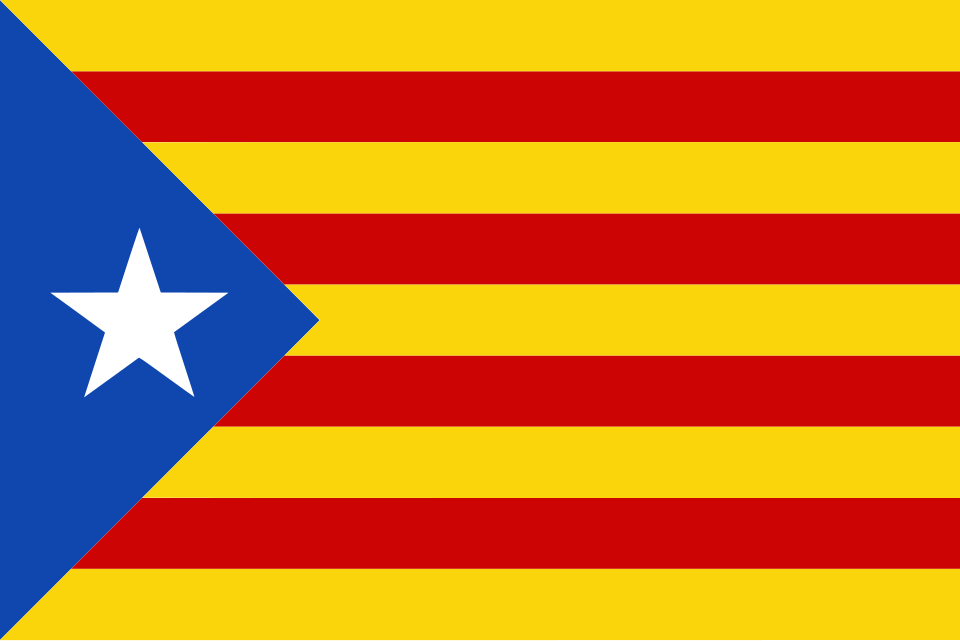
For a quiz, compare three regional symbols: the Ikurriña with two crosses, the Catalan Senyera with red bars on yellow, and the Galician flag with one blue diagonal stripe on white. Each uses an entirely different visual principle despite all being connected to autonomous communities in Spain.
Frequently asked questions
What is the Basque flag called?
The Ikurriña or Ikurrina, the regional flag of the Basque Autonomous Community.
Who designed the Ikurriña?
Luis and Sabino Arana Goiri designed the original flag in 1894.
What do the colors represent?
The red is linked to historic Biscayan arms, green to the Saint Andrew saltire and Gernika oak traditions, and white to the religious symbolism of the designers.
What are the two crosses?
A green diagonal saltire and a white upright cross.
When was the Ikurriña adopted?
First officially by the Basque Government in October 1936; the 1979 Statute of Autonomy recognizes it in the modern autonomous community.
Is the Basque Country a sovereign country?
The Basque Autonomous Community is part of Spain, while the broader Basque cultural region crosses Spanish and French borders.
Is the Ikurriña the same as Catalonia’s flag?
No. Catalonia’s official Senyera has four red bars on yellow, without the Ikurriña’s crossed design.
Is the Basque flag a green Scottish flag?
No. Although both use a saltire, the Ikurriña has a red background and an additional white upright cross.
Can the flag be used outside Euskadi?
It is widely used as a Basque cultural symbol outside the autonomous community, but that does not make it the official governmental flag of every Basque-speaking territory.
Historical sources and artwork credits
Basque Government — Anthem and Flag, English
Basque Government — Symbols and identity
Basque Government — Official Ikurriña dimensions
Basque Government — statutory recognition in 1979
Wikimedia Commons — Ikurriña vector
Ikurriña vector drawn by Daniele Schirmo (Frankie688), Wikimedia Commons. This page uses a PNG rasterization of the source, with attribution and the file-page license. The illustrative Catalan Estelada comparison is sourced from Commons.
The image files are PNG renderings of the linked Wikimedia Commons vectors and are used for identification. Follow the credited file-page licenses when reusing artwork. The historical designs, regional symbolism, and competing interpretations were checked November 2026.