Catalonia Flag: Senyera Stripes vs Estelada Explained
What do Catalonia’s four red stripes on yellow mean, and how does the official Senyera differ from the star-and-triangle Estelada used by independence supporters?
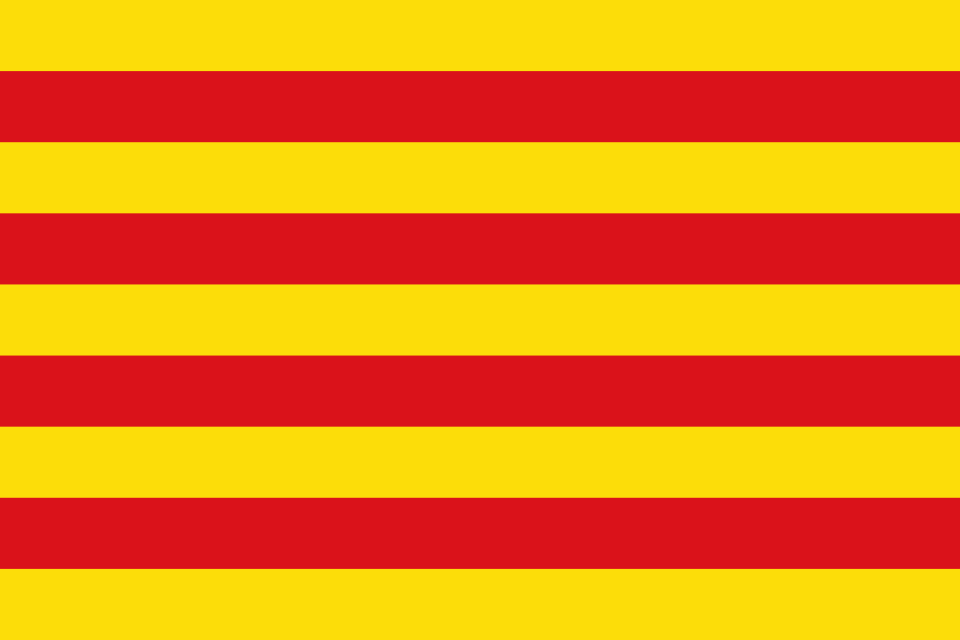
Barcelona and the wider autonomous community of Catalonia use one of Europe’s most recognizable striped flags. Visitors often encounter two similar-looking designs: the yellow-and-red Senyera and a version bearing a star in a triangle. They are not interchangeable in their official status or political significance.
The Parliament of Catalonia describes the Senyera’s medieval heraldic roots and its modern civic use. Article 8 of the Statute of Autonomy specifies the traditional flag of four red stripes on a yellow background for public buildings and official acts. These primary sources provide a reliable way to tell the official design apart from political variants.
This page covers the flag itself, rather than attempting to resolve contemporary debates about Catalonia’s political future. Readers wanting to identify Spain’s national colors can also see our flag of Spain guide.
Senyera and Estelada flags: identification chart
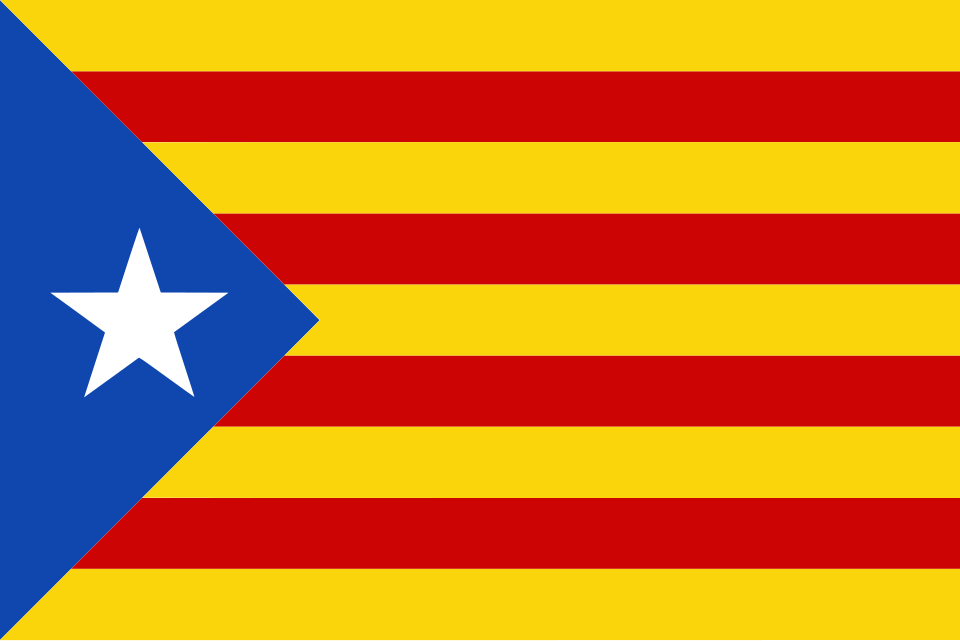
The official Senyera uses four red bars across a golden-yellow background. The blue Estelada adds a blue triangle at the hoist with a white star. Both may be visible in Barcelona and other Catalan communities, but only the Senyera is the regional flag defined in Catalonia’s Statute.
| Flag detail | What to know |
|---|---|
| Region | Catalonia (Catalunya), autonomous community of Spain |
| Official name | Senyera / senyera catalana |
| Design | Four red horizontal stripes on yellow |
| Early documentary reference | Seal of Ramon Berenguer IV, dated 1150 |
| Modern legal basis | Article 8, Catalonia Statute of Autonomy |
| Alternative seen at protests | Estelada blava with blue triangle and white star |
Why does the Catalonia flag have four red stripes?
The Senyera’s four red stripes come from a medieval heraldic emblem: four red vertical pales on a gold shield. When displayed as a flag, those heraldic features appear as four horizontal red bars across a yellow cloth. The design is historically linked with the counts of Barcelona and the Crown of Aragon.
The Catalan Parliament dates the earliest documentary evidence for the emblem to a 1150 seal of Ramon Berenguer IV. That gives the design an identifiable medieval source. It does not establish that someone first invented the stripes on that exact day, or that every later regional banner was already in continuous use in precisely the modern form.
On the flag, four red bars produce nine alternating horizontal bands: five yellow and four red. Some summaries call it simply “four stripes,” while others count all nine visible bands. Both descriptions refer to the same design if the color sequence is correctly identified.
Is there a meaning for each individual red stripe?
The red bars are part of the historic heraldic emblem. Stories attributing each stripe to a particular event or group should not be treated as official symbolism without documentary support. The important verified connection is to the medieval red-on-gold arms.
Is the story of four bloodstained fingers true?
A well-known legend says a ruler drew four bloodied fingers down a golden shield to reward a wounded count. This dramatic story is frequently used to explain the origins of the Catalan stripes, but historical researchers generally treat it as a much later legend rather than a contemporary account of the emblem’s creation.
The medieval heraldic record is the more useful evidence. Catalonia’s Parliament points to the twelfth-century seal and the history of the counts of Barcelona and Aragon. There is no need to repeat the blood legend as an established fact to explain the flag.
When publishing educational captions, it helps to say “traditional legend” clearly. Doing so preserves an important part of cultural storytelling while distinguishing it from what surviving seals and records can establish.
Senyera vs. Estelada: what is the difference?
The Estelada builds on the four-stripe Senyera but adds a star and triangular field at the hoist. In the familiar Estelada blava, the triangle is blue and the star is white. The design is associated with Catalan independence movements and was influenced in part by flag traditions in other national liberation movements.
A yellow-triangle Estelada variant with a red star also appears. The color of the triangle and star can carry different political associations within pro-independence circles. Neither version replaces the traditional four-stripe Senyera in Article 8 of the Statute of Autonomy.
The distinction is useful in news images. If a banner has yellow and red stripes only, it is the standard Senyera. If it adds a star, it is an Estelada variant. Describing every starred flag simply as “the official flag of Catalonia” would be inaccurate.
People may display the Estelada for political, historical or cultural reasons, but the presence of one at a demonstration does not establish the views of everyone in Catalonia. This guide identifies the symbol rather than endorsing or opposing any political proposal.
How old is the Catalan flag?
Its medieval emblem appears in documentary heraldry by the mid-twelfth century. It developed in association with the counts of Barcelona and the Crown of Aragon and spread across territories influenced by those rulers. As medieval political institutions and regional cultures changed, the four red bars remained a powerful identifier.
The Catalan Parliament describes later restrictions on the Senyera after 1714, its revival during the nineteenth-century cultural and political renaissance and official recognition by the Mancomunitat in 1914. The flag’s public status changed again during twentieth-century dictatorships.
When the Generalitat of Catalonia was restored in 1977, the Senyera recovered an official role. Today’s statute specifies it as a regional symbol and requires its presence on public buildings and at official acts. The flag therefore has deep historic origins but also a modern legal framework.
Where is the official Catalan flag displayed?
Catalonia’s Statute of Autonomy states that the Senyera is a symbol of Catalonia and should be present on public buildings and at official acts. It is common at regional government offices, civic events and the Diada, Catalonia’s national day on September 11.
The Estelada may also appear in demonstrations, cultural events and private displays, but its presence there does not give it the same official status. A classroom chart should therefore label the Senyera as the official flag and any star-bearing variation according to its specific name.
Regional legislation and local display rules should be consulted for precise protocol. This article is a visual and historical guide rather than an instruction to change official flag arrangements at an institution.
How to recognize Catalonia’s flag accurately
Start with a yellow field crossed by exactly four red horizontal bars. The flag has no central coat of arms, fleur-de-lis or star. A blue triangle and white star identify the Estelada blava, while a yellow triangle and red star identify a different political variation.
Compare Catalonia with the national Spanish flag, which has three horizontal bands in red-yellow-red, with a wider yellow centre and usually the Spanish coat of arms in official use. The Senyera has more alternating red bars and a different color rhythm.
To make a student worksheet, show the Senyera and Estelada side by side and ask whether each contains a star, whether it is the official regional flag, and which historical heraldic tradition they share. This tests identification and historical context without reducing the symbols to political slogans.
Frequently asked questions
What is the official flag of Catalonia called?
The Senyera, a yellow flag with four horizontal red stripes.
What do the four red stripes mean?
They derive from the red bars of the medieval heraldic arms associated with the counts of Barcelona and Crown of Aragon.
Is Catalonia’s official flag the Estelada?
No. The Estelada is associated with Catalan independence advocacy; the traditional unstarred Senyera is the official flag under the Statute of Autonomy.
What does the white star on the Estelada mean?
It is a political symbol associated with independence movements. The blue Estelada places a white star inside a blue triangle at the hoist.
How many stripes are on the Catalan flag?
Four red stripes separated by yellow; the full alternating pattern has nine visible horizontal bands.
When was the Senyera first used?
Catalonia’s Parliament documents the red-on-gold emblem on a 1150 seal of Ramon Berenguer IV; the modern official flag developed over many centuries.
What is the difference between Catalonia and Spain flags?
Catalonia’s Senyera has four red bars on yellow. Spain’s national flag has a wide yellow middle band between two red bands.
Why does Aragon have a similar flag?
Both regions share historical heraldic roots in the Crown of Aragon.
Do all Catalans support the Estelada?
No. It is an independence-associated flag and should not be assumed to represent the political views of every Catalan resident.
Sources and image credits
Parlament de Catalunya — Symbols and history of the Senyera
Parlament de Catalunya — Statute of Autonomy, Article 8 (English)
Wikimedia Commons — official Senyera artwork
Wikimedia Commons — Estelada blava artwork
Official Senyera is public-domain simple geometric artwork by Motoroil / Commons contributors (source). Estelada blava image is sourced from Wikimedia Commons; check source-page reuse conditions for any derivative publication.
Flag artwork was imported as PNG renderings of linked Wikimedia Commons source files. Official emblem use may be restricted independently of image copyright. Checked November 2026.