American Flag During the Civil War: 33, 34, 35 & 36 Stars
See four American flag designs associated with the Civil War years, find the correct star count for a specific date, and learn why President Lincoln kept stars for the states that seceded.
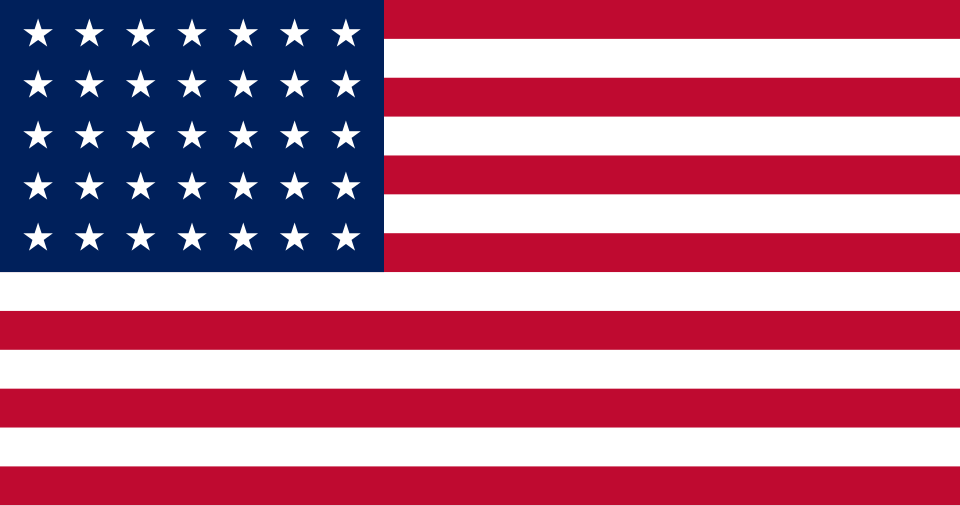
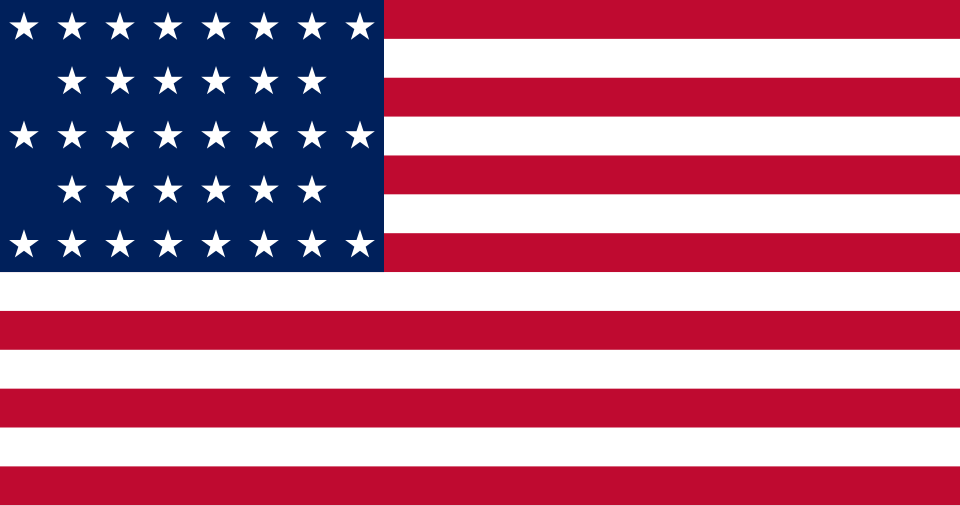
A Civil War photograph, museum banner or textbook illustration may show an American flag with a number of stars that looks wrong by modern standards. During the war, the United States was admitting new states while eleven southern states claimed to have left the Union. The federal government did not remove those states’ stars. Instead, the national star count continued to grow under the law already established in 1818.
This article answers a narrower question than our complete U.S. flag stars-by-year chart: exactly which flag was official during the different stages of the American Civil War, why a 33-star flag was still raised in April 1865, and how to distinguish a historical national banner from a regiment’s colors. It covers 1859–1867 to give the years immediately before and after the war proper context.
Find the U.S. flag for a Civil War date
Enter a date between July 4, 1859 and July 3, 1867. The tool checks the legally effective U.S. star count for that date, not the star count a state anticipated or the particular flag a regiment chose to display.
The article’s dated table and event list remain readable if the interactive control is unavailable.
For example, selecting April 12, 1861 gives 33 stars. Selecting April 9, 1865, the date of Lee’s surrender at Appomattox, gives 35 stars. July 4, 1865 gives 36 stars because Nevada’s star had finally taken effect.
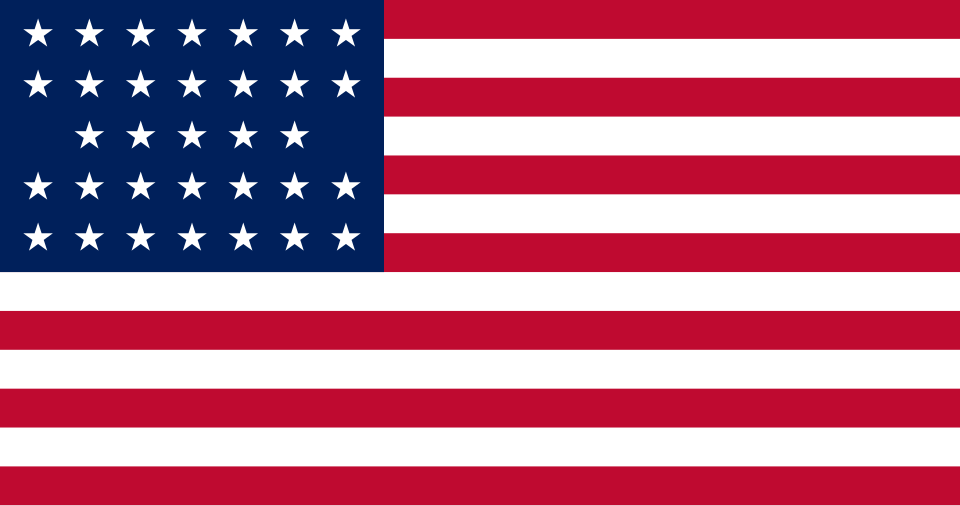
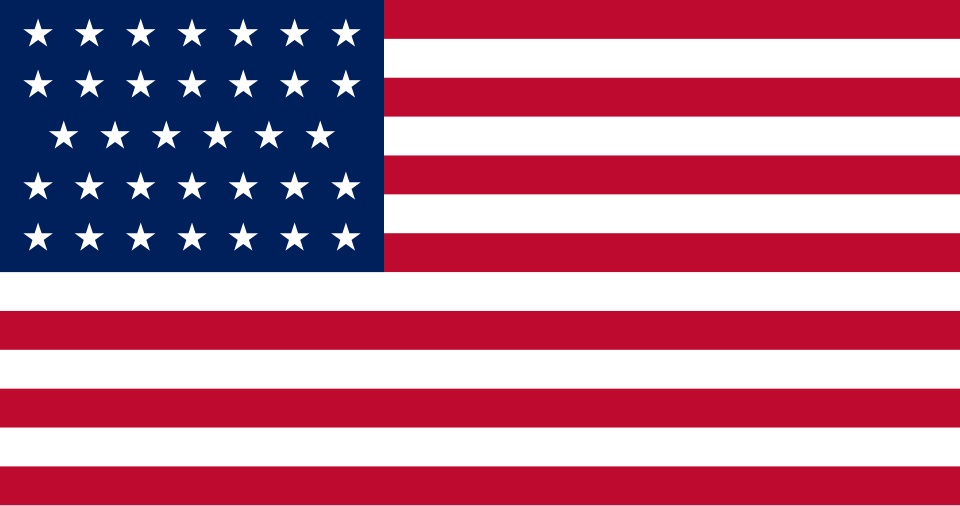
Compare the 33-, 34-, 35- and 36-star American flags
All four flag designs share thirteen alternating red and white stripes and a blue canton containing white stars. The important differences are the star count and the date on which that count became official. These images are representative modern illustrations, not photographs of four particular flags used on Civil War battlefields.
At the outbreak of war: Kansas was already a state in April 1861, but its star had not yet taken effect.
First wartime star increase: The flag kept stars for the seceded states. Nothing was subtracted when Kansas’s star was added.
Later Civil War and surrender: The 35th star reflected West Virginia’s creation during the conflict.
After principal fighting: Nevada entered during the war, but the star first became official on July 4, 1865.
| Flag | Official dates | State that added the last star | Context |
|---|---|---|---|
| 33 stars | July 4, 1859 – July 3, 1861 | Oregon (admitted February 14, 1859) | During the war or outbreak |
| 34 stars | July 4, 1861 – July 3, 1863 | Kansas (admitted January 29, 1861) | During the war or outbreak |
| 35 stars | July 4, 1863 – July 3, 1865 | West Virginia (admitted June 20, 1863) | During the war or outbreak |
| 36 stars | July 4, 1865 – July 3, 1867 | Nevada (admitted October 31, 1864) | After principal wartime surrender |
Why did Fort Sumter fly a 33-star flag in April 1861?
Two important Fort Sumter flags
When Confederate forces opened fire on Fort Sumter in Charleston Harbor on April 12, 1861, the United States flag had 33 stars. Oregon had become the 33rd state in February 1859, and its star had been added on July 4 that year. Kansas had joined the Union on January 29, 1861, but its 34th star was not legally due until July 4, more than two months after the bombardment.
Major Robert Anderson’s garrison possessed two United States flags. The enormous garrison flag was used in ordinary conditions. A smaller storm flag was raised during bad weather or when a smaller banner was needed. National Park Service accounts describe the history and later preservation of both flags; they should not be treated as one object merely because both have 33 stars.
Strong winds had torn the large garrison flag just before the bombardment, leaving the smaller storm flag in use during the attack. Both represented the same 33-star national design. The famous Fort Sumter colors are actual historic textiles with their own provenance, unlike the generic vector illustrations in the gallery above.
Why did a 33-star flag return to Fort Sumter in 1865?
On April 14, 1865, four years after the fort’s surrender, Robert Anderson returned for a ceremony marking its recovery. The original 33-star storm flag from 1861 was deliberately raised again. This was an act of commemoration: by that day the official United States national star count was 35.
This creates an important trap for anyone dating a photograph solely by its stars. A picture from April 1865 can legitimately show a 33-star flag because the ceremony reused the preserved old flag. That does not mean the federal government had returned to a 33-star national design. The National Park Service’s history of the Fort Sumter storm flag explains that continuity.
Why did Abraham Lincoln keep stars for the Confederate states?
The United States government did not recognize the secession of eleven slaveholding states as a lawful termination of their membership in the Union. Lincoln regarded secession as an unlawful rebellion against the United States rather than the creation of legally independent countries. Therefore, the national flag continued to include stars representing those states.
The political and legal position explains why a flag with 34 or 35 stars could still represent the entire United States even while federal and Confederate armies fought. Removing stars would have suggested that the government accepted separation. The Smithsonian’s National Museum of American History explicitly notes that the U.S. flag retained stars for the seceded states during the Civil War.
The war was fought over the future of the Union and the conflict over slavery, which had driven secession. Keeping stars expressed the federal claim of an undivided nation; it did not mean the seceding states were still cooperating with Washington or that slavery was an incidental issue. The flag’s symbolism and the actual political conflict need to be understood separately.
The federal rule for adding stars still applied. As new states entered, the number increased rather than decreasing. A 34-star flag from 1862 included the southern seceded states in its count, while a 35-star flag from late 1863 also recognized newly admitted West Virginia.
How Kansas, West Virginia and Nevada changed the flag
Kansas: 34 stars from July 4, 1861
Kansas became a state on January 29, 1861, shortly before Lincoln took office and before Fort Sumter was attacked. The state’s place on the national flag did not change that day. The Flag Act’s rule meant that the 34-star national banner became official on July 4, 1861.
Consequently, the period from April through June 1861 is easy to mislabel. The United States had 34 states after Kansas’s admission, but its official flag still displayed 33 stars. Readers interested in state-level symbolism can also explore the modern Kansas state flag, which is entirely separate from the federal 34-star design.
West Virginia: 35 stars from July 4, 1863
West Virginia entered the Union on June 20, 1863, after the movement to create a Union-aligned state from western Virginia. Its 35th star joined the national flag on July 4, 1863—only two weeks after admission and one day after the last day of the Battle of Gettysburg.
This offers a precise history lesson: during the three days of Gettysburg, the official U.S. flag had 34 stars, although West Virginia was already a state. On the Fourth of July, the official count increased to 35. The current West Virginia state flag represents its own later history and should not be substituted for the 1863 U.S. national flag.
Nevada: 36 stars from July 4, 1865
Nevada entered the Union on October 31, 1864, during the final months of the war. Its official national star, however, did not arrive until July 4, 1865. Lee’s April 9 surrender at Appomattox and other major Confederate surrenders occurred while the 35-star national flag remained official.
The 36-star design therefore belongs most clearly to the immediate postwar and early Reconstruction period, even though the state that prompted the change joined before fighting ended. Nevada’s modern Battle Born state flag commemorates its Civil War-era admission, but is a distinct state flag, not the 36-star U.S. national banner.
Which flag was official during key Civil War events?
This event list uses the official national flag dates, not necessarily the star pattern on a particular banner seen at the event. Historical flagmakers could continue to display an older design, create an anticipated new star arrangement or carry regimental colors separate from the national flag.
Confederate batteries begin the bombardment of Fort Sumter; the official federal flag has 33 stars.
Kansas’s star officially takes effect even though Kansas became a state in January.
The Battle of Antietam occurs during the official 34-star period.
West Virginia enters the Union, but the national flag remains at 34 stars until July 4.
The Battle of Gettysburg takes place just before the 35-star flag becomes official. On July 3 the national count is still 34.
West Virginia’s star is added. At Vicksburg’s surrender on this date the newly authorized national count is 35.
Nevada becomes the 36th state, but the national flag does not gain its star immediately.
Lee surrenders the Army of Northern Virginia at Appomattox Court House; the official flag still has 35 stars.
Robert Anderson raises the preserved 33-star Fort Sumter storm flag at the fort as a commemorative act. The national flag for that date has 35 stars.
Nevada’s star becomes official, after the principal campaigns and surrenders of the war.
The most useful contrast is between Gettysburg (July 1–3, 1863), still a 34-star period, and July 4, when 35 stars became official. Appomattox (April 9, 1865) occurred during the 35-star period, whereas the 36-star flag did not take effect until July 4, 1865.
Why did Civil War flags have different star arrangements?
Today, most people know the American flag as fifty white stars arranged in alternating rows of six and five. During the Civil War, a maker had considerable flexibility in laying out the required stars. Rings, rows, medallions and large-star patterns all appear in surviving American flags from the nineteenth century.
The federal law fixed the number of stars and thirteen stripes but did not yet mandate one uniform star geometry for every U.S. banner. Federal standardization of the exact star arrangement came later, including the presidential instructions for the 48-star flag in 1912. This is why a historically authentic 34-star national flag may look quite unlike a tidy modern 34-star vector drawing.
Colors, dimensions and construction methods also varied. Some flags were made for forts and large buildings; others were carried by soldiers or displayed in homes. A 34-star flag made for a specific regiment is not a fake merely because its stars form an unusual constellation. To date it more closely, researchers need textile evidence, provenance and records.
How to date a Civil War-era flag accurately
Start by counting visible stars without assuming that hidden or missing stars were never present. Look for repairs, damage, overpainted stars, fabric patches and later alterations. A surviving flag may have lost part of its canton or been changed for continued use after a new state was admitted.
Next compare the likely star count with the official effective periods in the table above. A 34-star design is consistent with the July 1861–July 1863 national flag period, but its age cannot be proved simply from that count. Flags with older star totals sometimes continued in service, and anticipated new counts sometimes appeared before federal dates.
Then seek documentation: a maker’s inscription, a unit’s inventory, dated exhibition records, photographs, museum accession data or a family provenance that can be corroborated. The Smithsonian’s collection of national and regimental colors illustrates why specific artifacts tell more precise stories than generalized flag charts.
Finally, distinguish the United States national flag from a regimental color, state flag, battle flag or later commemorative reproduction. Many authentic Civil War textiles are not national Stars and Stripes. If a flag has a unit name, coat of arms or battle honors, research its actual purpose instead of matching it to a star-count category by appearance alone.
Classroom activity: identify the right flag for the date
Show the four illustrated flags without the date labels and ask students to arrange them in chronological order. Then give them four events: Fort Sumter in April 1861, Antietam in September 1862, Gettysburg in July 1863 and Appomattox in April 1865. Ask them to match each event to the official national star count.
Correct matches are 33 for Fort Sumter, 34 for Antietam, 34 for Gettysburg’s three battle days and 35 for Appomattox. The trick is that Gettysburg took place just before the 35-star version began on July 4. Learners can verify their answers using the date lookup above or the complete table.
For a more advanced activity, compare a photograph of an actual Fort Sumter storm flag from the National Park Service with the generic 33-star illustration here. Identify which image represents a particular surviving artifact and which is only a convenient diagram of the legal count. This introduces the difference between evidence about a historic textile and a modern flag reconstruction.
Frequently asked questions
How many stars were on the American flag when the Civil War began?
Thirty-three. The Fort Sumter bombardment began April 12, 1861, during the 33-star flag period. Kansas had been admitted in January, but its additional star did not take effect until July 4.
How many stars were on the Union flag in 1862?
Thirty-four. The 34-star national flag was official from July 4, 1861 through July 3, 1863.
What flag flew during the Battle of Gettysburg?
The official U.S. national flag had 34 stars on all three days of the Battle of Gettysburg, July 1–3, 1863. West Virginia’s 35th star became effective the following day, July 4.
How many stars did the flag have at Appomattox in April 1865?
Thirty-five. Nevada had already entered the Union in October 1864, but the official 36-star period did not begin until July 4, 1865.
Did the Union remove Confederate states from the American flag?
No. President Lincoln regarded secession as rebellion, not lawful separation of states from the United States. Union flags retained stars representing the seceded states.
Why did Kansas get a star in 1861 rather than 1860?
Kansas became a state January 29, 1861; federal law made the new star effective on July 4, 1861. The previous year, 1860, still used the 33-star flag.
Did the U.S. flag have 36 stars during the Civil War?
The 36-star flag officially began July 4, 1865, after the main Confederate surrenders. Nevada had become the 36th state during the war in October 1864, and unofficial or anticipatory 36-star flags may have been made earlier.
How many stripes did Civil War American flags have?
Thirteen. Since 1818, the U.S. flag’s stripe count has stayed at thirteen, representing the original colonies, even as states and stars were added.
Why do some real Civil War flags have stars in circles or a large star?
Before federal design standardization in 1912, flagmakers could arrange the required number of stars in many patterns, including rows, rings, medallions and large-star arrangements. Counting the stars is usually more informative than their layout alone.
Was the flag raised at Fort Sumter in April 1865 the current 35-star design?
No. At the April 14, 1865 ceremonial flag raising, the original 33-star storm flag from 1861 was deliberately used. The official U.S. national star count on that date was 35.
Did every Union regiment carry the same national flag?
No. Regiments carried national colors and often separate regimental or state colors. A photographed unit banner may contain distinctive emblems and should not automatically be identified as the national flag.
Were Union and Confederate flags the same?
No. The Union continued using the United States national Stars and Stripes. Confederate states and military units used separate flags. This article focuses on the lawful U.S. national flag and its changing star counts.
Fort Sumter’s 33-star storm flag is a different physical artifact from Fort McHenry’s 15-star banner of 1814. Compare the two historical contexts in our Fort McHenry 15-star original flag guide.
Juneteenth commemorates the June 19, 1865 announcement of emancipation in Galveston, Texas, shortly after the Civil War’s principal surrenders. Our Juneteenth flag history and symbolism guide explains the modern starburst design and its connection to that event.
Historical sources and illustration credits
Smithsonian Institution — Facts about the United States Flag
Smithsonian National Museum of American History — Seven things you didn’t know about the Star-Spangled Banner
National Park Service — Fort Sumter Storm Flag
National Park Service — Fort Sumter Garrison Flag
National Park Service — Flags of Fort Sumter
National Park Service — Banners of Glory, Vicksburg
Smithsonian — United States National 34-Star Flag (collection)
Library of Congress — Civil War in America: Epilogue, 36-star flag
4 U.S.C. §2 — Additional stars after admission
33-star U.S. flag, Commons file
34-star U.S. flag, Commons file
35-star U.S. flag, Commons file
36-star U.S. flag, Commons file
All four diagrams are PNG imports of public-domain Wikimedia Commons vector flags, stored in the FlagExplorers WordPress media library. Their star arrangements are representative, not federally mandated layouts or photographs of the flags preserved at Fort Sumter. The National Park Service and Smithsonian sources above document the star counts and original artifacts. Reviewed November 2026.