Sons of Liberty, Bedford & Cowpens Flags: History and Pictures
A visual guide to the striped Sons of Liberty flag, Bedford’s crimson sword banner and the thirteen-star Cowpens pattern—what they symbolize, how to identify them and which battle stories historians question.
The American Revolution’s flags were not one tidy sequence of official national designs. Colonists used protest symbols before independence, militia units retained older local standards, and makers produced many variations of the Stars and Stripes after Congress adopted the national pattern in 1777.
This article compares three flags whose stories illuminate those differences: the red-and-white Sons of Liberty stripes, the physically surviving Bedford militia flag, and the well-known Cowpens or Third Maryland star arrangement. They do not all belong to the same type of historical object. One is primarily remembered as a protest banner, one is a preserved early-eighteenth-century artifact, and the third is associated with a battle through a disputed later account.
To explore other Revolutionary-era symbols, see our Gadsden, Pine Tree and Moultrie flag guide and the Culpeper, Taunton and Green Mountain Boys comparison. The U.S. flag stars-by-year chart separately tracks the official national star-count changes and does not treat every military banner as a legal predecessor.
Compare the Sons of Liberty, Bedford and Cowpens flags
The three flags have very different visual identities. Start with the most obvious clues: vertical stripes, a raised sword on crimson, or a star in the middle of a blue canton. The images below are modern reconstructions rather than photographs of the original fabrics.
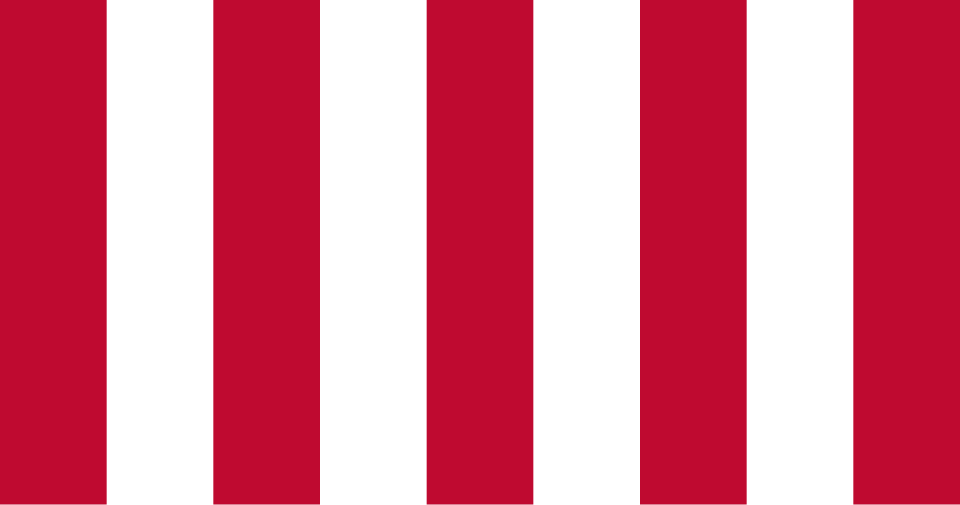
Nine vertical red-and-white stripes, with no blue canton and no stars.
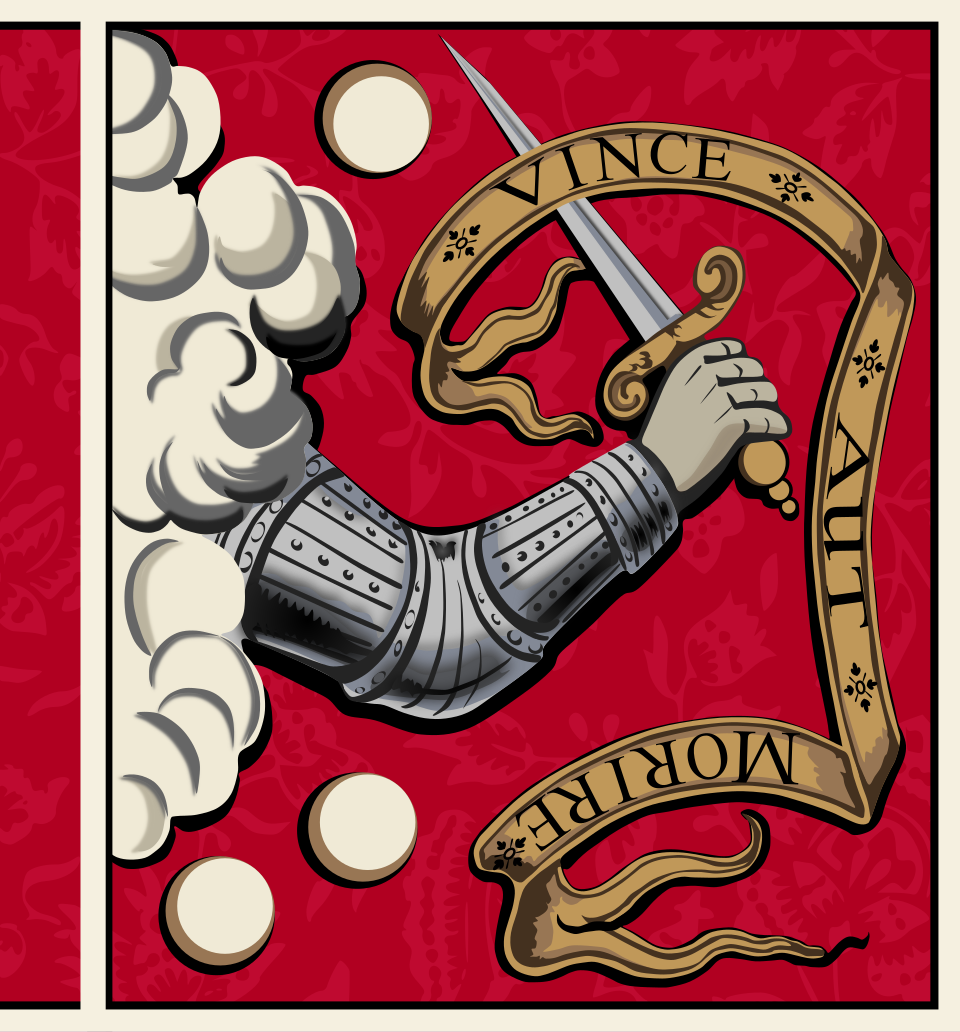
A near-square crimson banner with armored arm, raised sword, three silver balls and the Latin motto VINCE AUT MORIRE.
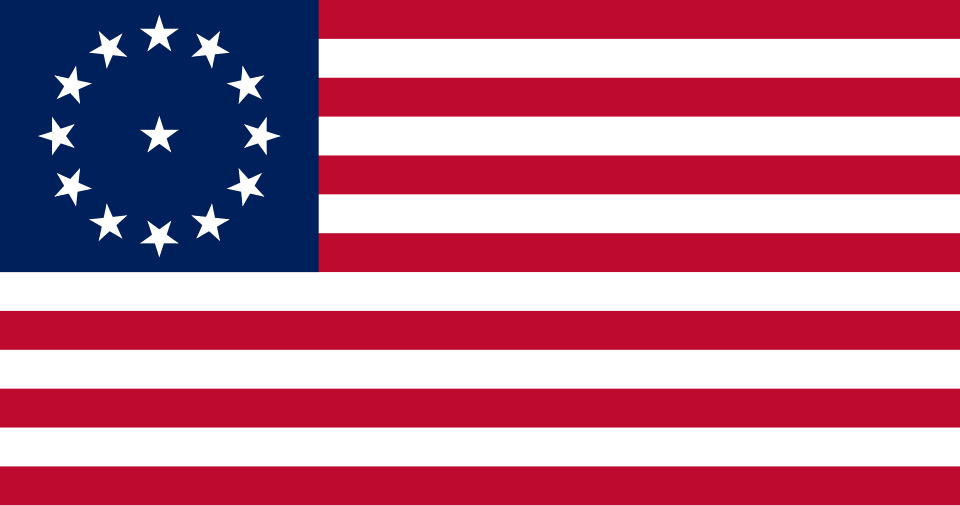
Thirteen stars: twelve in a ring and one in the center, above thirteen alternating red-and-white stripes.
| Design | Fastest identification clue | Historical qualification |
|---|---|---|
| Sons of Liberty — nine stripes | Nine vertical red-and-white stripes, with no blue canton and no stars. | The association with the Stamp Act Congress is a common interpretation; the exact meaning of every stripe is not a surviving statutory rule. |
| Bedford Flag | A near-square crimson banner with armored arm, raised sword, three silver balls and the Latin motto VINCE AUT MORIRE. | An old flag truly survives in Bedford, Massachusetts. The story that Nathaniel Page took it to Concord comes from later family testimony. |
| Cowpens Flag | Thirteen stars: twelve in a ring and one in the center, above thirteen alternating red-and-white stripes. | The well-known Revolutionary battle attribution has serious provenance problems documented by the Smithsonian and Maryland State Archives. |
Sons of Liberty flag: why nine rebellious stripes?
The protest movement before independence
The Sons of Liberty emerged in the mid-1760s as networks of colonial opponents of British revenue policies, particularly the Stamp Act. In Boston, public demonstrations around Liberty Tree and, later, liberty poles helped turn local protests into visible political events. Other colonies had their own groups and leadership, so the name described a movement rather than a single regiment with standardized uniforms.
The flag most often illustrated for this period has nine alternating vertical red-and-white stripes. It is often called the Rebellious Stripes. The design has no blue canton and no stars, making it easy to distinguish from the Stars and Stripes adopted by Congress in 1777. The U.S. District Court’s historical display recounts a nine-stripe flag associated with Boston’s Sons of Liberty and the movement’s meetings near Liberty Tree.
Why nine instead of thirteen?
The usual explanation connects nine stripes with the nine colonies represented at the Stamp Act Congress in New York during October 1765. Delegates challenged Parliamentary taxation without colonial representation. Thirteen colonies existed, but only nine sent delegates to that meeting; Georgia, New Hampshire, North Carolina and Virginia were not represented.
This is an understandable symbolic association and is repeated in historical flag accounts. It should still be presented as the conventional interpretation rather than as a stripe rule laid down in a surviving act of Congress. The flag was a political expression from a time when American national flag legislation did not yet exist.
Did the Sons of Liberty use thirteen horizontal stripes too?
Yes, later thirteen-stripe designs are also associated with colonial protest and union across the colonies. Some historical descriptions refer to a thirteen-stripe Union Flag associated with Boston’s Liberty Tree. This creates confusion because a drawing with thirteen horizontal stripes resembles the later American national flag with its blue canton removed.
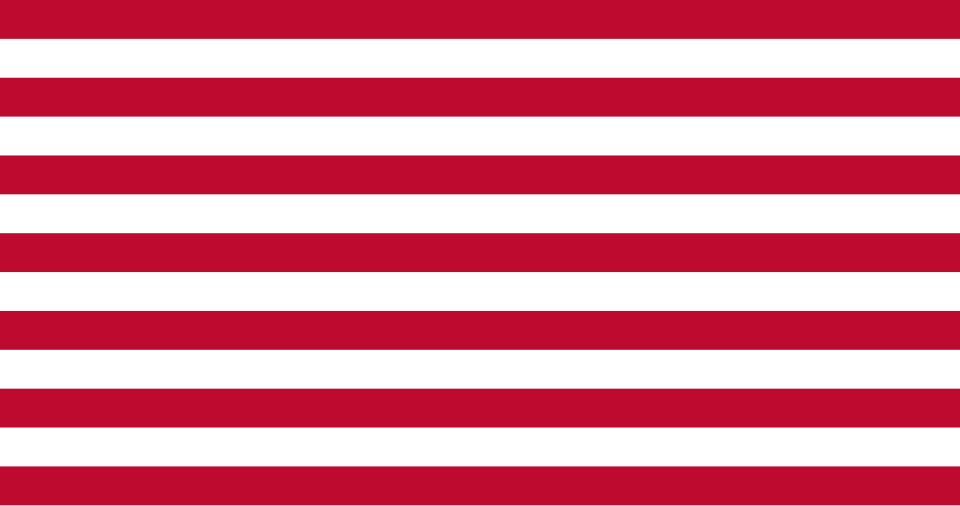
The Boston History collection preserves an old striped textile connected by provenance to Liberty Tree traditions, providing more than a modern retail illustration. However, descriptions of the original, its display history and the orientation of stripes in later drawings do not always agree. For accuracy, label a given picture as a nine-vertical-stripe or thirteen-horizontal-stripe reconstruction instead of implying all Sons of Liberty flags were identical.
Was it the first national flag?
No. A protest flag from the 1760s can influence the design language of a later national symbol without being a formally adopted American national flag. The Continental Congress passed the flag resolution establishing thirteen stars and thirteen stripes on June 14, 1777. The years between the Stamp Act Congress and that resolution included many other military and maritime banners.
For another banner incorporating the pre-independence British Union emblem, read our Taunton Liberty and Union flag explanation. That 1774 design also belongs to the transitional political world before independence.
Bedford Flag: crimson silk, raised sword and “Conquer or Die”
What does the Bedford Flag look like?
Unlike most early flags represented online only through tidy modern vectors, the original Bedford Flag survives. The historic textile is roughly square, measuring approximately 27 by 29 inches, and made of crimson silk damask. It carries a painted armored or mailed arm grasping an upright sword, accompanied by three silver balls and a gold ribbon bearing the Latin words VINCE AUT MORIRE.
The Latin translates to “Conquer or Die.” It is not the same wording as Patrick Henry’s well-known “Liberty or Death,” even though both are expressions of military resolve. The banner’s heraldic imagery is older in style than the simplified stars and stripes most people associate with the American Revolution.
How old is the original flag?
The Bedford Free Public Library explains that textile evidence places the flag’s origin in the early eighteenth century; the exact maker and production year remain unknown. It was already an old family and militia object when fighting began in April 1775. An original commission dating to 1737 names John Page as cornet of a troop of horse—an officer traditionally responsible for bearing the unit’s colors.
The commission supports the Page family’s longstanding connection to local militia flag-bearing. It does not prove the cloth itself was made in 1737, and it certainly does not justify describing it as a national flag designed in 1775. Bedford’s flag belongs to the history of Massachusetts provincial military organizations before the national Revolution.
Did Nathaniel Page carry the Bedford Flag at Concord?
Local tradition says Nathaniel Page carried the old colors when Bedford’s militia joined the fighting at Concord’s North Bridge on April 19, 1775. His service that day is documented. The story about this particular flag, however, was recorded in later Page family recollections and town histories, rather than in a contemporary 1775 description of the banner.
The library itself says the story is plausible but acknowledges that no contemporary account corroborates it. The distinction is essential: Bedford owns an original historic flag, and Nathaniel Page served in the Revolution; the two facts do not independently prove that the flag was flying at the bridge. An honest caption should say “traditionally associated with the Battle of Concord,” not “documented battlefield photograph” or “certainly flown that morning.”
Where can the original be seen?
The Bedford Free Public Library in Bedford, Massachusetts, preserves the flag in a protected environment. It passed from the Page family to the town in the late nineteenth century and underwent specialist conservation. The library’s own Bedford Flag history supplies the most direct public description of its fabric, decoration and provenance.
If you are reproducing this historic symbol, avoid replacing its sword-bearing arm with the rattlesnake of the Culpeper flag or the crescent of the Moultrie flag. Those were different regional designs with different origins.
Cowpens Flag: a centered thirteenth star and a contested 1781 story
How can you recognize the Cowpens pattern?
The well-known Cowpens Flag has thirteen alternating red-and-white stripes and a blue canton containing thirteen white stars. Twelve stars form a circle; the thirteenth stands in its center. This distinguishes it from the familiar Betsy Ross–style image, whose thirteen stars are usually all on the circular perimeter.
The star in the center is often said to represent Maryland because the flag is also called the Third Maryland Regiment or Batchelor Flag. That specific assignment should not be stated as an established rule of the 1777 national flag resolution. Early flag law required the stars and stripes, not a binding code assigning individual stars to particular states.
What happened at the Battle of Cowpens?
On January 17, 1781, American forces under Brigadier General Daniel Morgan defeated British troops led by Lieutenant Colonel Banastre Tarleton in South Carolina. The battle became an important turning point in the southern campaign of the Revolutionary War. The victory itself is well documented by military histories and the National Park Service.
The historical certainty of the battle does not establish the presence of every flag later named after it. An association between the twelve-around-one star pattern and the fighting appears in later accounts involving the Batchelor family. That later provenance requires closer investigation.
Why is the Third Maryland story disputed?
A traditional account says William Batchelor carried the flag with a Maryland unit at Cowpens and that the banner later appeared in the War of 1812. Maryland State Archives research identifies problems with the Batchelor family’s genealogy and service claims. The particular regiment often named in the story was not established as a participant at Cowpens in the manner those later accounts suggest.
Grace Rogers Cooper’s Smithsonian study of surviving thirteen-star flags examined the historic textile and the claims attached to it. Her research questioned whether the flag later presented to the state of Maryland was even the same object associated with the earlier Old Defenders’ accounts. She found no secure evidence that the familiar twelve-around-one arrangement could be dated to the Revolutionary War from the material then available.
Was any flag carried at Cowpens?
Different military units and commanders had their own colors. National Park Service accounts also discuss a flag associated with Colonel William Washington’s cavalry, which is a separate tradition. Evidence about that cavalry flag should not be transferred automatically to the modern Cowpens or Third Maryland star-pattern illustration.
A visitor to a museum or heritage page may therefore see several banners linked to Cowpens. Always check whether the label describes an actual preserved textile, a documented unit standard, a later commemorative image or a popular pattern whose attribution has been questioned. These are different kinds of evidence.
How the three flags differ in purpose and appearance
The Sons of Liberty design communicates a protest movement through stripes alone. The Bedford Flag belongs to a provincial militia tradition and carries heraldic imagery, a Latin motto and costly fabric. The Cowpens pattern combines the same national stars-and-stripes vocabulary mandated in 1777 with one particular arrangement of thirteen stars.
Only the Bedford example is associated with an extant old flag whose early manufacture is supported by textile evidence. The Sons of Liberty design has protest-era records and a preserved striped textile linked to Boston. The Cowpens image is especially useful for teaching how a familiar battlefield name can remain attached to a design despite disputes over the surviving artifact’s origins.
None should be treated as a separate national flag law between the original thirteen-star flag and the fifteen-star flag. If you need those officially authorized changes, the U.S. star-count chronology is the appropriate reference.
Timeline of the flags and their later histories
The crimson silk militia colors originated in the early eighteenth century. Their precise production year is unknown; a 1737 commission documents the Page family’s flag-bearing role.
Delegates from nine colonies meet in New York. The nine stripes of the Sons of Liberty banner are commonly associated with that number, although no national flag law prescribed the connection.
Striped protest flags are associated with meetings, liberty poles and opposition to Parliamentary tax measures. Local newspaper accounts and later collections help document the tradition.
Bedford militia members take part in the Revolutionary fighting. The story of Nathaniel Page carrying the Bedford Flag to Concord is recorded later and is not corroborated by a contemporary description.
This establishes the national pattern. Makers were still free to arrange the thirteen stars in various ways, including rings and rows.
Daniel Morgan’s force defeats Banastre Tarleton. The famous twelve-around-one Cowpens pattern later becomes associated with the battle, but the specific attribution is disputed.
Families, veterans’ groups, libraries and museums collect old banners. Smithsonian and state archival investigations later revisit claims about who carried individual fabrics and when.
Three common mistakes in historic flag charts
Calling every protest banner an official national flag
A group could fly a nine-stripe banner without acting on behalf of Congress or all thirteen colonies. Before the national 1777 resolution, military and civic symbols were varied. A chronological poster should not place the Sons of Liberty flag in a line of “official U.S. flags” without labeling its actual protest-era role.
Assuming an old surviving flag proves a specific battle story
The Bedford Flag’s early-eighteenth-century materials and family history are valuable. But a documented early textile and a later account of battlefield use are distinct types of evidence. A collection can be authentic even when a dramatic association remains uncertain.
Using a battle name as proof of provenance
Calling a twelve-around-one thirteen-star banner the Cowpens Flag does not prove it flew there in January 1781. Museum conservation and archival research can overturn claims repeated for generations. This is why the Smithsonian’s physical study and the Maryland State Archives biography matter more than a sales label on a reproduction.
These cautions also apply to other flags covered on FlagExplorers, including the Betsy Ross and Bennington designs. Historical terminology is useful, but the evidence should control what the caption claims.
Try identifying these early American flags
Show the three main pictures without their names and ask each learner to identify a single clear detail. Does it have stars? How many stripes are visible? Is there a sword, an animal, a motto or a ring of stars? The answers identify the designs even when the historical names are forgotten.
For a harder challenge, compare the nine vertical Sons of Liberty stripes with the thirteen horizontal variation. Explain how a change in stripe number and orientation can reflect a different time or a different reconstruction. Then compare Cowpens’ centered star with a traditional thirteen-star circle. Both can have thirteen stars, but the arrangements are not the same.
Finish with a historical evidence exercise. Label three statements as documented, traditional or disputed: the Bedford library preserves an old crimson flag; the Page family remembered its presence at Concord; the surviving Cowpens pattern is proven to have flown in 1781. Correct answers: documented, traditional and disputed. This teaches source evaluation rather than merely memorizing flag names.
Frequently asked questions
What does the Sons of Liberty flag look like?
The best-known early reconstruction has nine alternating vertical red and white stripes, without stars. A later design with thirteen horizontal stripes is also associated with the movement. Accounts of stripes and orientation are not always identical, so identify the specific version.
Why did the Sons of Liberty flag have nine stripes?
A common interpretation links the nine stripes with the nine colonies represented at the October 1765 Stamp Act Congress. The nine-colony symbolism is plausible and widely repeated, but is best described as an interpretation rather than a formal specification adopted by all colonial groups.
Is the Sons of Liberty flag the first United States flag?
No. It was a protest-era symbol predating the 1777 congressional flag resolution. A red-and-white striped precedent does not make it the legal predecessor in a single official sequence of U.S. national flags.
What do the words on the Bedford Flag mean?
VINCE AUT MORIRE is Latin for ‘Conquer or Die.’ The motto appears on a gold scroll surrounding a mailed arm with sword. It is not the same phrase as the ‘Liberty or Death’ slogan associated with Culpeper’s Minutemen.
Where is the original Bedford Flag today?
The original artifact is preserved by the Bedford Free Public Library in Massachusetts, in protected, climate-controlled conditions. It is a genuine early-eighteenth-century militia flag, rather than only a modern digital drawing.
Did Nathaniel Page definitely carry the Bedford Flag at Concord in 1775?
The story is part of Bedford’s local and family tradition. Page’s militia service is documented, and the flag existed by that time, but the library notes that a contemporary account directly confirming the flag’s presence at Concord is lacking.
What is unusual about the Cowpens Flag stars?
Twelve white stars form a ring and a thirteenth appears in the center. That contrasts with a conventional Betsy Ross-style ring of thirteen stars around an empty center. The center star should not automatically be identified as Maryland.
Was the Cowpens Flag carried in the Battle of Cowpens?
The claim is traditional but not securely established. The Maryland State Archives and Smithsonian research question whether the specific surviving flag dates to the Revolution or belongs to the unit and battle cited in later stories.
Is the Cowpens Flag the same as William Washington’s battle flag?
No. Accounts of Colonel William Washington’s cavalry flag concern a different object and tradition. The common 13-star Cowpens or 3rd Maryland pattern should not be used as proof about the design of Washington’s flag.
Are the pictures downloadable or free to use?
The four reconstructions used in this article are derived from Wikimedia Commons files marked public domain. The Commons file pages are linked in the credits. Check those pages for the complete reuse notices and confirm the license of any other illustration you substitute.
Historical references and image credits
Revolutionary Spaces / Boston History — Liberty Tree Flag research
U.S. District Court, District of Puerto Rico — The Rebellious Stripes
Bedford Free Public Library — History and physical description of Bedford Flag
Massachusetts Board of Library Commissioners — Revolutionary History at a Massachusetts Library
Maryland State Archives — Joshua F. Batchelor biography and claims
Smithsonian Institution, Grace Rogers Cooper — Thirteen-Star Flags: Keys to Identification (1973, pp. 28–29)
National Park Service — Battle of Cowpens historical context
Nine-stripe Sons of Liberty illustration — Gunter Küchler / Sarang, public domain
Thirteen-stripe Sons of Liberty illustration — public domain geometric artwork
Bedford Flag illustration — HoosierMan1816, public domain
Cowpens Flag illustration — DevinCook, public domain
The Sons of Liberty, Bedford and Cowpens images on this page were imported into the FlagExplorers WordPress media library as PNG renderings of Commons files. They are modern illustrations. The original Bedford artifact and the preserved Boston striped textile are different from these illustrations, and the disputed Cowpens attribution is not presented as established history. Reviewed November 2026.