Antigua and Barbuda Flag: Meaning, Rising Sun, History, Ratio & Facts
Explore the seven-point rising sun, the V for victory, the official color meanings, Reginald Samuel’s 1966 design and the flag’s 1967 adoption.
What does the Antigua and Barbuda flag look like?
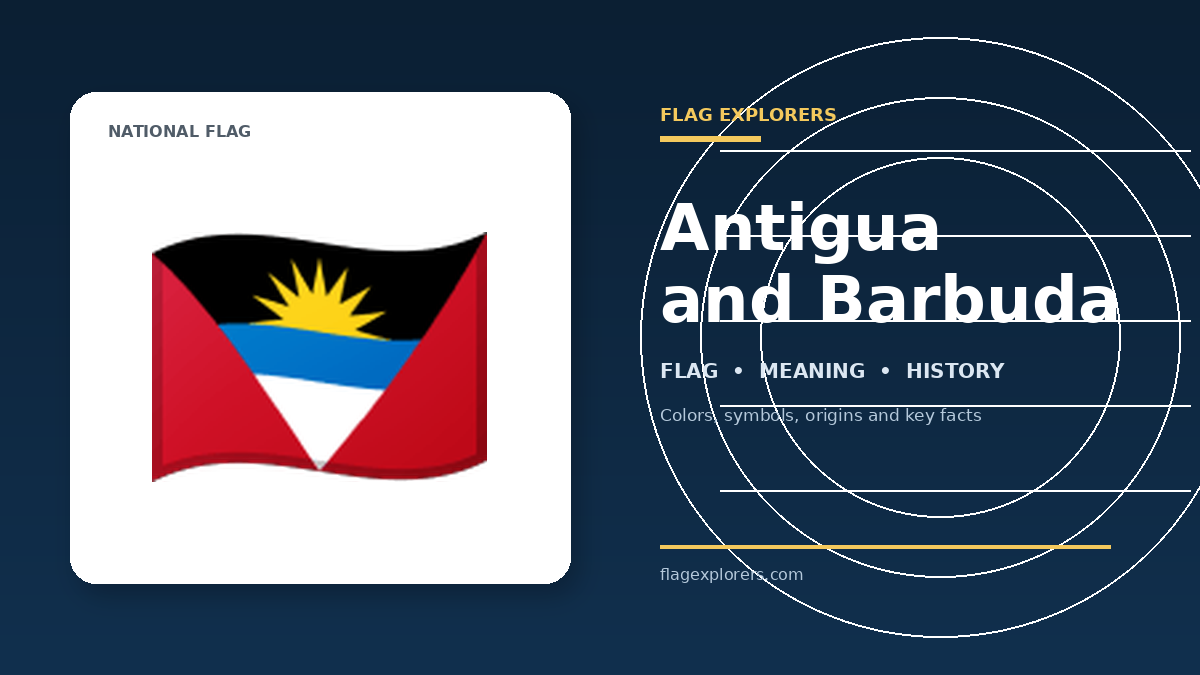
The flag uses a red outer field that creates a large V around a central arrangement of black, blue and white. A golden rising sun sits in the black upper field.
The visual structure is unusual among Caribbean flags because the geometry itself carries meaning: the V is part of the symbolism rather than simply a decorative frame.
What do the rising sun and V mean?
The seven-point golden rising sun represents the dawn of a new era, while the flag’s V shape stands for “Victory at last!” For the full symbolism and design logic, see the rising sun and V symbolism guide.
What do the Antigua and Barbuda flag colors mean?
Red reflects energy and the lifeblood of forebears, black connects to African heritage, blue represents hope, and the gold-blue-white combination evokes sun, sea and sand. For the detailed official symbolism, see the Antigua and Barbuda flag colors guide.
Who designed the Antigua and Barbuda flag?
Antiguan artist and sculptor Reginald Samuel created the winning design in 1966. It was adopted on February 27, 1967 and retained at independence in 1981. Read the full flag history or our Reginald Samuel profile.
What is the Antigua and Barbuda flag ratio?
The flag is commonly standardized at 2:3. For the rising-sun geometry, V layout and practical construction sequence, see how to draw the Antigua and Barbuda flag.
Antigua and Barbuda flag quick facts
| Designer | Reginald Samuel |
|---|---|
| Designed | 1966 |
| Adopted | February 27, 1967 |
| Independence | November 1, 1981 |
| Sun | Seven-point golden rising sun |
| V meaning | Victory at last |
| Standard ratio | 2:3 |
Antigua and Barbuda flag FAQ
Who designed the Antigua and Barbuda flag?
Reginald Samuel designed it in 1966.
When was the flag adopted?
February 27, 1967.
What does the rising sun mean?
The dawn of a new era.
What does the V mean?
“Victory at last,” according to the government.
How many points does the sun have?
Seven.
Government of Antigua and Barbuda — National Symbols
Government of Antigua and Barbuda — Constitution