Fort McHenry’s 15-Star Flag: Pictures, History & Missing Star
Why did the American flag at Fort McHenry have fifteen stars and fifteen stripes? See an authentic Smithsonian photograph alongside clean flag diagrams, discover how Mary Pickersgill made the enormous banner, and find out what happened to its missing star.
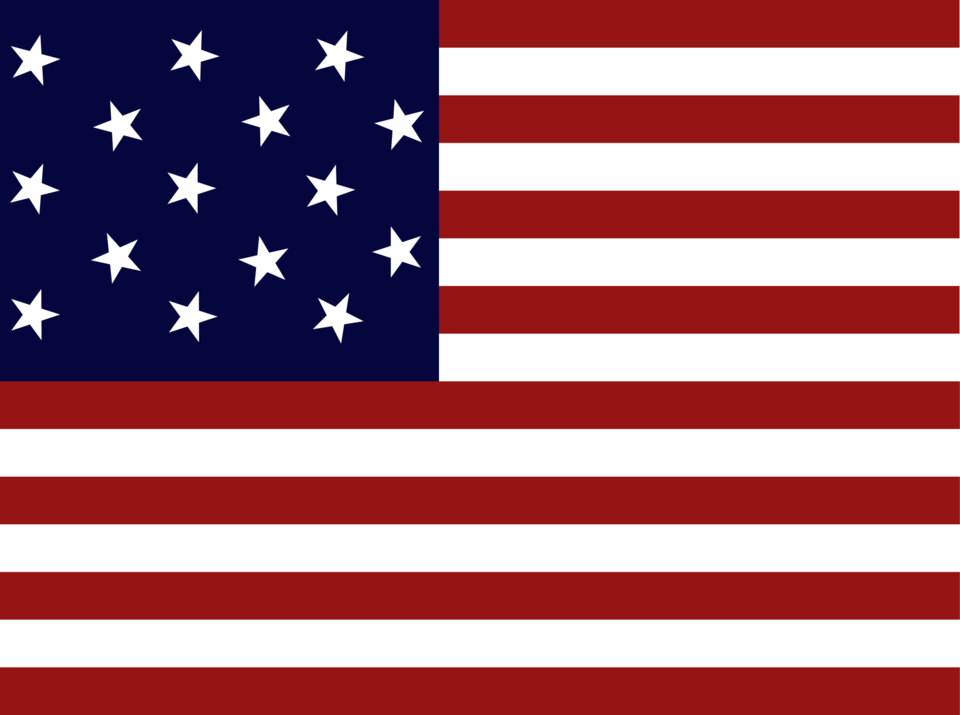 Reconstruction of the fifteen-star, fifteen-stripe flag
The Star-Spangled Banner is both a famous patriotic song and the name of the actual enormous United States flag that flew over Fort McHenry after the British bombardment of Baltimore in 1814. The textile is much older than the flag people fly today. It belongs to a unique period when Congress had increased not only the number of stars but also the number of stripes.
This page is a closer look at the original 1813 Fort McHenry artifact: how it was made, how it differed from the current American flag, how it survived, why one star is missing, and what historians know about the smaller storm flag. For the complete succession of U.S. national designs, visit our American flag stars-by-year reference. For the full modern flag meaning, see the main United States flag guide.
What did the Fort McHenry flag look like?
It had a deep blue union holding fifteen white stars, with fifteen red-and-white horizontal stripes. Seven stripes were white and eight were red, so the top and bottom stripes were both red. The overall design was much larger than an ordinary household flag: 30 feet high and 42 feet long when originally sewn. Each stripe was approximately two feet wide and the large stars measured roughly two feet across.
The fifteen stars and stripes represented the fifteen states counted by the 1794 flag law when the design became effective in 1795. Vermont and Kentucky were the two additions beyond the original thirteen. Individual stars did not identify particular states by a legally required position; historical makers used several arrangements before twentieth-century federal standardization.
The surviving artifact is an irregular, weathered textile rather than the perfect rectangle in most flag illustrations. The Smithsonian states that the flag is now approximately 30 × 34 feet. Pieces were removed during the nineteenth century as patriotic keepsakes, and one of the original stars is no longer attached.
Original Fort McHenry flag vs. historical reconstructions
These four pictures answer different questions. The black-and-white 1914 Smithsonian photograph documents the actual historic cloth; the modern 1814 illustration shows how the complete fifteen-star pattern can be represented; a clean diagram shows the fifteen-star national design; and the twenty-star diagram shows what replaced it in 1818.
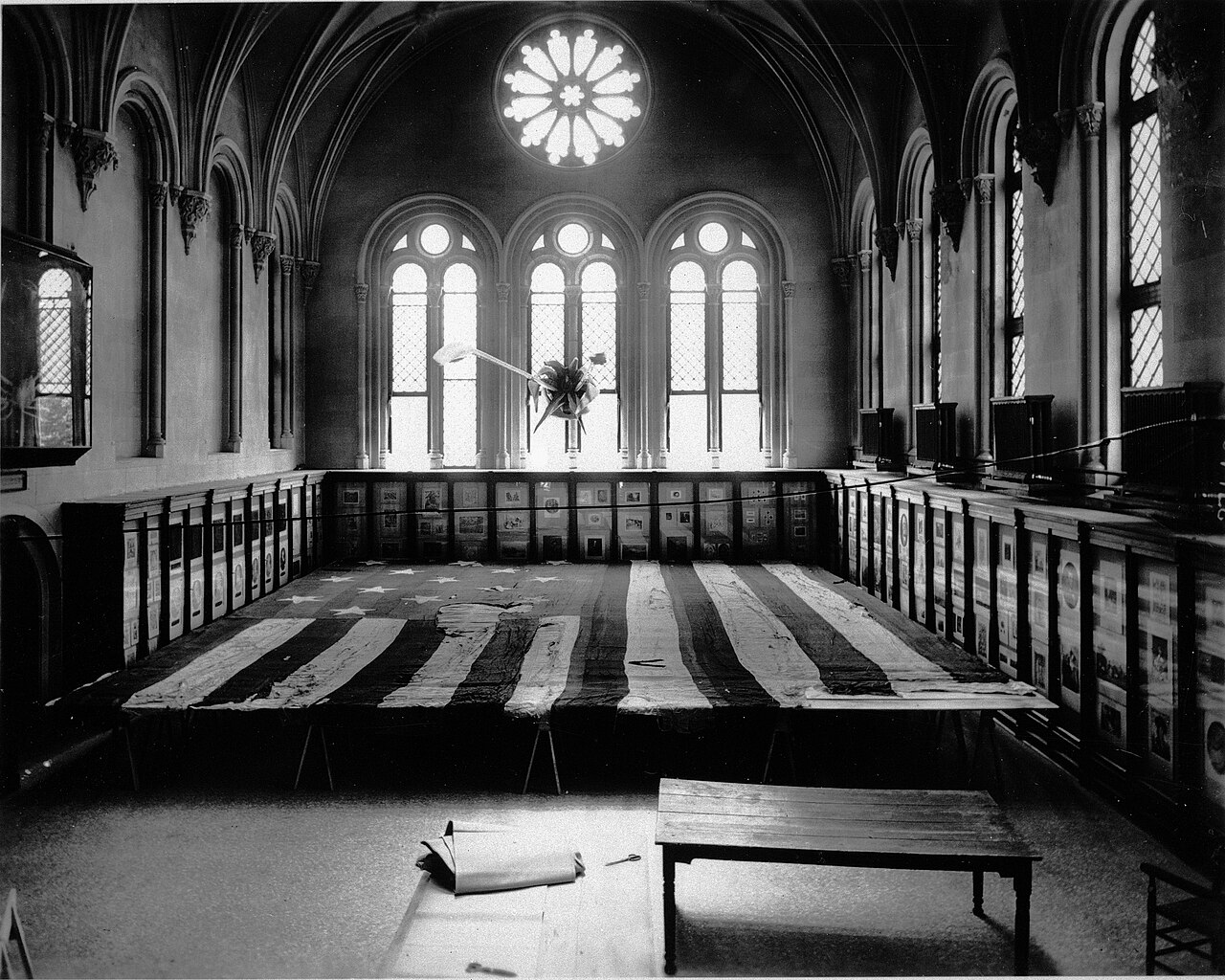
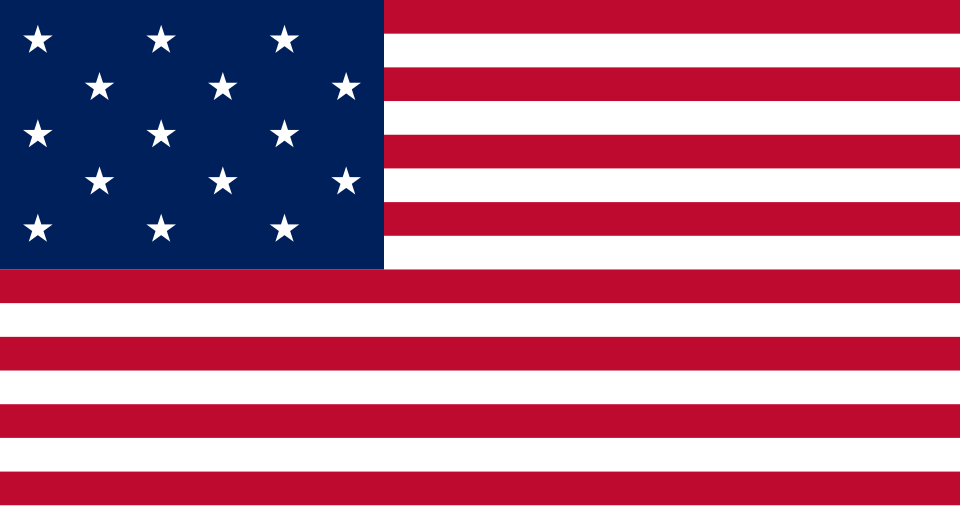
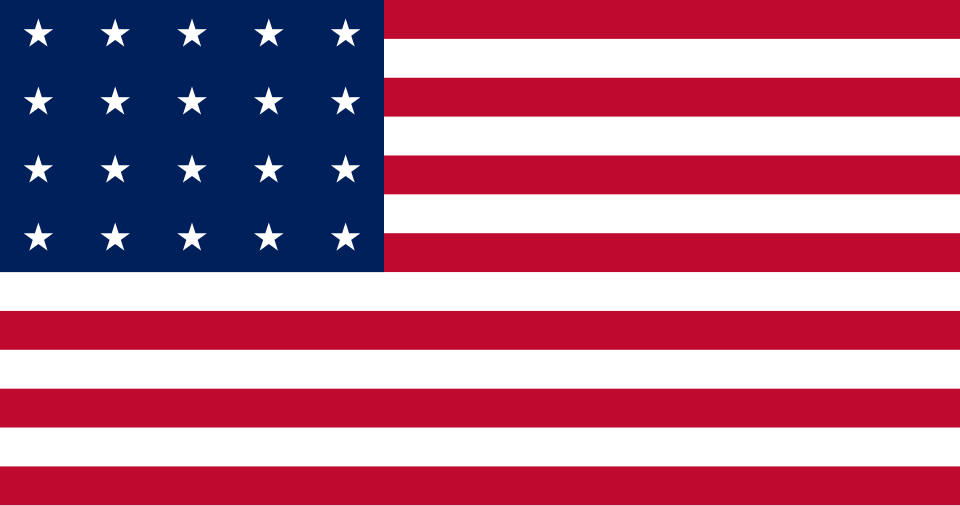
The photograph was made when the flag was spread across tables in the Smithsonian Institution Building in 1914, before backing was attached for its early treatment. It preserves a rare view of the real fabric before later museum conservation. In the article’s image captions, the source and difference from a modern reconstruction are stated explicitly.
Why did the American flag have 15 stars AND 15 stripes?
Vermont and Kentucky changed both counts
The original 1777 flag resolution specified thirteen stars and thirteen stripes. Vermont was admitted as the fourteenth state in 1791 and Kentucky as the fifteenth in 1792. Congress passed a new law on January 13, 1794, ordering that the flag should contain fifteen stripes and fifteen stars from May 1, 1795.
For this one historical period, the number of stars and the number of stripes both increased to reflect expansion. That is why a War of 1812 national flag has fifteen stripes rather than the thirteen seen in today’s United States flag. The design also appeared during the Quasi-War with France and the early United States conflicts in the Mediterranean.
Was the United States actually larger than 15 states in 1814?
Yes. Tennessee joined in 1796, Ohio in 1803 and Louisiana in 1812, bringing the total to eighteen states by the bombardment of Fort McHenry. Nevertheless, Congress had not yet changed the design introduced in 1795. The official flag remained at fifteen stars and fifteen stripes, making it incorrect to assume that each official flag immediately reflected the number of states on any given date.
Indiana entered in 1816 and Mississippi in 1817. Congress then passed the Flag Act of April 4, 1818. Effective that July 4, the national flag had twenty stars but returned to thirteen stripes. The law also established the rule that new stars would be added each Fourth of July following admission of a new state.
| U.S. flag | Official period | What changed? |
|---|---|---|
| 15-star, 15-stripe flag | May 1, 1795 – July 3, 1818 | Congress approved fifteen stars and fifteen stripes, adding Vermont and Kentucky; also used at Fort McHenry in 1814. |
| 20-star, 13-stripe flag | July 4, 1818 – July 3, 1819 | Congress restored thirteen stripes, established twenty stars and adopted the July 4 rule for future additions. |
| Modern 50-star flag | Since July 4, 1960 | Fifty stars for fifty states, thirteen stripes for the original colonies; these are not the Fort McHenry flag’s counts. |
The U.S. flag history overview explains how Congress made these national design decisions. The Fort McHenry banner is a particularly important surviving example of the fifteen-stripe era, not an exception to the law.
Who made the original Star-Spangled Banner flag?
Mary Pickersgill’s Baltimore workshop, 1813
Major George Armistead, the officer commanding Fort McHenry, commissioned a prominent flagmaker in Baltimore named Mary Pickersgill to sew two enormous flags in summer 1813. Armistead wanted a banner large enough for British ships to see from far away. The order called for a thirty-by-forty-two-foot garrison flag and a smaller seventeen-by-twenty-five-foot storm flag.
Pickersgill was an experienced professional who supported her family through her flagmaking business. She had learned a trade associated with her mother, Rebecca Young, who had made flags during the earlier American Revolution. The famous banner was not a casual sewing project for one woman working alone; the historic sources identify several people contributing labor.
Who helped sew the flag?
The National Park Service identifies Pickersgill’s teenage daughter Caroline, her nieces Eliza and Margaret, and thirteen-year-old African American indentured apprentice Grace Wisher among the workers. Smithsonian historical accounts also discuss her mother Rebecca Young and younger niece Hannah; exactly who performed which tasks is not fully documented. Wisher’s contribution matters because the labor of girls and Black apprentices was often excluded from later simplified accounts of the flag’s creation.
Large sections of English wool bunting were pieced together, while cotton was used for the stars. The flag was so large that the workers spread it across the floor of a nearby brewery for assembly. The pair of flags was completed in August 1813, in time for the fort’s preparations for the British naval threat the following year.
Mary Pickersgill’s house on Pratt Street is associated today with the Star-Spangled Banner Flag House museum. The Smithsonian’s October 2026 historical feature provides additional context for her work as a businesswoman and for the assistants who helped make the flag. The National Park Service account also documents the size, workers and materials.
What happened at Fort McHenry on September 13–14, 1814?
During the War of 1812, a British force attacked Baltimore after occupying Washington and setting important government buildings on fire in August 1814. Fort McHenry defended the water approaches to Baltimore. From September 13 into the morning of September 14, British warships bombarded the fort, using cannon fire and rockets during the prolonged attack.
The fort survived. Its defenders remained in place, and the British naval assault did not open the harbor to an invasion of Baltimore. The battle became a powerful symbolic American success, helping to restore morale after the destruction in Washington. It was not a battle that ended the war; peace negotiations and further fighting continued afterward.
What did Francis Scott Key actually see?
Francis Scott Key, a Maryland lawyer who had gone to negotiate the release of a prisoner, was held near the British fleet during the attack. Unable to leave, he witnessed the bombardment and wondered whether the fort would survive. When the large United States garrison flag was raised on the morning of September 14, it signaled that the American defenders had held out.
Smithsonian research places the raising of the large flag around 9 a.m., after the bombardment ended. Key’s relief and the sight of the flag inspired words that came to be known as “The Star-Spangled Banner.” The event did not require the giant flag to have flown visibly for every minute of the stormy night; the smaller storm flag was likely used during much of the attack.
The stars and stripes were significant because they could be recognized from a distance as the national colors. The detailed picture of British rockets and cannon fire in Key’s writing came from the military events he witnessed, while the surviving garrison flag connects that account with a physical object preserved more than two centuries later.
What was the difference between the garrison flag and the storm flag?
The two flags served different practical purposes. A garrison flag was the enormous banner used for the fort in suitable conditions, to be seen across the harbor. Pickersgill’s garrison flag measured thirty by forty-two feet and became the artifact now preserved by the Smithsonian.
A storm flag was smaller and easier to fly in severe weather. The flag ordered for Fort McHenry measured seventeen by twenty-five feet. The smaller banner is believed to have flown over the fort during the rainy British attack, while the larger garrison flag was raised when weather and circumstances permitted on the morning of September 14.
Historians do not possess the smaller original storm flag today; its ultimate fate is unknown. Images sometimes show only one flag at the fort and mistakenly imply that the museum’s giant garrison flag was continuously exposed through the whole bombardment. The more careful distinction is that two separate 15-star, 15-stripe flags were made, and one survives as the famous Smithsonian artifact.
Why is one star missing from the Smithsonian’s flag?
Mary Pickersgill’s flag was made with fifteen stars, as the law required. Yet if you count stars on a modern museum photograph, you will see that one of the original fifteen is gone. This does not mean the United States once adopted a fourteen-star national flag or that the banner originally had fourteen stars.
The Smithsonian’s curators say that Louisa Armistead, who inherited and kept the flag after her husband’s death, cut out the fifteenth star and gave it to someone as a keepsake. The identity of the recipient and the star’s current location have not been reliably established. Stories sometimes claim a cannonball made the missing-star hole, but the museum’s documented history does not support that explanation.
Other pieces of the flag were removed as mementos over the nineteenth century. The long edge was shortened by roughly eight feet, leaving the artifact approximately thirty by thirty-four feet today. The missing sections explain why the historic cloth’s outline does not match the neat, rectangular modern diagrams used to teach the 1795 flag design.
Conservators are not simply trying to make the flag look freshly sewn again. Modern conservation aims to preserve the original historic textile and its visible evidence of use, age and later alterations. That is why the Smithsonian displays an aged object rather than replacing the missing star or repainting the stripes.
How did the flag inspire the national anthem?
After the battle, Key developed words describing the dramatic night and the sight of the surviving American colors. The text appeared in Baltimore in September 1814 as “Defence of Fort M’Henry,” and it was set to the tune of an existing song commonly known as “To Anacreon in Heaven.” The Smithsonian emphasizes that Key was familiar with the melody and may have intended the words to be sung from the outset.
The song spread through printed broadsides, newspapers and performances during the nineteenth century. It became a familiar patriotic piece long before it gained official status. Congress enacted legislation making “The Star-Spangled Banner” the national anthem, signed by President Herbert Hoover on March 3, 1931.
The words are often printed or discussed as a poem, but this page is chiefly about the historic flag, not a transcription of the song. The distinction matters for readers who are searching for the original 1814 banner or asking why an early American flag had fifteen stripes. The Smithsonian has a separate set of resources devoted to the anthem’s music and text.
What happened to the Fort McHenry flag after the battle?
Major George Armistead kept the giant garrison flag after the defense of Fort McHenry. The banner passed through his family, including his widow Louisa and later his daughter Georgiana Armistead Appleton. For decades the flag was displayed on patriotic occasions and kept as a family treasure. Some fragments were removed as souvenirs along the way.
Armistead’s grandson Eben Appleton brought the flag to the Smithsonian in 1907, initially on loan. It was subsequently transferred to the museum as a permanent gift in 1914. The museum carried out early backing and preservation work in that period, and further conservation around the turn of the twenty-first century stabilized the fragile wool and cotton fabric.
Today the historic Star-Spangled Banner is housed at the Smithsonian’s National Museum of American History in Washington, D.C. It is shown under carefully controlled lighting and environmental conditions to protect the textile. Visitors see the original artifact and its documented damage, not an exact-size replica or the more modern fifty-star flag.
Vermont and Kentucky are represented by two extra stars and stripes.
The garrison flag and smaller storm flag are completed in Baltimore.
The large flag is raised after the British bombardment, inspiring Key.
Congressional reform produces a twenty-star, thirteen-stripe flag.
Initially loaned by Eben Appleton, then given permanently to the museum.
President Hoover signs the legislation on March 3.
How to identify a real 15-star, 15-stripe U.S. flag
Count both stars and stripes. A complete fifteen-star flag of the type mandated in 1795 should also have fifteen alternating red-and-white stripes. If you see fifteen stars but thirteen stripes, you are looking at a different historical or commemorative arrangement, not the standard national design adopted in 1795.
Next look at its source. A modern illustration with perfect stars and straight stripes is a helpful diagram but cannot tell you the age of a physical artifact. The Fort McHenry original has a specific provenance, manufacturer and museum accession history. A flag sold as “War of 1812” may be a modern reproduction created for historical events, schools or collectors.
The familiar 1814 banner’s missing star and damaged edges make its surviving photograph especially distinctive, but those features are later changes to the actual cloth. They should never be copied into a generic illustration without explaining that the original flag was complete when first made.
For further comparisons, see our early American flag image guide and the timeline of official U.S. star counts. Those pages cover earlier patterns and the later national changes without repeating the details of Mary Pickersgill’s 1813 flag.
Frequently asked questions
How many stars were on the American flag in 1814?
The official U.S. national flag had 15 stars and 15 stripes. The count dated from May 1, 1795 and remained unchanged until July 4, 1818, even though more states joined in the meantime.
Why did the U.S. flag have 15 stripes instead of 13?
Congress briefly added both stars and stripes for Vermont and Kentucky under the Flag Act of 1794, effective May 1, 1795. The 1818 law restored the original 13 stripes while continuing to add stars for new states.
Who made the Star-Spangled Banner flag?
Baltimore professional flagmaker Mary Pickersgill led the work in 1813, assisted by younger female relatives and her apprentice Grace Wisher, with possible participation by her mother Rebecca Young. The Smithsonian and National Park Service document this work.
Was the Fort McHenry flag made by Betsy Ross?
No. The surviving Fort McHenry garrison flag was made in 1813 by Mary Pickersgill and her workers. Betsy Ross was a different flagmaker associated with stories about the earliest national flag.
What size was the original Star-Spangled Banner?
The large garrison flag was originally 30 feet high by 42 feet long. The surviving banner is now approximately 30 by 34 feet after pieces were removed over the years. A separate smaller storm flag measured about 17 by 25 feet.
Why does the Smithsonian flag have only 14 visible stars?
The 1813 flag originally had 15 stars. One was cut out after the battle and given away as a keepsake; the Smithsonian says the recipient and present location are unknown. It was not a legal 14-star flag.
Was the missing star destroyed by a cannonball?
The Smithsonian says no credible evidence establishes that story. Its historical research indicates Louisa Armistead cut out the star as a commemorative gift sometime after the battle.
Was the 30-by-42-foot flag flying through the entire bombardment?
The smaller storm flag is believed to have flown during much of the stormy attack. The large garrison flag was raised on the morning of September 14, 1814 and was the banner Francis Scott Key saw. The exact minute-by-minute display history is not completely documented.
When did The Star-Spangled Banner become the U.S. national anthem?
Francis Scott Key wrote the words after the 1814 battle. The song became the official United States national anthem on March 3, 1931, after Congress passed the measure and President Herbert Hoover signed it.
Where is the original Fort McHenry flag today?
At the Smithsonian’s National Museum of American History in Washington, D.C., where it is conserved and exhibited under controlled environmental conditions.
Did the American flag change immediately after the War of 1812?
No. The 15-star, 15-stripe design stayed official until July 4, 1818. The Flag Act of April 4, 1818 set 13 stripes and 20 stars, then added a star for each newly admitted state on the following July 4.
Is a 15-star flag proof that it was made during the War of 1812?
No. Fifteen-star reproductions, commemorative flags and historical replicas were made long after 1818. Establishing an object’s age requires provenance, fabric analysis and other evidence, not just its star count.
Historical sources and image credits
Smithsonian — Resources: Star-Spangled Banner FAQs
Smithsonian — Making the Flag (1813 workshop and helpers)
National Park Service — Fort McHenry: The Great Garrison Flag
Smithsonian National Museum of American History — Visual Description
Smithsonian — The Star-Spangled Banner collection object
Smithsonian Magazine (October 2026) — Mary Pickersgill and the Flag
National Park Service — Star-Spangled Banner National Historic Trail
National Park Service — Lewis and Clark’s American Flag (15-star design and 1818 Act)
The original flag photograph is an archival Smithsonian Institution image from 1914, distributed via Wikimedia Commons under the U.S. public-domain government work designation. The Fort McHenry 1814 flag diagram is a 2026 CC0 reconstruction by Tablelegs6. The generic fifteen- and twenty-star national flag illustrations are public-domain Wikimedia Commons files already held in the FlagExplorers media library. Direct links to all four file pages are provided under the images.
The article intentionally distinguishes the surviving museum object from the digital reconstructed designs. Facts are sourced to Smithsonian Institution and U.S. National Park Service historical resources; verified November 2026.