U.S. Virgin Islands Flag: Eagle, Three Arrows, Meaning and History
Learn how to recognize the golden eagle, shield, three arrows and initials on the official territorial flag.
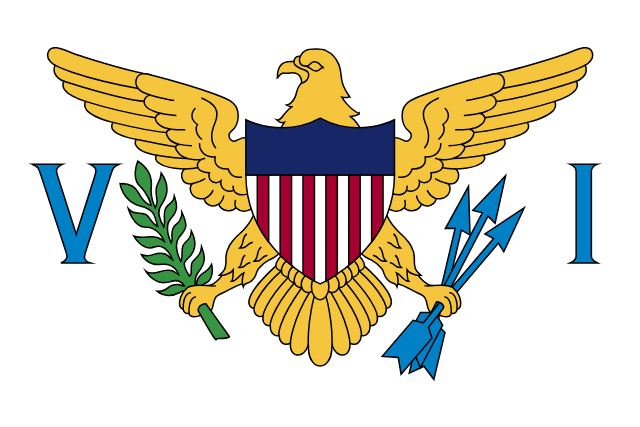
The flag of the United States Virgin Islands has a white background, a golden eagle with a shield, the blue initials V and I, a green branch and three blue arrows. Adopted on May 17, 1921, it combines an American national symbol with a reference to the three principal islands: St. Croix, St. John and St. Thomas. This guide explains the design and the history behind it without confusing the U.S. territory with the neighboring British Virgin Islands.
Flag at a glance
| Jurisdiction | United States Virgin Islands |
|---|---|
| Adoption | May 17, 1921 |
| Field | White |
| Main emblem | Golden eagle with shield |
| Letters | V and I |
| Arrow count | Three |
| Principal islands | St. Croix, St. John, St. Thomas |
What does the U.S. Virgin Islands flag look like?
Begin with the white field. Unlike the flags of Guam and American Samoa, the U.S. Virgin Islands design does not depend on a large dark blue background. It leaves a broad light space around the main figure so that the eagle is clearly visible. On either side of that bird is a single capital letter. The two letters form an abbreviation of the territory’s name.
The eagle has outspread wings and a shield across its body. Red and white vertical divisions appear on the shield beneath a blue upper section. The shield resembles the national heraldic device of the United States rather than a depiction of the islands on a map. The flag’s surrounding white field is not another white stripe in that shield.
Two objects are held in the eagle’s claws: a leafy green branch and a group of three blue arrows. When you examine a normal front-facing illustration, the bird looks toward the pole side. The branch is on the viewer’s left and the arrows on the right. Avoid reversing them because a description uses the eagle’s own right and left, rather than the viewer’s orientation.
At a distance the first features to look for are the white background and the golden shape of the bird. Then check the two blue initials, which make this design unusually easy to distinguish from other American heraldic flags. A photograph may hide an individual arrow or leaf when the fabric folds, so rely on the combination of the major features before concluding which flag you have seen.
The central figure is an emblem in its own right. The flag does not simply place a circular modern government seal in the center. This distinction matters when selecting a reference image for a flag collection, since a search for a governmental symbol may return the seal instead of the flag.
Why does the eagle hold three arrows?
The group of three arrows refers to St. Croix, St. John and St. Thomas. These are the three principal islands usually named in explanations of the flag. The choice of three is a meaningful departure from the thirteen arrows in the Great Seal of the United States. It adapts a familiar heraldic arrangement to identify a particular territory.
St. Thomas is home to Charlotte Amalie, the territorial capital. St. John lies to the east of St. Thomas, while St. Croix is farther south. Their locations can be explored on a map as a companion exercise to studying the flag. The arrows do not reproduce the geographical positions of the islands; their number is what conveys the association.
The Virgin Islands also include smaller islands and cays. Therefore, the three arrows should not be interpreted as a claim that the territory contains exactly three pieces of land. The distinction between principal islands and every island is important in geography. The emblem condenses the place into a recognizable set of three.
An effective classroom activity is to provide a blank map of the eastern Caribbean alongside the flag. Learners can identify and label the three principal islands, then circle the corresponding group of arrows in the picture. That links an abstract emblem to actual geography without inventing a separate meaning for the color of every arrow.
Some artwork renders the arrows close together, and a small printed flag may make them look like one shape. Use the full-sized image when counting them rather than enlarging a low-resolution emoji. A stylized replacement containing thirteen arrows would remove a defining feature of the territorial design.
The eagle, shield and branch
The eagle is a visual expression of the relationship between the islands and the United States. It is helpful to compare the territorial design with the federal Great Seal: both use a bird, a shield and objects in its claws. Yet the two designs are not interchangeable, and the simplified golden treatment of the territorial eagle is a prominent difference.
The chest shield creates a second link to American heraldry. It is a smaller design embedded within the flag rather than an independent flag hanging from the eagle. Its upper blue area and vertical red and white stripes need to remain distinct when the emblem is reproduced.
Reference descriptions differ in the terminology used for the leafy branch. Some describe it as laurel, others as olive. The Virgin Islands government description and specialist flag references identify a sprig of laurel. The most useful visual description is a green leafy branch in the claw opposite the three arrows; do not alter the artwork to fit a botanical interpretation.
Laurel is traditionally associated with victory, whereas olive imagery is often associated with peace. These are wider heraldic associations rather than a reason to invent a definitive official explanation where documentary sources use different terms. A careful account identifies the actual object from the reference and makes any interpretive qualification explicit.
The eagle’s appearance also should not be treated as a wildlife identification chart. Heraldic birds often have exaggerated or stylized features. The golden eagle figure in this design functions as a political symbol, and the artwork’s golden color is not evidence of a particular species living on the islands.
The bird holds both attributes simultaneously. A generic American eagle illustration might omit the arrows, substitute thirteen arrows, change the branch, or add a scroll or a constellation above the head. Such substitutions make an attractive picture but not an accurate rendering of the U.S. Virgin Islands flag.
Colors and the letters V and I
The flag uses a combination of white, gold, blue, red and green. White takes up the surrounding field, gold defines most of the eagle, and blue is used for the letters and arrows as well as part of the shield. Red and white appear again in the shield, while green is associated with the branch.
This distribution of colors is more important for identification than a list of color names. A second flag might contain all five of them but arrange them differently. On the Virgin Islands flag, the white field is a large uninterrupted area, not a narrow outline around the bird. The initials are separate from the central illustration.
The letters stand for Virgin Islands. They do not form part of a national motto, and they are not a Roman numeral printed to indicate the number six. When working with a graphic on a small screen, keep enough space around the eagle for the letters to be read individually.
Printed textiles, screen displays and photographs do not necessarily show identical shades. A yellow-looking eagle in one photograph and a more orange-gold eagle in another do not automatically indicate different official designs. Lighting and manufacturing can account for those differences.
For a school artwork project, a readable dark blue for the initials and arrows, a warm golden yellow for the bird, a green branch and a clearly distinguished shield are more important than claiming an exact numerical digital palette. If producing official materials, consult the government specification and approved artwork rather than sampling colors from this page.
A white flag also creates a special design problem in digital layouts. Its outer boundaries can disappear against a white website background. A thin neutral frame outside the reference image is useful for displaying its edges, but it must not be mistaken for an additional border that belongs to the flag.
From the Danish West Indies to the 1921 flag
The flag’s adoption occurred after a major political change in the eastern Caribbean. The islands were formerly administered by Denmark as the Danish West Indies. The United States acquired them in 1917, and the formal transfer of sovereignty took place on March 31 of that year.
The Danish flag was lowered and the United States flag was raised at the transfer ceremony. The date is still commemorated as Transfer Day. It is important to keep that event separate from the adoption of the distinctive local flag four years later.
In the first years of American administration, the islands did not immediately acquire the present territorial emblem. The need for a local flag became part of the development of a distinct administrative and public identity. Specialist histories associate Governor Sumner Ely Wetmore Kittelle with the initiative to create it.
Flag histories credit William Russell White with involvement in the design process. As with many historical flags, there is a distinction between the official who requested a design, the person who prepared it and the authority that formally adopted it. The adoption date is firmer than any simplified claim that one individual alone created every detail.
The design was adopted on May 17, 1921, by executive order. Its incorporation of American heraldic features reflects the political context of the time, while the number of arrows identifies the principal islands. The flag was not simply carried over from the Danish period.
For a historical comparison, place the Danish Dannebrog, the United States flag and the present Virgin Islands flag on a timeline. Label 1917 as the sovereignty transfer and 1921 as the introduction of the territorial design. This prevents the common mistake of illustrating the 1917 ceremony with a flag that had not yet been adopted.
Transfer Day is a living commemoration rather than a change to the flag’s appearance. The territorial government issues announcements for particular anniversaries, and the legislature has discussed the significance of the historical transition. Readers seeking the program for any future celebration should consult current local announcements.
U.S. Virgin Islands vs British Virgin Islands flags
The neighboring territories have different political relationships and entirely different flag designs. The British Virgin Islands flag is a British blue ensign with a Union Jack in the upper hoist and a shield featuring Saint Ursula and lamps. It is not a variant of the white American Virgin Islands flag.
The easiest identification test is the main field. A white field with a golden eagle and blue initials indicates the U.S. territory. A dark blue field with a Union Jack and a shield indicates the British territory. Neither description requires the observer to recognize every fine heraldic detail.
The word Virgin Islands alone can refer to the wider geographical island group. In an encyclopedia, however, the entries must identify the relevant jurisdiction rather than use the shorter name as though it were unambiguous. A map can include both territories, and the flag key should specify which symbol belongs to which one.
American Samoa also has an eagle on its flag, but the surrounding design is a red-edged white triangle on blue. The objects carried by its eagle are different, reflecting Samoan cultural traditions. A bird alone is therefore not enough to identify either flag; the background and attributes provide the decisive clues.
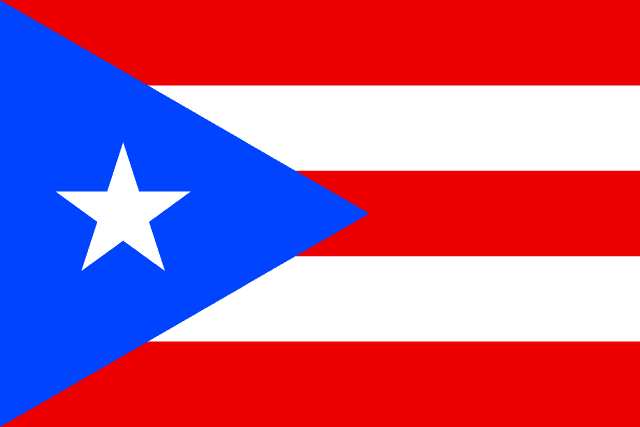
Puerto Rico’s flag is built from stripes, a blue triangle and a single star. The U.S. Virgin Islands flag has no comparable large triangle. A useful activity is to classify these flags first by their geometry and then by their political status, rather than assuming all territorial flags share the same visual template.
How to make an accurate classroom drawing
Use a rectangular sheet and lightly mark its center. Keep the white background clear, drawing the outline of the bird before coloring it. Add two temporary vertical guidelines to help position the initials evenly on either side.
Sketch the wings so that the figure is balanced across the center. Reserve space for the shield over the breast. Use the reference image rather than copying an unrelated eagle from another source, because the shape and attributes of the bird are essential to this particular flag.
Draw the shield with a clear upper section and vertical lower divisions. At small sizes the internal stripes may be difficult to reproduce; an enlarged reference helps. Do not extend those stripes across the bird’s wings or the surrounding flag.
Draw the leafy branch in the claw on the left of the normal front view and place exactly three arrows on the right. Color the arrows blue rather than treating them as an extension of the gold bird. Finish by adding the initials and checking that they are separate from the wings.
For a display of multiple flags, draw all the outer rectangles at a consistent height while maintaining their respective proportions. Label this exercise as a student illustration. A hand-drawn version can teach recognition effectively without claiming to be an approved production master.
If comparing artwork, note that a border added to show the edge of a white rectangle is part of the presentation, not the flag. Leave that distinction clear when transferring the design to colored paper.
What territory does the flag represent?
The U.S. Virgin Islands are an insular territory of the United States, not one of the fifty states and not an independent sovereign country. The territorial flag identifies the local jurisdiction; it does not replace the national flag.
A geographical classification places the islands in the Caribbean, within the broader North American region used by many flag directories. A political classification places the flag alongside Guam, American Samoa, Puerto Rico and the Northern Mariana Islands. Both approaches are valid provided that the directory explains the distinction.
A classroom can use the flag to learn three separate concepts: an archipelago is a geographical grouping, a territory is a political jurisdiction, and a flag is a visual symbol. Those categories may overlap, but they are not synonyms. The three-arrow design is a useful example because it connects a local political identity with geographical features.
When researching a ceremony or official reproduction, refer to the relevant government rather than assuming that the rules of a different territory apply. Educational use of a flag picture does not confer permission to present a business or event as government-endorsed.
Frequently asked questions
When was the flag adopted?
May 17, 1921.
What do the three arrows represent?
St. Croix, St. John and St. Thomas, the principal islands.
What do V and I mean?
Virgin Islands.
Is it the British Virgin Islands flag?
No. The British territory uses a blue ensign with a Union Jack and shield.
What is Transfer Day?
The March 31 commemoration of the 1917 transfer from Denmark to the United States.
Sources and image credit
U.S. Virgin Islands government budget reference — official flag description
U.S. Virgin Islands Government, territory history and Transfer Day
Virgin Islands Legislature, Transfer Day
U.S. Flags Design, Virgin Islands design and history
Flags of the World, U.S. Virgin Islands
Flagpedia, downloadable flag artwork
Illustration: existing FlagExplorers media attachment 2087, from Flagpedia/FlagCDN. Educational reference only, not a claim of government endorsement. Reviewed November 2026.