Puerto Rico Flag: Colors, White Star, History & U.S. Status
Explore the design, symbolism and documented historical changes of this American regional flag, with sources and accurate comparisons.
Flag at a glance
| Feature | Verified detail |
|---|---|
| Official adoption | 1952 |
| Historic design origin | 1895 |
| Design | Blue triangle and white star; five red/white stripes |
| Current constitutional status | Unincorporated U.S. territory/commonwealth |
What does the Puerto Rican flag look like?
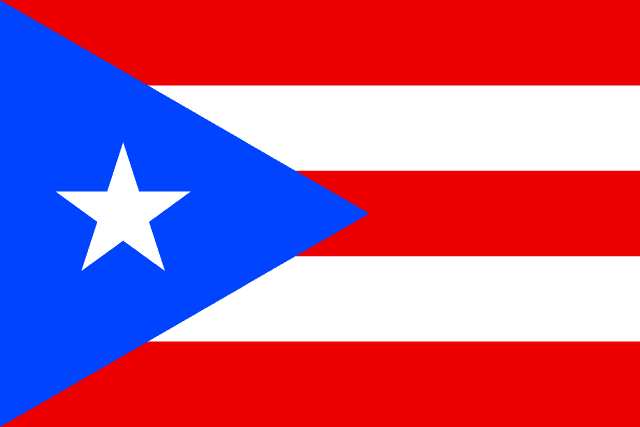
The flag has a triangle at the hoist edge, with a single white five-pointed star inside. Five horizontal stripes extend across the remaining field: three red stripes alternating with two white stripes. The red stripes are at the top, in the center and at the bottom, and the star’s orientation has one point facing upward.
The flag is often mistaken for Cuba’s because both share a similar design language. Cuba has a red triangle, a white star and five blue-and-white stripes, while Puerto Rico has a blue triangle and red-and-white stripes. The colors appear in different places and their political histories are distinct.
Where did Puerto Rico’s flag come from?
The design emerged in New York among Puerto Rican activists connected with independence organizations in the 1890s. It is conventionally dated to 1895 and closely related to the Cuban revolutionary flag, reflecting bonds between the two island movements. Contemporary attributions of the single individual responsible for the earliest design vary; an accurate history distinguishes the organization and wider movement from uncertain personal credit.
Puerto Rico passed from Spanish to U.S. control after the Spanish–American War in 1898. The flag was then used in political and cultural contexts before later being officially recognized. Its meaning therefore spans the late-nineteenth-century independence movement and Puerto Rico’s subsequent history under U.S. sovereignty.
When did Puerto Rico officially adopt its flag?
Puerto Rico’s government adopted the historic design as its official flag in 1952, during the establishment of the Commonwealth of Puerto Rico. The law specified the emblem in broad terms. This date describes its legal recognition, not the first public display of the design, which occurred decades earlier.
The flag is now widely used by public institutions and residents. In an educational setting, it should be identified as the Puerto Rican territorial or commonwealth flag, not described as an additional U.S. state flag. Puerto Rico is not currently one of the fifty states.
What do its red, white and blue colors mean?
Interpretations commonly connect the white star with Puerto Rico and the triangle with the republican ideals of the original movement. Popular symbolic readings also associate the red stripes with blood or struggle, the white stripes with liberty and rights, and blue with sky or government institutions. Different activists and reference works frame these meanings differently.
The legally adopted design does not establish an exclusive universal HEX value for its blue triangle. Historic banners and modern reproductions vary from light to dark blue. Avoid presenting one shade from an image download as the only historically legitimate version without citing a specific contemporary official manufacturing standard.
Is Puerto Rico a U.S. state, territory or independent country?
Puerto Rico is an unincorporated U.S. territory with its own locally elected government and commonwealth designation. Its residents are generally U.S. citizens, but Puerto Rico is not a U.S. state and does not have the same federal congressional representation or presidential voting arrangements as a state.
The Puerto Rican flag is a visible expression of local identity and culture. Displaying it alongside the American national flag does not make Puerto Rico an independent foreign country, and a historical account of the 1895 design should not be confused with the present constitutional status of the territory.
How to draw Puerto Rico’s flag accurately
Draw a rectangular flag and divide it into five equal horizontal stripes. Color the top, middle and bottom stripes red; leave the other two white. Add a blue triangle at the hoist side with its base along the full flag height and its point reaching toward the center. Place a white five-pointed star inside the triangle.
Use an official flag image to check the size and angle of the triangle and star. Do not invert red and blue to match Cuba’s flag, and do not add fifty stars or the seal of Puerto Rico to the design. For a classroom comparison, use the U.S. territories directory to distinguish island and district flags.
Frequently asked questions
How many stripes are on Puerto Rico’s flag?
Five: three red and two white.
Why does it resemble Cuba’s flag?
The design arose amid connected Puerto Rican and Cuban revolutionary movements in the 1890s.
When was it adopted officially?
1952.
Is Puerto Rico a U.S. state?
No. It is an unincorporated U.S. territory/commonwealth.
What is the official blue shade?
The exact shade has varied historically; the 1952 law does not uniquely specify a digital HEX value.
Puerto Rico Department of State
Puerto Rico legislative law archives
Smithsonian — Puerto Rican cultural history
Illustration from Flagpedia/FlagCDN or Wikimedia Commons, with source and licensing information on the media library attachment. Updated November 2026.