Guam Flag: Meaning, Colors, Symbols and History
Discover the coastal emblem, CHamoru heritage, documented design history and official display rules of Guam’s flag.
Marine blue field, deep red border and a pointed coastal emblem.
The Guam flag combines a marine-blue background with a narrow red border and a pointed emblem depicting an island coastal scene. Its original design dates to 1917, and legislation in 1948 documented the red trim familiar today. The flag represents Guam’s local identity and CHamoru heritage within the United States.
Whether you are identifying a flag you have seen, preparing a geography lesson or researching the history of the Pacific, this guide explains the visual details, documented milestones and rules that make Guam’s flag distinctive.
What does the Guam flag look like?
The flag is easy to recognize once you know its three main visual features. A marine-blue rectangle occupies most of the design, a continuous deep-red frame surrounds the rectangle, and a small upright emblem sits in the center. Unlike many flags that divide their surface into broad horizontal or vertical stripes, Guam uses the surrounding blue space to draw attention to a single detailed scene.
Look at the outline of that scene before studying the smaller details. It resembles a tall lens with a pointed top and bottom rather than a circle or a conventional heraldic shield. The outline is red. Inside it is an island landscape containing a coconut palm, a sailing canoe, a beach, water and distant land. The island’s name is printed across the scene in red capital letters.
The large dark field is particularly helpful when trying to identify a distant flag on a pole. At close range the palm and boat are the most useful secondary clues. At a greater distance the lettering and landscape can disappear into a small patch of color, but the red frame and pointed central shape remain distinctive.
The flag is an official local symbol of Guam, not a replacement for the United States national flag. If you encounter a display of flags representing all American jurisdictions, you should expect Guam to appear among the territories rather than among the fifty states. A display of independent countries may instead identify it separately as a territory.
Guam flag facts and official proportions
| Jurisdiction | Guam, United States territory |
|---|---|
| Local name | Guåhan |
| Original flag plan | 1917 |
| Red-border specification | 1948 |
| Main colors | Marine blue and deep red |
| Central emblem | Pointed coat of arms with a coastal scene |
| Official legal reference | 1 GCA §§ 406–409 |
The statutory description is found in Title 1, Chapter 4 of the Guam Code Annotated. Sections 406 and 407 are the most relevant provisions for the artwork and dimensions. The code gives the blue field a length of 78 inches and a height of 40 inches, with a two-inch red trim and a central design measuring 24 inches vertically by 16 inches horizontally.
These measurements are more useful than a random downloadable picture when producing a flag for a school project. If a drawing is one-tenth of the statutory size, the blue field would be 7.8 inches long and four inches high. The trim would be one-fifth of an inch wide and the emblem would measure 2.4 by 1.6 inches. Scale every component consistently.
Be careful about quoting a single aspect ratio from those numbers. The wording specifies the dimensions of the blue field and also describes the border. Treating the border as an additional outer band rather than as part of the stated rectangle changes the overall measurement. If you need a manufacturing specification rather than an educational sketch, consult the current code and the appropriate Guam government office.
A larger flag for official holidays is specified in the same law. This is a size variation, not a different flag: its proportions and basic design remain the same. A small desk flag and a much larger public building flag should therefore share the same recognizable layout even though the smaller version cannot show every detail as clearly.
What do the colors of Guam’s flag mean?
The dominant blue and red are often the first colors people name, but the emblem itself contains a wider palette. The law identifies the colors of the landscape elements, which provides a firmer basis for describing the design than assigning an invented moral meaning to every shade.
The darker blue gives the flag its main visual identity and is also used for the water in the central scene. The sky inside the scene is a lighter blue. Keeping those areas distinct matters: coloring the sky and ocean the same shade makes the landscape harder to read.
Yellow identifies the sandy shore. The trunk of the coconut palm and the canoe use brown, while green identifies the palm’s leaves. The sail is white and the distant elevated land is gray. Red returns in the perimeter, the emblem outline and the island’s name. Together these smaller areas create the contrast needed for the picture to remain recognizable.
The official language commission emphasizes the connection of the imagery and colors with the island’s environment and cultural identity. This is a more useful way to understand the whole flag than treating the landscape as a collection of unrelated decorative shapes.
You may encounter claims that the red border represents suffering during a particular historical period. The postwar introduction of the border is documented, but a precise symbolic interpretation should be attributed to a source rather than presented as a requirement of the flag law. The statute describes the colors and composition; it is not a complete explanation of every historical association.
For digital projects, use a consistent, well-documented flag illustration. A color sampled from a photograph can change because of lighting, fabric, camera settings or compression. The statutory descriptions are color names rather than a complete universal RGB or HEX specification, so a web palette should be labeled an approximation if you provide one.
The slingstone, canoe, palm and landscape
The pointed outline is commonly associated with the traditional slingstone, known in CHamoru as atupat. Its shape connects the image to an object with cultural and archaeological significance. This is why replacing the outline with a generic oval removes an important identification detail. The commission responsible for the CHamoru language explicitly connects the shape with the island’s heritage.
The sailing vessel is a flying proa, a type of outrigger canoe associated with the maritime traditions of the Mariana Islands. It is not a modern yacht or a large European sailing ship. The word proa appears in historical writing about Pacific vessels, but it is the local knowledge of boats, construction and navigation that gives the symbol its particular relevance in Guam.
For a geography lesson, the vessel offers a starting point for discussing how islands are connected by water. An ocean can be understood as a route for travel and exchange, not simply as the empty space separating landmasses on a map. A flag with a canoe makes that relationship visible in a compact form.
The coconut palm is a recognizable feature of tropical coastal landscapes. On the Guam emblem it stands near the river mouth in the foreground. Its trunk and fronds create a strong vertical shape that balances the horizontal shore and the sail further away. The tree therefore has a practical role in making the small landscape legible, as well as its cultural associations.
The setting is associated with the Hagåtña River where it reaches the sea. Hagåtña is Guam’s capital, and older English-language documents may use Agana or Agaña for the same place. These different spellings are worth recognizing when comparing historical accounts. The spelling of a place in a source can reflect the period and language conventions in which the source was written.
The scene also includes distant land. Some visitor-oriented accounts identify the cliff with Puntan Dos Amantes, often called Two Lovers Point in English. The statutory wording describes the landform without requiring that a reader identify it by a named viewpoint. The landscape should be understood as a stylized scene, not a detailed navigational chart.
Finally, the red word GUAM names the place directly. That is unusual compared with many national flags, which rely entirely on colors and symbols. For a beginner learning geography, the lettering provides an additional confirmation of the identity of the flag.
History: from 1917 to the modern design
Before the island acquired a distinctive flag of its own, the flags of the powers governing Guam were used. Spanish colonial rule ended following the Spanish-American War in 1898, and the island came under United States control. The emergence of a local flag in the early twentieth century created a recognizable symbol specific to Guam.
The year 1917 marks the first important milestone. Guam’s naval governor approved a flag plan on July 4 of that year. Historical accounts also describe the presentation of the island flag during a parade two days later. These are related but different events: one concerns approval of a design and the other concerns a public appearance.
Another date encountered in historical descriptions is July 4, 1918, when the flag was raised during a fair in Hagåtña. A reader comparing dates should pay attention to the event being described. A first approval, a presentation, a ceremonial raising and formal government recognition do not necessarily happen on the same day.
The naval government returned to the design during the 1930s. Records discussed by Guampedia document recognition of the seal in 1930 and a 1931 order designating the island flag. The earlier version had a dark blue background and the emblem; the familiar outer red frame belongs to the later history of the design.
Guam experienced Japanese occupation during World War II before returning to United States control in 1944. The flag’s postwar development belongs to this period of rebuilding local institutions. In February 1948, legislation approved by naval governor Charles A. Pownall described the flag with the deep-red border now familiar to viewers.
The Organic Act of Guam in 1950 established a civilian governmental framework. The Guam Congress also addressed the official seal in 1950. Those developments are important for the history of the emblem but should not be mistaken for the original invention of the flag in that year.
Modern readers consequently have several legitimate dates to learn. If a quiz asks when the design originated, 1917 is the appropriate starting point. If it asks about the flag with the red trim, the documented postwar specification is the more relevant milestone. If it asks when a particular seal law was adopted, the question concerns a different legal instrument.
Who designed the Guam flag?
The authorship of the original emblem is not entirely settled. There is a difference between being credited with an image that inspired a flag and being documented as the person who prepared the final approved construction drawing. Guam’s historical sources preserve more than one account of how the design emerged.
The CHamoru language commission gives particular attention to Francisco Feja, a local artist whose work captured the coastal scene. A Guam legislative resolution in 1992 recognized his contribution. This acknowledgment is significant because it places the local artist and his community at the center of the flag’s cultural history.
Another account credits sketches by Helen Paul, who lived on Guam with her husband, a naval officer. Her work is also discussed in historical records concerning the first flag. A photograph from the collection of former naval governor Robert Coontz has been suggested as another possible influence.
These accounts do not need to be collapsed into a confident claim that a single person was unquestionably responsible for every element. A good historical answer can explain the competing attributions while recognizing the evidence for Feja’s contribution. This approach is especially appropriate when a school textbook, tourism publication and local historical encyclopedia give different versions.
The distinction also helps explain why historical research is valuable in flag studies. A familiar modern design can conceal a long sequence of sketches, approvals, reproductions and legislative changes. Its official appearance today does not settle every question about the artistic decisions made more than a century earlier.
Guam, Guåhan and the United States
Guam is an island in the western Pacific and is part of the Mariana Islands. It is an unincorporated territory of the United States with a local government. It is not one of the fifty states and is not a separate sovereign country.
Guåhan is the CHamoru name widely used in cultural and local-language contexts. CHamoru is the spelling used by the island’s language commission. The official flag’s lettering uses the English name GUAM, so the appearance of the local name in an article does not imply that there is a second official flag with different lettering.
The central image is an expression of local heritage within that political relationship. The presence of a territorial flag alongside the Stars and Stripes is not unusual: the national and local flags represent different levels of identity. Visitors can see similar distinctions in other United States jurisdictions, even though their histories and constitutional arrangements are not identical.
For a classroom map, Guam belongs geographically in Oceania and politically in a collection of United States territorial flags. Flag collections can use either classification if they clearly explain their organizing principle. This article is linked to the United States territories collection because that is the most useful starting point for readers comparing these local flags.
How to distinguish Guam from other flags
Guam and the Northern Mariana Islands are closely connected geographically, but their flags have distinct visual structures. The Northern Mariana Islands flag has a blue background with a white star, a latte stone and a decorative wreath. Guam instead has a red frame and a small coastal landscape. Do not use a blue background alone as an identification clue for either.
The flag of the Federated States of Micronesia is another blue Pacific design. It has four white stars and no central landscape. The Marshall Islands flag uses a star and diagonal bands of color. These comparisons show how useful the presence or absence of a central picture is when narrowing down an unknown Pacific flag.
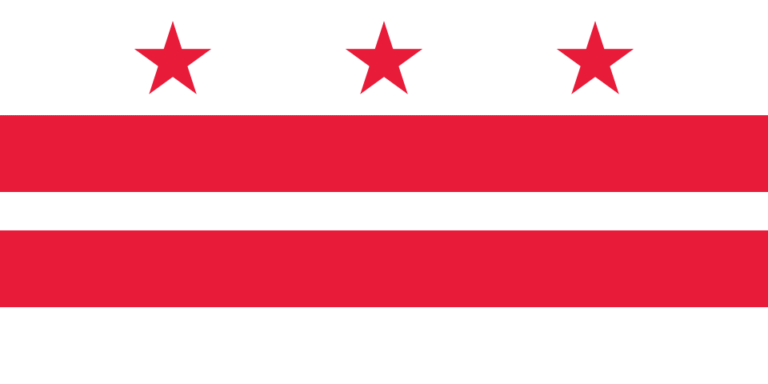
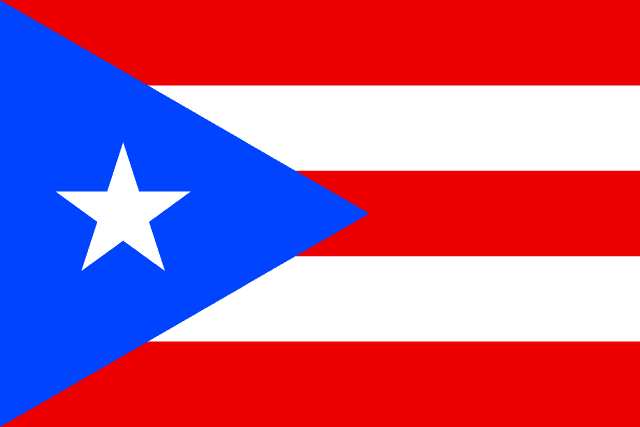
Puerto Rico’s flag has red-and-white horizontal stripes and a blue triangle with a star. Washington, D.C.’s flag has red stars and bars on white. Neither has Guam’s perimeter frame and slingstone-shaped picture. When grouping flags of American jurisdictions, it is helpful to compare their geometry first and only then consider shared colors.
Another common source of confusion is the Great Seal of Guam. The flag carries the pointed coat of arms, while the formal Great Seal adds surrounding text. A circular seal with external lettering is not an alternative version of the rectangular flag. The statute describes these as separate official symbols.
For an identification exercise, cover the island’s name on a picture of the flag. Ask the learner to use the red border, dark blue field and outline of the emblem to recognize it. Then reveal the lettering as confirmation. This trains visual recognition instead of relying entirely on a printed label.
How to draw the Guam flag for a project
Start with a horizontal rectangle and use a ruler to keep the four sides straight. Choose whether you are making a simplified educational drawing or a carefully scaled construction study. For the latter, calculate all component sizes using the statutory measurements rather than relying on the apparent ratio of a screen image.
Draw a narrow red perimeter of equal thickness on every side and fill the interior with marine blue. Mark the geometric center lightly in pencil. A central guide line helps ensure that the pointed emblem does not lean left or right.
Sketch the emblem as a vertically oriented shape with a tapered upper and lower end. Keep it taller than it is wide. Inside, divide the picture into a distant sky and land, darker water, and a beach toward the foreground. Draw the palm with a visible brown trunk and green leaves; add a small canoe with a white sail in the water.
Add the red name across the picture without placing it outside the emblem. Use a verified reference illustration to check the arrangement of the details. You can simplify individual leaf shapes or the distant landscape for a young learner, but do not omit the boat, palm or red border if the exercise is intended to teach identification.
If you are making a poster, label the result as a student illustration rather than an official manufacturing reproduction. Avoid using a drawing of the emblem as a business logo or a certification mark. Guam’s law separately regulates commercial uses of its official arms and seals, so obtain appropriate guidance before using them for advertising or merchandise.
Flag display and respectful use
Guam’s flag display provisions are set out in Section 408 of Title 1. For a public ceremony the local flag is normally subordinate to the United States flag when the two share one pole. There are also rules for separate displays, raising and lowering the flag, illumination at night and half-staff observances. For an actual event, follow the current statute and the organizer’s instructions rather than a drawing on the internet.
Section 409 makes clear that a pledge to the local flag cannot be required. This is a useful distinction for teachers who are comparing the practices surrounding state, territorial and national flags. A flag can have substantial cultural importance without every ceremonial practice being compulsory.
Section 414 regulates commercial and official-looking uses of the Great Seal and coat of arms. Educational recognition is different from suggesting that a product, organization or service is endorsed by the government. In particular, do not extract the central arms and use them as an endorsement badge.
This guide is an independent educational explanation. It is not an official source of permission to manufacture a government emblem. If a project involves commercial reproduction, consult the appropriate government authority and verify any restrictions before proceeding.
Frequently asked questions
Is Guam’s flag a national flag?
It is Guam’s official local flag. Guam is a United States territory rather than an independent sovereign state.
What is the shape in the middle?
It is the official pointed coat of arms, associated with the traditional CHamoru slingstone.
What is the boat on the flag?
A flying proa, representing the island’s maritime heritage.
When did Guam adopt its flag?
The design dates to 1917; the red-bordered version was documented in legislation in 1948.
Who created the design?
Francisco Feja received legislative recognition, but historical accounts also mention Helen Paul and other potential influences.
Is the Guam flag the same as the Great Seal?
No. The Great Seal adds surrounding lettering to the arms.
Is Guam one of the United States?
It is a U.S. territory, not one of the fifty states.
Sources and further reading
Guam Code Annotated, Title 1, Chapter 4 — statutory flag, arms and display rules.
Kumisión I Fino’ CHamoru: Guam Flag and Seal — local cultural interpretation and artistic heritage.
Guampedia: Guam Seal and Flag — historical records, disputed authorship and postwar design.
Guampedia: Proa and Navigation and Slingstones — cultural context.
Guam Visitors Bureau: Centennial of the Guam Flag — alternative historical account. Flag artwork may be viewed at the language commission link above. This independent article does not claim authorization to use official arms commercially. Reviewed November 2026.