Northern Mariana Islands Flag: Star, Latte Stone, Wreath and History
Identify the white star, gray latte stone and Carolinian floral wreath in the Commonwealth’s flag.
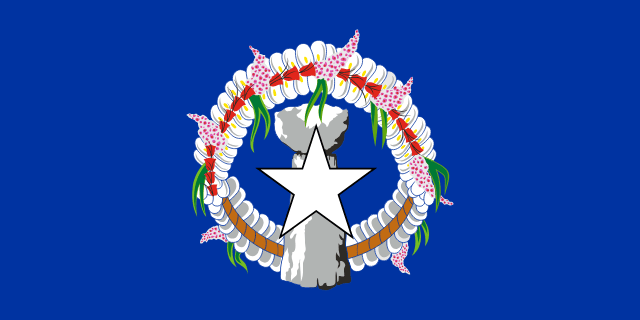
The flag of the Commonwealth of the Northern Mariana Islands is ocean blue with a white star superimposed on a gray latte stone and surrounded by a Carolinian floral wreath. The three central elements connect the Commonwealth’s relationship with the United States and the cultural heritage of its CHamoru and Carolinian communities. The familiar design developed through several historical stages, rather than appearing unchanged at a single founding ceremony.
Flag at a glance
| Jurisdiction | Commonwealth of the Northern Mariana Islands |
|---|---|
| Abbreviation | CNMI |
| Field | Ocean blue |
| Central symbols | White star, gray latte stone, mwáár wreath |
| Early flag | 1976 |
| Modern design milestone | 1985 |
| Legal reference | CNMI Constitution, Article XXII |
What does the Northern Mariana Islands flag look like?
The flag is a blue rectangle with a compact group of symbols in its center. A large white star appears in front of a gray stone structure. A ring of patterned flowers and leaves surrounds the two central objects. Unlike a flag that uses stripes or diagonal bands, the design leaves a wide uninterrupted blue area around the emblem.
The stone has a distinctive shape. A tall base supports a rounded cap, forming the profile of a latte stone. It is not intended to represent a vase, a mushroom or an abstract letter. The white star overlaps the stone so that both remain visible in the same central composition.
The wreath has a recognizable circular shape, but it is not a simple plain gold ring. Its artwork depicts the floral tradition of the Carolinian community. The floral details add secondary colors to the mainly blue, gray and white design and help distinguish the current flag from earlier, simpler versions.
At a distance the star and dark stone outline are useful initial clues. Once the flag is closer, look for the wreath surrounding the central pair. A distant or low-quality photograph might make the wreath look like a ring, but the shape and the overlapping star still help identify it.
Do not confuse the flag with the Commonwealth’s official seal. The seal contains the same core imagery within a circular format and additional identifying text. The official flag uses those symbols on a blue rectangular field. The constitutional descriptions distinguish the two devices even though the emblems share a common visual language.
What does the white star represent?
The single white five-pointed star is associated with the Commonwealth’s relationship with the United States. It does not indicate that the Northern Mariana Islands are an additional state of the Union. The Commonwealth is a United States insular area with a political status established through its Covenant.
A star can convey different meanings in different flags. In a United States state flag, a star might refer to statehood, a date or a particular regional symbol. Here the star operates together with the latte stone and wreath. It is not a complete description of the Commonwealth’s identity on its own.
The star’s placement is especially significant for recognition. It is not scattered across the blue background as part of a constellation, and it does not appear inside a small canton. It overlays the stone at the center of the emblem. Moving it to the corner would create a different composition even if all the same colors remained.
When examining a detailed illustration, separate the white star from any lighter portions of the stone and flowers. A small thumbnail may merge the elements into one pale spot. The outline of the gray supporting form below and behind the star provides the second identification clue.
For an educational exercise, show the flags of the Federated States of Micronesia and the Northern Mariana Islands at the same size. The former displays four white stars against blue. The Commonwealth’s flag displays a single star as part of a complex central emblem. This comparison illustrates how the number and placement of stars can be more informative than the background color alone.
What is a latte stone?
A latte stone is associated with the historic CHamoru communities of the Mariana Islands. Traditional latte structures consist of stone supports with separate capstones. They are among the most recognizable archaeological features of the islands and have become a visual symbol of local heritage.
The upright component of a latte structure supports a rounded upper piece. On the flag, the two components are simplified into a single recognizable silhouette. The central illustration does not show an entire building or a full row of supports; one stylized example is enough to communicate the association.
The stone has cultural significance beyond its physical construction. It connects the modern Commonwealth to a history of settlement and community life in the Mariana Islands long before contemporary territorial institutions existed. For this reason a generic drawing of a pillar would not be an equally suitable substitute.
Latte stones are associated with the Marianas more broadly, including Guam. That shared cultural geography does not imply that the two jurisdictions use the same flag. Guam’s official flag has a red perimeter and a pointed coat of arms containing a coastal scene. The latte stone is the prominent central object on the Northern Mariana Islands flag.
The word latte in this context is not related to the modern drink made with coffee and milk. A reader unfamiliar with Mariana history may encounter unrelated search results when looking up the term. Adding the words stone, Mariana Islands or CHamoru heritage helps distinguish the archaeological subject.
For classroom projects, a learner can draw the stone silhouette separately before placing the star on top of it. Label the upright support and capstone, and explain that the flag is a stylized symbol rather than a measured architectural diagram. This helps students connect the flag with the historical object without inventing a precise scale for an emblem.
The Carolinian mwáár wreath
The wreath identifies another important cultural tradition of the Commonwealth. Article XXII of the Constitution uses the name mwáár for the Carolinian wreath. The word also appears without accent marks or in other transliterations in English-language flag references, so different spellings do not necessarily indicate different symbols.
Rather than treating it as a generic decorative frame, the constitutional description connects the wreath with particular flowers. This specificity is important: a circle of arbitrary clip-art leaves would not accurately reproduce the official composition. The precise flower names can be checked against the official constitutional text.
The wreath surrounds the star and stone. Visually it connects the two central elements into a single emblem, while also maintaining its own identity as a Carolinian symbol. Its position and colors distinguish the current design from earlier images of the flag that lack this feature.
The addition of the wreath reflects the importance of representing the Carolinian community alongside the CHamoru heritage conveyed by the latte stone. It is better to describe these as distinct cultural traditions within the Commonwealth than to collapse them into a single unnamed Pacific culture.
An appropriate research exercise is to compare a current reference picture with an early photograph or a historically documented flag illustration. Identify whether the wreath is present before comparing the finer artwork. A missing wreath on an old image may be historically meaningful rather than a printing error.
If drawing a classroom interpretation, use the reference image to preserve the relationship between the ring and the central symbols. The flowers should surround the emblem without obscuring the points of the star. A student drawing can simplify the individual petals while preserving their recognizable arrangement; a formal reproduction should use authorized or verified artwork.
What do the colors tell us?
Ocean blue is the dominant field color specified in the Commonwealth’s constitutional description. The blue area extends to the edges of the flag without the red frame found on Guam’s flag. It provides the background against which the gray latte stone and white star stand out.
The white star is highly visible against the blue field, while the gray color of the stone is consistent with its depiction as a stone object. The wreath incorporates additional colors to illustrate the flowers. This is an emblem with a detailed secondary palette, not a flag with a fixed number of colored horizontal bands.
The constitutional names of the colors provide the strongest basis for identifying them. It is possible to derive digital color samples from a particular illustration, but those values should not be presented as a universal official digital specification without a supporting legal or production standard.
A printed reference can look different under daylight and indoor lighting. A small low-quality image may also reduce the number of visible wreath colors. For recognition, use the arrangement of the symbols and the large blue field before attempting to match individual shades.
An effective visual comparison is to place three blue Pacific flags side by side and identify their secondary symbols. The Federated States of Micronesia uses four stars. Guam has a red border and central coastal emblem. The Northern Mariana Islands has the star, stone and floral ring. Each is identifiable from its structure even without color samples.
When preparing a graphic on a blue website background, a neutral border outside the flag image may help separate the illustration from the surrounding page. It should not be described as part of the official flag. Similarly, do not place additional letters or a website logo inside the flag rectangle.
History of the flag and its modern emblem
The islands have a long history that precedes the modern Commonwealth. Foreign administration changed over time, and after World War II the Northern Mariana Islands were administered within the Trust Territory of the Pacific Islands. The development of a separate political relationship with the United States occurred in this broader postwar context.
A Covenant to Establish a Commonwealth of the Northern Mariana Islands in Political Union with the United States was signed in 1975. The United States approved it in 1976. The Covenant is an important legal milestone, but its approval date should not be treated as the single date of every subsequent flag or constitutional development.
Educational histories trace the early Commonwealth flag to 1976. Its basic design featured a star and latte stone on blue. That earlier flag expressed the American connection and Mariana cultural heritage through a compact set of symbols.
The Commonwealth Constitution was ratified in 1977 and took effect in 1978. Its provisions and later amendments establish the basis for the official flag and seal. The history of those constitutional provisions is especially useful when trying to resolve conflicting adoption dates from different flag websites.
The current design incorporating the wreath is associated with the 1985 changes. The constitutional amendment history and educational accounts both help distinguish the more recent form from the earlier two-symbol design. The word adopted can therefore refer to the early flag or to a later version of it.
If a historical atlas lists 1976 and a contemporary flag reference lists 1985, do not automatically assume one is wrong. Compare what each source is dating. The date of an initial design, the date of a constitutional provision and the date of an amendment are different historical events.
A useful timeline begins with the political-status negotiations, then marks the Covenant, the early flag, the Constitution and the later wreath design. The timeline should label each event explicitly rather than presenting several years as rival answers to the same vaguely worded question.
For the modern flag’s legal description, consult Article XXII of the CNMI Constitution. It describes the symbols and provides that their dimensions are to be established by law. A flag illustration can show the arrangement accurately while leaving any precise manufacturing measurements to the relevant legal specification.
Where are the Northern Mariana Islands?
The Commonwealth occupies part of the Mariana archipelago in the western Pacific. Saipan, Tinian and Rota are among its best-known islands, and the Commonwealth also encompasses a chain of islands extending northward. Saipan is the seat of the Commonwealth government.
Guam is geographically part of the Mariana archipelago but is a separate United States territory. This is a frequent source of confusion for readers who encounter the two names together in maps, history books or travel descriptions. The Commonwealth flag does not represent Guam, and Guam’s flag does not represent the entire Mariana archipelago.
The Commonwealth’s political relationship with the United States is established by the Covenant. It is not an independent country or one of the fifty states. It can nevertheless have its own flag, constitution and local institutions, which make its territorial identity visible.
In a world flag directory, the entry belongs geographically to Oceania and politically to a collection of United States insular areas. These classifications answer different questions. One locates the islands in the Pacific; the other identifies their constitutional relationship.
A classroom map exercise can mark Guam and Saipan separately, then connect each with its own flag picture. Add American Samoa farther away in the Pacific to illustrate that U.S. territories are not all located in the same archipelago. The geographical exercise gives meaning to the flag collection beyond memorizing names.
How to tell it apart from Guam and other Pacific flags
Guam’s flag has a continuous red outer frame and a central pointed emblem. The Northern Mariana Islands design uses a plain blue perimeter and the circular floral arrangement. Look at the edge of the flag first if you cannot see its center clearly.
American Samoa uses a large white triangular field edged in red and an eagle. Its layout is strongly directional, pointing toward the hoist. The Northern Mariana Islands emblem is centered and does not contain a broad white triangle. These are distinct design systems even though blue and white appear in both.
The flag of Nauru is another blue design with a star, but it has a yellow horizontal band and a white star placed below the band near the hoist. The central latte stone and wreath are absent. Comparing star positions is an efficient way to identify flags that share a dominant background color.
When searching for the Northern Mariana Islands flag, use the full name or CNMI. The word Mariana can refer to the archipelago or to other geographical names. A correct collection should label the specific Commonwealth rather than use an ambiguous regional name.
The official seal is distinguished by its circular field and identifying text around the central design. If a source shows the emblem inside a ring with words, it may be illustrating the seal rather than the flag. Choose the rectangular flag image for a flag worksheet.
How to draw or identify the flag in a project
Start with a horizontal rectangle and mark the center with light pencil lines. Fill most of the sheet with blue, reserving a central region for the emblem. Use the reference image to judge the emblem’s position and scale rather than imposing an invented legal proportion.
Sketch the gray latte stone with its rounded cap and upright base. Place the white five-pointed star over the stone, leaving the outline of the stone visible. The two elements must overlap; placing them side by side changes the visual structure.
Draw the surrounding floral ring as a separate guide. Add the flowers and leaves in the arrangement seen in the reference illustration. For a simplified educational picture, keep the circular wreath visible even if the smallest decorative details are omitted.
Check the finished design against three visual tests: the star must overlap the stone, the floral ring must surround the central pair, and the blue field must remain uninterrupted outside the emblem. Do not add a red perimeter, a Union Jack, or an eagle from another Pacific flag.
When creating an official-use reproduction, consult the Commonwealth’s current legal requirements and use appropriate approved artwork. An independently drawn educational illustration should not be represented as a government-approved seal or as evidence of official endorsement.
The full flag and the separate circular seal are useful examples for a lesson in visual identity. Ask learners to explain what changes between the two designs and what remains the same. This teaches the difference between an emblem, a seal and a flag without requiring every flower to be drawn perfectly.
Frequently asked questions
What is the stone on the flag?
A latte stone, associated with CHamoru heritage.
What is the wreath?
The traditional Carolinian mwáár.
What does the star mean?
It is associated with the relationship with the United States.
Is this Guam’s flag?
No. Guam has a red-edged blue flag with a coastal emblem.
Why are 1976 and 1985 both mentioned?
They refer to the early flag and later design development.
Sources and image credit
Commonwealth Public Law 06-11 — flag composition and proportional dimensions
CNMI Constitution, Article XXII
Official NMI Flag and Seal, California Educators Together
U.S. Social Security Administration, Covenant
Flags of the World, Northern Mariana Islands
Illustration: existing FlagExplorers media attachment 2086, from Flagpedia/FlagCDN. Educational reference only, not a claim of government endorsement. Reviewed November 2026.