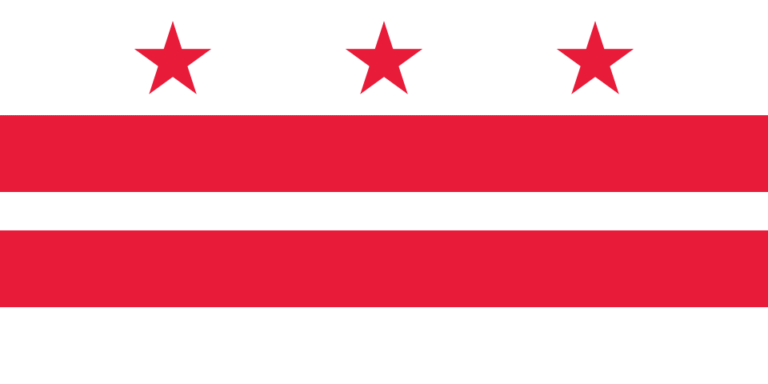
How to Draw the Washington, D.C. Flag: Three Stars, Two Bars and Exact Measurements
Measured construction steps, practical examples and accuracy checks.
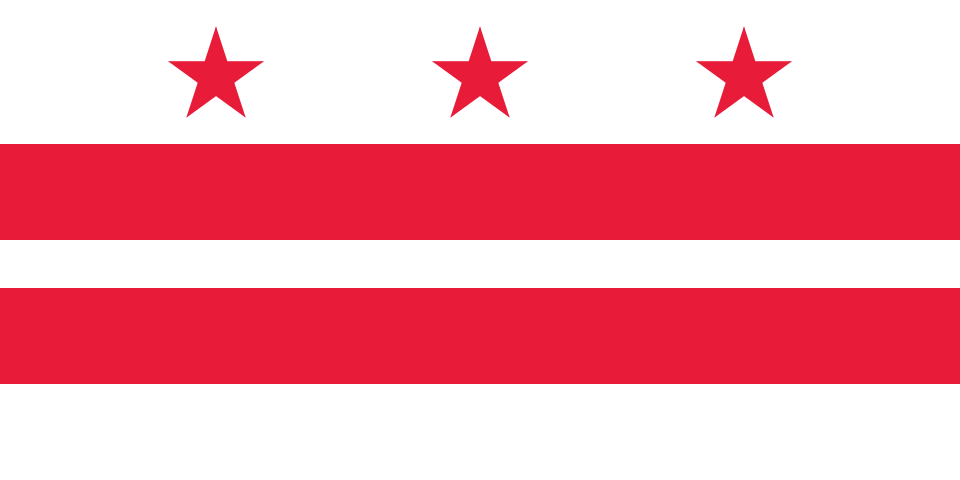
Draw the Washington, D.C. flag by dividing a white rectangle into ten height units. The upper three units hold three red stars, the next two form a red bar, the next one is white, the following two are red, and the last two remain white. Each star has a diameter of two units. D.C. Code §1–151 establishes these vertical proportions but permits different overall flag lengths. This tutorial uses a common 2:1 reference rectangle and explains how to calculate, draw and check the design at any scale.
For the history and symbolism, read our Washington, D.C. flag guide.
Construction measurements
| Chief height | 3/10 of height |
|---|---|
| Each red bar | 2/10 of height |
| White gap between bars | 1/10 of height |
| White base | 2/10 of height |
| Star diameter | 2/10 of height |
| Example length:height | 2:1; overall length may vary |
Step 1: Set the height before choosing the length
The statute uses the hoist, or vertical dimension, as the reference for all its fractions. Drawing software usually calls the horizontal dimension width, so begin by naming the two measurements explicitly. Use H for the height and L for the length from the pole to the free end.
For a classroom drawing, choose a height of twenty centimeters. A length of forty centimeters preserves the familiar two-to-one reference proportions. This is the ratio of the existing illustration above; the law does not require every permitted D.C. flag to use exactly that length.
The ten height units then measure two centimeters each. Mark a vertical guide at each two-centimeter interval along both sides of the rectangle. Those light marks allow the colored bands to be established without introducing unequal stripe widths.
A smaller drawing ten centimeters high and twenty centimeters long works on ordinary graph paper. Each construction unit is one centimeter. A poster thirty centimeters high and sixty centimeters long has three-centimeter units.
For a digital artboard of one thousand by five hundred pixels, the height unit is fifty pixels. Work at that scale or another multiple of ten so that the principal vertical measurements do not need rounding.
Check the opposing sides of the rectangle before continuing. If the paper has been cut unevenly, establish a separate rectangular drawing area rather than using the paper edge as a guide. The horizontal bars will make any skewed edge particularly noticeable.
Keep the background white. Do not draw a permanent black line around the flag; a pencil boundary is useful on a white sheet, but a black outline is not an element of the civic design. A neutral frame outside the artwork is acceptable for presentation when the white field otherwise disappears against a page.
Step 2: Measure the two red horizontal bars
Starting at the top, the chief occupies three-tenths of the height. On the twenty-centimeter example this is the first six centimeters. Leave that area white for the three stars.
The first red bar begins at six centimeters and ends at ten centimeters below the top. It is four centimeters high. The white gap beneath it is two centimeters high, extending from ten to twelve centimeters.
The second red bar begins at twelve centimeters and ends at sixteen centimeters. It too is four centimeters high. The remaining four centimeters below it form the white base. Check that the two red bars have identical dimensions and run from the hoist to the fly.
This gives the sequence of vertical boundaries at six, ten, twelve and sixteen centimeters. The complete flag remains twenty centimeters high. In particular, the upper white region is larger than the lower white region, and the gap between the bars is narrower than either.
A frequent mistake is to divide the flag into five equal horizontal stripes and then add stars to the upper one. That arrangement would give the upper star field only one-fifth of the height and make the central white gap too large. The D.C. design instead uses five regions of unequal height, with the ratios three, two, one, two and two.
On a five-hundred-pixel-high artboard, create a red rectangle from y equals 150 through 250 and another from y equals 300 through 400. Both span the full horizontal length. The white background can be a single base rectangle beneath them.
If working with colored paper, cut two red strips four centimeters high and forty centimeters long for the larger example. Use a ruler to position the upper strip before attaching the lower one. Cutting the strips together helps ensure they have the same thickness.
For a final measurement, add the two red heights, the white chief, the central white gap and the white base. Their combined heights must equal the original rectangle. Any unexplained remainder indicates a scaling or marking error.
Step 3: Establish the three star sizes and vertical position
The red stars each have a specified diameter equal to one-fifth of the flag height. A star on the twenty-centimeter drawing therefore has a four-centimeter construction diameter. Set a compass to a radius of two centimeters and draw a temporary circle for the first star.
The chief is six centimeters high in this example. Centering the stars vertically within it gives a guide centerline three centimeters below the top, leaving one centimeter between the bounding circle and either edge of the chief. This is a practical placement method consistent with the centered appearance of the reference artwork.
Do not confuse the diameter of the circle through the star’s outer tips with the exact rectangular bounding box of a five-pointed star. With one tip pointing directly upward, the other outer points do not all reach the circle’s extreme horizontal or vertical coordinates.
If a design application gives a star a width of four centimeters, inspect which measurement it means. A circle with a diameter of four centimeters is a more explicit construction guide than a bounding-box width assigned to an icon whose orientation may differ.
For a five-hundred-pixel-high flag, the star’s construction diameter is one hundred pixels. Its radius is fifty pixels. A vertically centered guide within the one-hundred-fifty-pixel chief lies at y equals 75.
All three stars must have the same diameter and should be positioned consistently in the upper field. Avoid making the middle star larger merely because it lies at the center of the flag. The three stars are equal members of the arrangement.
Keep the guide circles and centerline light enough to erase later. They are not part of the flag. An image containing three red rings around red stars would reproduce a different design.
Step 4: Distribute the stars horizontally
The statute requires the stars to be evenly spaced along the fly dimension. The two-to-one reference illustration offers a useful way to put that principle into practice. Divide the horizontal length into four equal intervals and place the star centers at the first, second and third quarter positions.
On the forty-centimeter-long example, those positions are ten, twenty and thirty centimeters from the hoist. The gaps between adjacent centers measure ten centimeters. The outer centers sit equally far from their respective flag edges.
At the digital scale of one thousand pixels long and five hundred pixels high, the three example centers are (250,75), (500,75) and (750,75). These coordinates are a reference-based construction example rather than a separate statutory requirement for a fixed fly length.
The overall length is variable under the code, so the horizontal positions must be recalculated if a different length is selected. For instance, a thirty-centimeter-long rectangle at the same twenty-centimeter height would give quarter-point centers at 7.5, 15 and 22.5 centimeters. The stars’ height-based diameter remains four centimeters.
This distinction is important: changing the fly length does not mean that the bars become thicker or that the stars grow larger. The vertical fractions depend on height, whereas the horizontal distribution must fit the chosen rectangle.
Use a straightedge to align the centers. A set of stars arranged in a shallow arc would introduce an unnecessary decorative feature. The reference design has the three symbols in a horizontal row.
After marking the centers, inspect the outer gaps. If the leftmost star is almost touching the hoist but the rightmost is well away from the fly, the distribution has shifted. The common reference arrangement is balanced about the vertical midpoint.
When resizing a drawing to a longer format, build a new background and redistribute the stars rather than stretching the completed graphic horizontally. Stretching a regular star produces a wider, distorted shape even if its center appears to be in the right location.
Step 5: Draw a regular five-pointed star
A compass and protractor can produce a consistent star without relying on freehand guesses. Begin with the circle of the required diameter around the first center. Mark the uppermost point, then four additional points separated by seventy-two degrees as you move around the circle.
Number the marks zero through four. Connect zero to two, two to four, four to one, one to three and three back to zero. The intersecting lines produce a pentagram. Trace the outside silhouette, then erase the interior lines.
The five notches in the silhouette must remain clear. A shape formed by connecting neighboring points instead would be a pentagon, not a star. An ordinary asterisk consisting of crossing straight lines also does not reproduce the filled flag symbol.
For digital drawing, use a regular five-pointed star with alternating outer and inner vertices. For a pentagram-derived star, the inner radius is approximately 0.382 of the outer radius. At an outer radius of fifty pixels, that gives an inner radius of about 19.1 pixels.
This is a mathematical drawing method, not an extra dimensional rule stated in the D.C. code. The law supplies the star diameter and arrangement. Compare the resulting silhouette and orientation with the reference illustration before exporting.
Once the first star is correct, use it as a stencil for the other two. A paper stencil made from thin card makes it easier to trace identical shapes without redrawing the geometry each time.
A vector editor can duplicate the original path and move the copies by numerical offsets. Group the three stars only after their centers and orientations have been checked. All should have one point facing upward in the ordinary front view.
Color the stars red and remove their guide circles. The red should match the two bars in the same illustration. Do not introduce a separate darker shade or an outline around the individual stars unless producing a clearly labeled instructional diagram.
Worked measurement examples for three drawing sizes
For a ten-centimeter-high flag, the chief is three centimeters high. Each red bar is two centimeters high; the middle white gap is one centimeter and the base is two centimeters. Each star’s construction diameter is two centimeters. At the example length of twenty centimeters, its centers lie five, ten and fifteen centimeters from the left edge.
For a twenty-centimeter-high flag, double all those dimensions. The chief is six centimeters high, the two red bars four each, the white separator two and the base four. The stars are four centimeters in diameter.
For a thirty-centimeter-high flag, the chief is nine centimeters high. The red bars measure six centimeters each, the central white gap three and the base six. The star construction diameter is six centimeters.
At a sixty-centimeter reference length, the three example horizontal centers lie fifteen, thirty and forty-five centimeters from the hoist. Their vertically centered guide line lies 4.5 centimeters below the top. The red bands start at nine and eighteen centimeters respectively.
The same approach works for pixels or any other measurement unit. A flag height of two hundred pixels gives a chief of sixty pixels, each red bar forty pixels, the gap twenty and the base forty. The star diameter is forty pixels.
A height of seven hundred fifty pixels gives a chief of 225 pixels, each red bar 150, the gap 75 and the base 150. The star diameter is 150 pixels. The calculations are straightforward even if the selected dimensions are not multiples of the example scales.
When a desired height produces fractional coordinates, keep the exact fractions in editable artwork until export. Do not round each stripe independently and then stretch the last one to compensate. That can make the two red bars unequal.
These worked measurements allow a teacher to prepare several versions of the same construction exercise. Students can choose different paper sizes while preserving the official height relationships.
Check the design against common mistaken versions
First count the red bars. There are exactly two, and neither touches the upper or lower edge. A flag with a third red bar or with a red base does not match the ordinary D.C. design.
Next count the stars. There are three red five-pointed stars above the bars. They are not white stars on a blue canton, and they do not appear in the central white gap. Their background is the white chief.
Measure the height of the chief and compare it with the bars. The chief is three units, each bar two, the white gap one and the base two. The overall ratio of these parts provides a more reliable check than comparing their apparent heights by eye.
Inspect the two bars to confirm they extend across the entire drawing. There should be no white margin at either end of a bar inside the flag rectangle. The bars are distinct from the red stars and do not join the star shapes.
The normal flag has the stars above the bars. Rotating it through a half turn would move them into the lower region and invert the intended arrangement. The three-star row gives the flag a clear upright orientation even though the individual red bars are symmetric from left to right.
The Office of the Secretary identifies the civic flag as deriving from the Washington family coat of arms. The flag itself is not a shield-shaped coat of arms and does not require a heraldic crest, helmet or other surrounding ornament.
D.C.’s official emblem should also not be confused with Washington state’s flag, which is predominantly green and features the state seal. The District is the federal capital, not the state in the Pacific Northwest. Clear labels are valuable when both flags appear in a collection.
A practical geometry and geography worksheet
Ask students to choose a flag height of forty centimeters and calculate all five vertical regions without looking at the worked examples. Their answers should be twelve, eight, four, eight and eight centimeters. Each star has an eight-centimeter construction diameter.
For the conventional eighty-centimeter example length, ask them to place star centers at twenty, forty and sixty centimeters across. Then ask how the centers would change if the fly length were shortened while keeping the height the same. The bar thicknesses and star diameter should remain unchanged.
A second exercise can focus on area. The two red bars together cover four-tenths of the rectangle before the stars are considered. The stars add further red area in the upper white field. Ask learners why merely measuring the bars does not determine the final total red coverage.
For a recognition activity, present an intentionally incorrect worksheet in which all five horizontal regions have equal height. Ask students to correct the boundaries using the ten-unit grid. Another version can contain unequal stars or a star row positioned between the bars.
In a geography lesson, distinguish the flag of the federal district from the flag of Washington state. Link the artwork with the city name and the documented 1938 adoption of the District’s flag. The longer historical account is available in our main D.C. flag guide.
Keep a clean artwork copy separate from the worksheet with construction marks. The exercise is designed to teach measured reproduction and recognition, not to establish an official production certificate. For official details or a different authorized design variant, consult the District’s current code.
Frequently asked questions
How many red bars does D.C. have?
Two, each one-fifth of the flag height.
What is the size of each star?
Its diameter is two-tenths of the flag height.
Is the flag always 2:1?
No. The statute leaves the fly length dependent on the proportions used; 2:1 is the common reference here.
What is the top white area’s height?
Three-tenths of the flag height.
Sources and artwork
D.C. Law Library: §1–151, official flag
Office of the Secretary: D.C. Symbols
Wikimedia Commons: flag artwork
Public-domain civic flag artwork, Wikimedia Commons, existing attachment 2083. Original educational calculations; reviewed November 2026.