How to Draw the Alabama Flag: Crimson Saltire, Diagonal Geometry and Measurements
Measured construction steps, practical examples and accuracy checks.
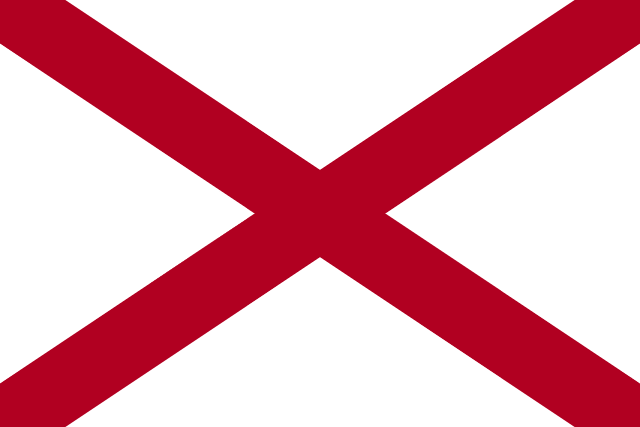
Alabama’s flag is a white field crossed by two crimson diagonal bars, forming the cross of St. Andrew, or saltire. Alabama Code §1-2-5 requires the bars to run diagonally across the flag and to be at least six inches broad. The law does not specify a single numerical outer ratio or a fixed fractional bar thickness. This tutorial separates those legal requirements from practical square and rectangular classroom construction examples.
For the history and symbolism, read our Alabama flag guide.
Construction measurements
| Field | White |
|---|---|
| Device | Crimson diagonal cross |
| Number of crossing bars | 2 |
| Legal minimum bar breadth | 6 inches for a full flag |
| Overall ratio | Not fixed in §1-2-5 |
| Example artwork | 3:2 rectangle; square examples also possible |
Step 1: Choose a rectangular or square drawing area
Alabama’s flag can be recognized through its saltire rather than through a single mandated aspect ratio. The short statutory description establishes a white field, a crimson diagonal cross and a minimum breadth of the bars. It does not give an exact numerical relationship between the height and length of the complete flag.
The reference illustration above is approximately three units long to two units high. For a classroom drawing, use a thirty-centimeter length and twenty-centimeter height. This leaves enough room for the diagonal bands to be drawn with a ruler rather than by eye.
A square study is also useful because the diagonal lines meet the edges at forty-five degrees. For that exercise, make the canvas twenty centimeters high and twenty centimeters long. Label it as a square construction example rather than claiming a universal statutory flag shape.
The basic construction works in both cases. The center lies halfway along the horizontal length and halfway down the vertical height. Draw faint horizontal and vertical guides through the center if you want to check the symmetry of the saltire.
Keep the field white. There is no central emblem, writing or contrasting canton. A pencil outline around the drawing area helps define the white rectangle, but a dark outline should not become part of the completed flag image.
For digital work, create a filled white rectangle of the desired proportions. Avoid applying a decorative border, rounded corners or a shadow to the flag itself. A separate presentation frame can distinguish its white edges on a white page.
In either format, the important visual feature is that the two diagonal bars reach the edges. An X floating entirely inside the white rectangle would not match the description of Alabama’s state flag.
Step 2: Draw the corner-to-corner centerlines
Use a straightedge to connect the upper-left corner to the lower-right corner. Then connect the lower-left corner to the upper-right corner. The two temporary lines should cross at the exact geometric center of the rectangle.
These lines are the centerlines of the red diagonal bands, not their finished outlines. If you simply color the lines with a thin pencil, the result will lack the broad saltire required by the design.
On a square canvas, both diagonals are the same length and cross at right angles. On a three-to-two rectangle, the diagonals are still equal in length and bisect each other, but they do not meet at a right angle. That difference affects how the bars intersect.
For the thirty-by-twenty centimeter rectangle, each diagonal has a length equal to the square root of thirty squared plus twenty squared. That is the square root of 1,300, approximately 36.06 centimeters. The diagonal makes an angle of about 33.69 degrees with the horizontal edge.
The corresponding angle on a square canvas is forty-five degrees. A drawing program’s default forty-five-degree line will therefore not connect opposite corners of the rectangular example. Either enter the correct endpoint coordinates or use a corner-to-corner snap tool.
This is a useful check when reproducing an existing rectangular flag image. The two centerlines should meet at fifteen centimeters from the left and ten centimeters from the top. If they cross elsewhere, at least one line is misplaced.
Leave these guidelines faint and make sure they run right into the corners. Later, the red strips will be clipped by the rectangle, creating the characteristic corner-to-corner arrangement. The final image should not display the guide lines as a different-colored stroke.
Step 3: Understand bar breadth and the six-inch minimum
The legal minimum of six inches is a physical dimension. Six inches equals 15.24 centimeters. It does not mean every small classroom illustration should have red bars fifteen centimeters broad.
A scaled drawing of a full-size flag reduces all dimensions by the same factor. If a model represents a flag forty inches high at a scale of one-tenth, the minimum six-inch bar becomes 0.6 inches on that model. If the artist chooses broader bars on the full-size reference, the scaled bars will be proportionally broader as well.
The breadth of a straight diagonal band is normally measured perpendicular to its centerline. Measuring the distance vertically along the edge of a flag gives a different number. The distinction matters because the bar is slanted.
For a classroom example, choose a perpendicular band breadth of three centimeters on the thirty-by-twenty rectangle. This is an illustrative choice, not a dimension prescribed by the Alabama statute. Mark it clearly in any accompanying construction diagram.
The two boundaries of each band should lie one and a half centimeters to either side of its centerline, measured at right angles to that line. Use a set square to establish the perpendicular directions. Connect corresponding offset marks with parallel lines.
Repeat the process for the other diagonal. The two red strips overlap in the center. Both should use the same chosen breadth so that the saltire appears balanced.
If using a printed reference rather than a newly constructed model, measure the breadth consistently across both diagonal strips. Then scale the whole reference proportionally. The minimum applies to the full flag, while the classroom drawing is a reproduction at a chosen scale.
Do not take an arbitrary red fraction sampled from a thumbnail and call it the official legal percentage. Alabama’s law supplies a minimum physical breadth, not a fixed one-sixth or one-fifth fraction of the flag height.
Step 4: Construct the saltire on a square grid
A twenty-centimeter square provides a useful exercise in diagonal geometry. Mark its corner-to-corner lines. Select a three-centimeter perpendicular breadth for each strip, with boundaries one and a half centimeters from the centerline.
Because the lines are at forty-five degrees, the distance between a corner and the point where one strip boundary meets an adjacent edge is the half breadth multiplied by the square root of two. For this example that is about 2.12 centimeters.
At each corner, mark that distance along the two neighboring edges. The red area around the corner extends to those marks. Draw the corresponding parallel boundaries across the canvas to establish the strip.
For a more precise coordinate construction, name the upper-left corner (0,0) and the lower-right (20,20). The centerline of the first diagonal is y equals x. Its two boundaries have the same slope and are offset by approximately 2.12 centimeters in the vertical direction.
The other centerline follows y equals 20 minus x. Its parallel boundaries use the same offset. Clip both strips to the twenty-by-twenty square.
At the center, the two strips overlap. Color their combined area crimson. Do not erase the intersection to form a white diamond or draw a third red shape on top of it. The saltire is one continuous crossed device.
A vector artist can draw the two centerlines with a three-centimeter-wide stroke and clip them to the artboard. Use extended endpoints or ensure the stroke treatment reaches the corners cleanly. A clipped shape avoids red extending beyond the outer rectangle.
The completed square should exhibit symmetry about both central axes. Folding a paper copy along either centerline should align corresponding red and white regions. This symmetry exercise offers a straightforward way to check the geometry.
Step 5: Construct a rectangular version without changing the diagonal angles incorrectly
Return to the thirty-centimeter-long and twenty-centimeter-high canvas. The descending diagonal has a slope of two-thirds, measured with the vertical coordinate increasing downward. The ascending diagonal has a slope of negative two-thirds.
For a chosen perpendicular breadth of three centimeters, each boundary must be offset one and a half centimeters from the centerline. When expressed as a vertical coordinate difference, the offset is one and a half multiplied by the square root of one plus four-ninths, approximately 1.803 centimeters.
This gives two parallel boundary lines above and below the diagonal. Their vertical separation is approximately 3.606 centimeters, larger than the three-centimeter perpendicular breadth. That difference is expected and does not mean the bar has been drawn too wide.
The corresponding horizontal edge offset from the corner is approximately 2.704 centimeters for this example. The horizontal and vertical offsets differ because the rectangle’s diagonal is shallower than forty-five degrees.
A student does not need to calculate these values to use the drawing method. A set square can mark perpendicular offsets directly. The calculations are useful for checking a precise digital illustration or understanding why a rectangular saltire differs from a square one.
For a raster or vector file, a canvas of nine hundred by six hundred pixels preserves the same proportions. The example three-centimeter bar breadth becomes ninety pixels at that scale. Draw the diagonal strokes with that width, extend them through the corners and clip them within the rectangle.
Do not simply stretch the finished square exercise into a wider shape and then assume its perpendicular strip breadth remains unchanged. Nonuniform scaling changes the angle and measured thickness of a slanted band.
The better method is to construct the diagonal centerlines within the chosen rectangle, then establish their perpendicular widths. This keeps the geometry consistent with the intended reference and prevents a visually uneven cross.
Step 6: Color the saltire and prepare a clean digital or paper image
The statute describes the cross as crimson. Use a red shade consistent with the reference artwork for an educational illustration. The short legal description does not specify a particular RGB triplet or Pantone number, so do not assign an unsupported compulsory color code.
Fill the two diagonal strips, including their intersection, with a single consistent crimson color. Leave the four surrounding regions white. Each white region touches one of the outer sides of the flag between the red corner areas.
For paper, trace the outer boundaries before coloring. Work from the intersection outward to reduce the chance of leaving a narrow uncolored seam. If using a marker, allow the first band to dry before filling the overlap again, because repeated strokes can darken the center.
Cut paper offers another option. Make two long red strips of equal width, cross them on a white rectangle and trim off the portions outside the rectangle. Check the measured breadth before gluing the strips down.
For vector work, use solid filled shapes or clipped strokes. If the two bars overlap, merge their paths or assign identical opaque fill colors. Transparent red strokes can create an unintentionally darker intersection.
Keep the clean flag separate from an annotated version that shows measurements and centerlines. Measurement arrows, labels, diagonal guide lines and color notes are useful in a tutorial, but none is part of the official design.
When reducing the flag for a small icon, preserve the complete aspect ratio and the bar geometry. A small white background with a thin red X may be recognizable but should not replace a properly proportioned reference image in an educational collection.
Distinguish Alabama’s saltire from other red crosses
Florida also uses a red diagonal cross on a white field, but its state flag includes a central seal. That seal is the immediate distinguishing feature when the entire flag is visible. Alabama has no such device in the middle of its saltire.
England’s national flag uses a red upright cross on white. Its bars run horizontally and vertically, not diagonally. A flag that resembles a red plus sign is therefore not the Alabama saltire.
Scotland uses a white saltire on a blue field. The underlying diagonal geometry is related, but the colors are different. The term saltire describes the X-shaped cross, not a particular national identity or color combination.
An unfamiliar historical red saltire may also belong to another flag tradition. The appearance of the cross alone is not enough to date a historical object. Consult the source, location and any accompanying emblem.
Alabama’s design has been discussed in the context of the state’s nineteenth-century history. The existing flag history guide addresses its adoption and competing interpretations of its origins. A geometry tutorial should not present an unverified claim about the intention of the original lawmakers merely because another historical flag has a similar diagonal structure.
The modern legal description is the useful basis for recognition: a white field and a crimson saltire reaching across it. The absence of text, seal and stars is as significant as the presence of the two diagonal bars.
In a state flag quiz, show Alabama and Florida next to each other. Ask students to look at the center before choosing. If the center is obscured in a photograph, explain that the available image may not be enough to distinguish the two.
A measured worksheet and final accuracy checklist
Ask students to draw a thirty-by-twenty rectangle and calculate its center coordinates. Then let them draw the two diagonals and measure their lengths. Both should be approximately 36.06 centimeters.
Provide two different drawing scales, perhaps fifteen by ten centimeters and thirty by twenty centimeters. Choose a reference bar breadth of three centimeters on the larger model. The smaller model should use one and a half centimeters if every dimension is scaled by one-half.
For a physical flag example, ask learners to distinguish the six-inch statutory minimum from the size of a small classroom model. A scale drawing need not contain six-inch-wide bars; the scale represents a larger flag.
Give them a second square drawing and ask why its centerlines meet at right angles while those of the rectangular model do not. This reinforces the relationship between aspect ratio and diagonal angle.
Finally inspect the finished artwork: two red bars, white background, equal chosen breadth, a central crossing and red extending into the corners. Remove all construction marks and make sure there is no center emblem.
For formal manufacture or institutional display, consult the applicable current law and reliable artwork. The sample widths and ratios in this tutorial are explicitly selected for classroom geometry and should not be treated as an additional official specification.
Frequently asked questions
What is the Alabama flag cross called?
A saltire, or cross of St. Andrew.
Does Alabama law specify a fixed aspect ratio?
The cited description does not.
How wide must the bars be?
At least six inches on the flag under the statute; small drawings use a consistent scale.
Does the flag have a seal?
No. The plain crimson saltire on white is the design.
Sources and artwork
Alabama Code §1-2-5, description of state flag
Alabama Department of Archives and History: state facts
Flagpedia: public-domain state flag artwork
Flagpedia/FlagCDN public-domain reference artwork, existing attachment 2132. Original educational calculations; reviewed November 2026.