Dominica Flag: Meaning, Sisserou Parrot, Colors & History
Explore one of the world’s most distinctive national flags: a forest-green field, yellow-black-white triple cross, ten stars and the purple-breasted Sisserou parrot at its center.
What does the Dominica flag look like?
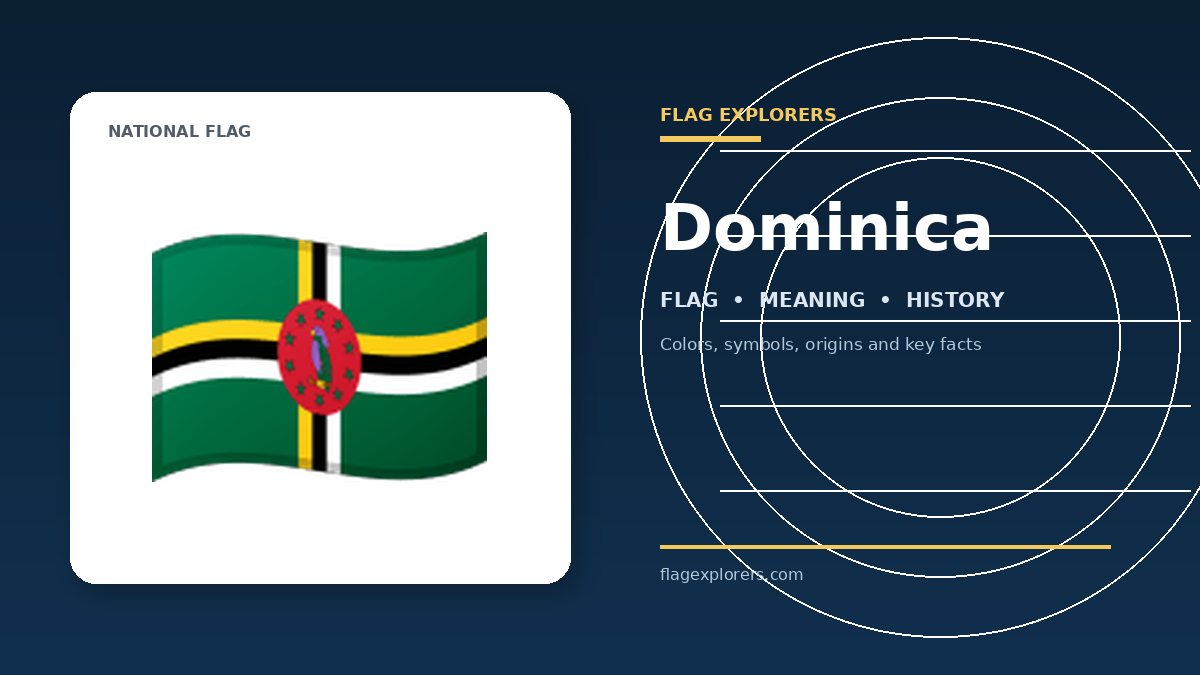
The flag of the Commonwealth of Dominica has a forest-green field crossed horizontally and vertically by narrow yellow, black and white stripes. At the center is a red circular disc containing a Sisserou parrot standing on a twig, surrounded by ten lime-green stars.
What do the Dominica flag colors mean?
The green field, yellow-black-white cross, red disc and purple-breasted Sisserou parrot all carry official symbolism. For the full color meanings, purple-flag context and digital color references, see our Dominica flag colors guide.
Why is there a Sisserou parrot on the flag?
The bird is the Sisserou parrot (Amazona imperialis), widely recognized as Dominica’s national bird and found only on the island. The government calls it the “Pride of Dominica.”
Official symbolism describes the parrot as representing flight toward greater heights and fulfilment of national aspirations. It also appears on Dominica’s coat of arms, public seal and other state symbols.
What do the ten stars represent?
The ten lime-green stars represent Dominica’s ten parishes. Official guidance says they have equal status, symbolizing equality among the people. The star is also described as a traditional symbol of hope.
| Saint Andrew | Saint David |
| Saint George | Saint John |
| Saint Joseph | Saint Luke |
| Saint Mark | Saint Patrick |
| Saint Paul | Saint Peter |
History of the Dominica flag
Dominica adopted its current national flag at independence on November 3, 1978, based on a design by Alwin Bully. Later revisions adjusted details including the cross bands, parrot depiction and stars. For the full chronology, see the history of the Dominica flag.
Why does the Dominica flag contain purple?
The purple comes from the Sisserou parrot at the center of the flag. Dominica is therefore one of the few sovereign national flags to visibly use purple. For the detailed explanation and color references, see Dominica flag colors and purple.
Dominica flag ratio and construction
Official protocol specifies that the flag should be in a 2:1 width-to-height proportion. It also states that the yellow, black and white stripes should be the same size and that the central red emblem should be a circle.
| Ratio | 1:2 height to width |
|---|---|
| Field | Forest green |
| Cross | Yellow, black and white triple stripes |
| Cross stripe widths | Equal |
| Center | Red circle |
| Stars | 10 lime-green stars |
| Bird | Sisserou parrot; purple breast specified by protocol |
How should the Dominica flag be displayed?
The Office of the President publishes protocol for national symbols. No other flag, color, standard, ensign or emblem should be displayed above or to the right of the Dominica flag, meaning the observer’s left when facing the display.
Official etiquette guidance also says the national flag is hoisted first and lowered last when displayed with other flags, and international flags should be placed on staffs of equal height where possible.
Dominica flag FAQ
What bird is on the Dominica flag?
The Sisserou parrot, Dominica’s national bird.
Why are there ten stars?
They represent the ten parishes and their equal status.
Who designed the Dominica flag?
Alwin Bully designed the independence-era flag.
When was the flag adopted?
November 3, 1978, the date of independence.
Does the Dominica flag really use purple?
Yes. Official protocol states that the Sisserou parrot’s breast is purple.
What is the flag ratio?
1:2 height to width.
Is Dominica the same as the Dominican Republic?
No. They are separate countries with entirely different flags.