Aruba Flag: Red Four-Pointed Star, Yellow Stripes & Meaning
Aruba’s blue flag features one white-edged red four-pointed star and two narrow yellow stripes. Discover the design, symbolism and Flag and Anthem Day.
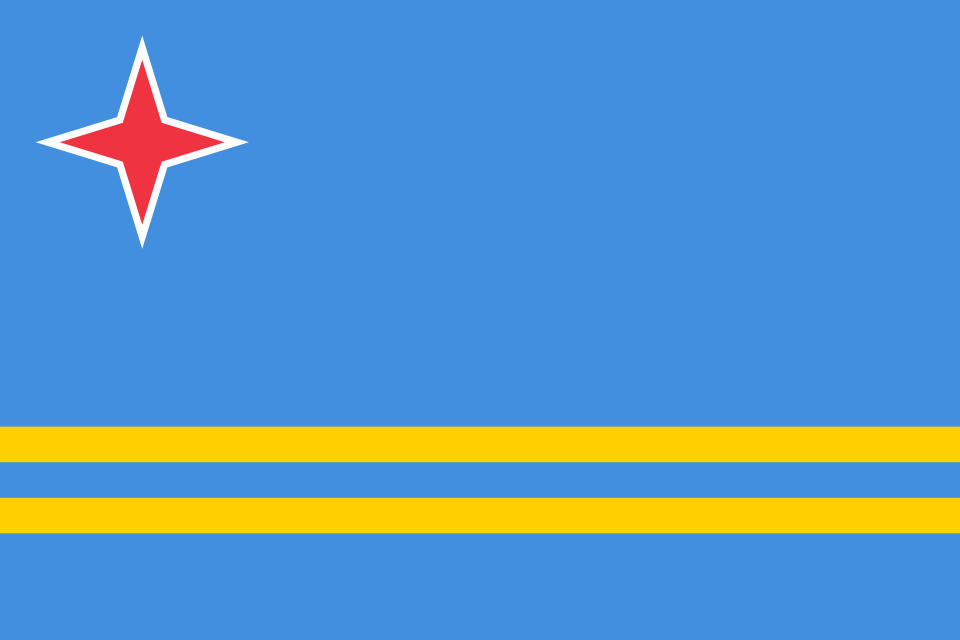
The flag of Aruba is one of the easiest Dutch Caribbean flags to distinguish by its geometry: just one four-pointed red star, outlined white, above two yellow lines. Its colours and shapes are governed by local design standards rather than arbitrary travel-logo styling.
Aruba’s Government national symbols page confirms the flag’s official adoption date, while the Department of Culture’s flag-design guidance supplies construction information. The flag was chosen before Aruba acquired its separate constitutional status in 1986.
Aruba flag at a glance
| Feature | Details |
|---|---|
| Place | Aruba, southern Caribbean |
| Political status | Constituent country of the Kingdom of the Netherlands |
| Capital | Oranjestad |
| Officially introduced | 18 March 1976 |
| Background | Light blue |
| Star | One red four-point star bordered white |
| Other elements | Two narrow parallel yellow stripes |
| Annual celebration | Flag and Anthem Day, 18 March |
These details describe the established flag design. They distinguish its historical adoption from later constitutional changes, and the original island symbolism from popular modern associations.
What does the Aruba flag look like?
The flag consists of a light-blue rectangular field. In its upper-left portion is a single red four-pointed star whose red area has a narrow white border. Across the lower half run two slender, evenly spaced yellow horizontal bands that reach both edges.
It does not have five-pointed stars, a coat of arms, a Union Jack or a broad yellow central band. The exact placement and relative band widths distinguish the official flag from simplified illustrations made for souvenirs.
What does the red four-pointed star represent?
The red star points to Aruba itself, while its four points have traditionally been explained as representing the four cardinal directions and the island’s people and connections from different parts of the world. The white border is commonly associated with the island’s beaches and its distinct identity.
The red has also been linked with Aruba’s red earth and historic local resources. Educational descriptions vary in how much symbolic meaning they assign to each point, so the most dependable facts are its four-point shape, location and surrounding white edge.
Why does Aruba’s flag have two yellow stripes?
The two narrow yellow stripes are a defining feature of Aruba’s flag. Explanations connect yellow with the island’s sunshine and historical economy; widely cited readings mention the earlier importance of gold and other industry and Aruba’s later development.
The exact relationship between each individual line and a single industry should not be stated as a legal requirement unless supported by the government’s text. For recognition, the main point is that Aruba has two yellow lines, unlike Curaçao, which uses one.
What does the blue background mean?
The light-blue field evokes the Caribbean sea and bright open sky surrounding the island. Blue is the dominant colour, with the small red, white and yellow accents standing out clearly.
Do not confuse this with Curaçao’s darker blue background. The official design uses a named blue colour reference, and Aruba’s Department of Culture provides construction and colour specifications for formal use.
When was the Aruba flag adopted?
Aruba’s flag and its official anthem Aruba Dushi Tera were inaugurated on 18 March 1976. The design was approved shortly before the public ceremony, and the day is still celebrated as National Anthem and Flag Day.
This is a different date from 1 January 1986, when Aruba acquired Status Aparte, becoming a constituent country within the Kingdom of the Netherlands. Its flag therefore predates that constitutional change by nearly ten years.
Is Aruba an independent country?
Aruba is one of the four constituent countries of the Kingdom of the Netherlands, together with the Netherlands, Curaçao and Sint Maarten. Aruba has substantial responsibility for its domestic affairs, while Kingdom matters such as defence and foreign relations are governed within the Kingdom framework.
This status differs from that of Bonaire and Saba, which are public bodies or special municipalities of the Netherlands. Having an individual flag does not make all six Dutch Caribbean islands constitutionally equivalent.
Aruba vs Curaçao and Bonaire flags
The Curaçao flag has two white stars on dark blue and a single yellow line. The Bonaire flag has diagonal yellow, white and blue areas with a black compass and red six-pointed star. Aruba instead has a red four-pointed star and two yellow horizontal lines.
The number of stars and lines provides a quick way to distinguish the ABC islands: Aruba has one red star and two stripes, Curaçao has two white stars and one stripe, and Bonaire has one six-pointed star within a compass.
How to draw and identify the Aruba flag
Start with a light-blue rectangle. Add a red four-pointed star in the upper-left corner, surrounded by a slim white outline. Then draw two narrow yellow horizontal stripes across the lower part of the flag, leaving blue between and beneath them.
Do not use a five-pointed white star, or add the entire coat of arms. In a flag quiz, the combination of a red four-pointed star bordered white and two yellow lines on light blue identifies Aruba.
Frequently asked questions
What is the star on the Aruba flag?
One red four-pointed star with a narrow white border.
Why are there two yellow stripes?
They are part of Aruba’s official design, commonly associated with local sunshine and historical economic activity.
When did Aruba adopt its flag?
18 March 1976.
What happens on March 18 in Aruba?
Flag and Anthem Day celebrates Aruba’s flag and the anthem Aruba Dushi Tera.
Is Aruba’s flag the same as Curaçao’s?
No. Aruba has a red four-pointed star and two yellow stripes; Curaçao has two white stars and one yellow stripe.
Is Aruba independent from the Netherlands?
Aruba is a self-governing constituent country within the Kingdom of the Netherlands, not a separate sovereign state.
Does Aruba’s flag have a coat of arms?
No. The usual flag has a star and two stripes, not the national coat of arms.
What colour is the background?
Light blue, with red, white and yellow details.
Official references and image credit
Government of Aruba — National symbols
Aruba Department of Culture — Official flag construction
Aruba Tourism Authority — Flag of Aruba
Netherlands Government — Kingdom’s four countries
Image is rendered from the Wikimedia Commons vector of the Aruba flag. Wikimedia Commons, original design credited Whitney Smith, vector by Wester. Public-domain simple-geometry flag rendering; governmental symbol protections may still apply.
Illustration provided for independent educational identification; no government endorsement is implied. Research reviewed November 2026.