Bonaire Flag: Red Six-Pointed Star, Compass & Colors
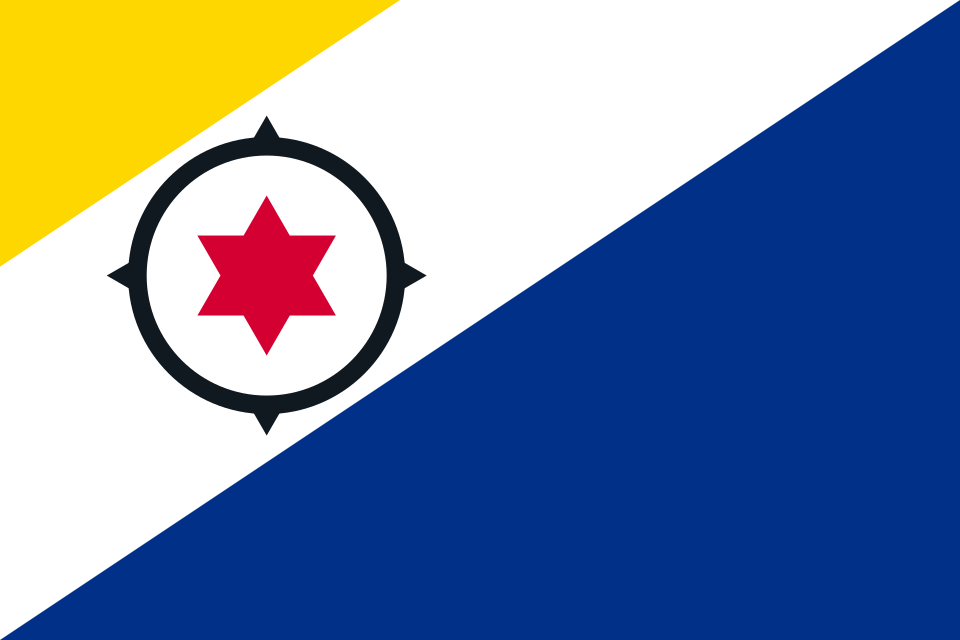
Bonaire’s flag uses a black compass rose around a red six-pointed star in a white diagonal stripe, with yellow and blue for the sun and sea.
Bonaire is a Caribbean island and a public body or special municipality of the Netherlands. Its flag is highly distinctive among Dutch Caribbean flags because its main design is diagonal, rather than a simple horizontal bicolour or a star on plain blue.
The Intangible Cultural Heritage Bonaire explanation documents the compass and six historic residential areas; Bonaire’s visitor information site explains the overall design and its use.
Bonaire flag at a glance
| Feature | Details |
|---|---|
| Place | Bonaire, Caribbean Netherlands |
| Status | Public body/special municipality of the Netherlands |
| Administrative centre | Kralendijk |
| Flag ordinance | 11 December 1981 |
| Flag in official use | 15 December 1981 according to local heritage sources |
| Colours | Yellow, white, blue, red and black |
| Central symbol | Black compass rose and red six-point star |
| Star points | Six historic Bonaire residential areas |
These details describe the established flag design. They distinguish its historical adoption from later constitutional changes, and the original island symbolism from popular modern associations.
What does the Bonaire flag look like?
The flag is divided diagonally, from the yellow triangle at upper-left through a broad white stripe to a blue triangle at lower-right. In the white section sits a circular black compass rose, and within it a red six-pointed star.
The central black ring is not a steering wheel from the coat of arms, although related nautical symbolism appears on both. The flag’s diagonal pattern is what distinguishes it from Curaçao and Aruba at a distance.
Why does Bonaire’s flag have a six-pointed red star?
The six points are commonly identified with six traditional areas of residence: Kralendijk, Nikiboko, Tera Kòrá, Antriol, Nort’i Saliña and Rincon. The red colour has been explained in relation to the islanders’ spirit, survival and historical determination.
The symbol is not the Star of David and the points should not automatically be interpreted as a religious reference. Here the number six has a specific island-geography interpretation in the local heritage account.
What does the black compass mean?
The black compass rose refers to navigation and seafaring. Bonaireans have a long maritime tradition, and the circular device with directional points emphasizes their connection with the waters around the island.
A compass rose is different from a six-pointed star, even though they overlap graphically. The centre includes a red star inside the black directional frame. Reproductions that show only one black wheel or only a red six-pointed star are incomplete.
What do Bonaire’s yellow, white and blue colours represent?
The yellow upper section represents the sun, the blue lower section the sea and the white diagonal band peace and liberty in local explanations. These meanings are especially appropriate for an island with a strong connection to maritime trade and the natural environment.
The black and red of the central emblem add historical and community symbolism. In a flag quiz, the five-colour combination is more distinctive than the individual yellow or blue fields, which appear on many Caribbean flags.
When was Bonaire’s flag adopted?
The island flag ordinance is dated 11 December 1981. Some local sources give 15 December 1981 as the day of establishment or entry into use. Both dates appear in reputable references because they describe related stages of the original legal process.
The 1981 flag predates Bonaire’s later transition in 2010 from the Netherlands Antilles to a public body within the Netherlands. A constitutional change does not automatically change an existing local flag.
Is Bonaire an independent country?
Bonaire is not one of the four constituent countries of the Kingdom of the Netherlands. Since 10 October 2010, it has been a special municipality/public body of the Netherlands in the Caribbean.
This differentiates Bonaire from Aruba and Curaçao, which are constituent countries. They may be geographically grouped as the ABC islands, but their legal arrangements are not identical.
When is Bonaire Day celebrated?
Bonaire Day (Dia di Boneiru) is marked on 6 September, an important local celebration of history and culture. The flag appears prominently on government offices, in community events and at ceremonies.
Do not confuse this day with the original December 1981 flag ordinance. The celebration of local identity and the exact legal establishment of a flag can fall on different dates.
Bonaire vs Aruba and Curaçao flags
Aruba uses a light-blue field with a white-edged red four-pointed star and two yellow lines. Curaçao uses dark blue with two white five-pointed stars and one yellow stripe. Bonaire uses one red six-pointed star inside a compass and diagonal areas.
The three flag styles make an excellent identification exercise for the ABC islands. Compare the number of star points, whether a compass is present and the direction of the main colour boundaries.
How to draw the Bonaire flag correctly
Draw a horizontal rectangle. Add a small yellow triangular area toward the upper-left and a large blue triangular area toward the lower-right, leaving a wide white diagonal band. In the central band draw a black compass circle with four directional indicators and a red six-pointed star inside.
Do not turn the central star into a red five-pointed emblem or move the white stripe to a vertical orientation. The unique diagonal arrangement and nautical compass identify Bonaire.
Frequently asked questions
Why does Bonaire’s flag have a six-pointed star?
Its six points refer to six traditional residential areas of Bonaire.
What does the black compass rose mean?
Navigation, seafaring skill and Bonaire’s maritime identity.
When was the Bonaire flag adopted?
The island ordinance is dated 11 December 1981; local heritage references give 15 December for establishment or use.
What do yellow, white and blue represent?
The sun, peace/liberty, and the sea respectively.
Is Bonaire a country?
No. It is a special municipality or public body of the Netherlands.
What makes Bonaire different from Aruba’s flag?
Bonaire has a diagonal design and six-pointed star in a compass; Aruba has two yellow stripes and a four-pointed red star.
When is Bonaire Day?
6 September.
Is the central ring a bicycle wheel?
No. It is a black compass rose containing the red star.
Official references and image credit
Intangible Cultural Heritage Bonaire — The Flag
Bonaire.com — Flag colours and symbolism
Government of Bonaire — Bonaire Day
Flags of the World — Bonaire legal adoption dates
Image is rendered from the Wikimedia Commons vector of the Bonaire flag. Public-domain vector by Mike Rohsopht, Wikimedia Commons, drawn from Bonaire’s 1981 ordinance. Official symbols may have separate legal protections.
Illustration provided for independent educational identification; no government endorsement is implied. Research reviewed November 2026.