Norfolk Island Flag: Green-White-Green & Norfolk Pine Meaning
Norfolk Island’s flag has a deep-green Norfolk Island pine between two green vertical bands. Learn its botanical meaning and official 1980 proclamation.
Norfolk Island lies in the southwest Pacific between Australia, New Zealand and New Caledonia. It is an Australian external territory with a local flag that is much simpler than Australia’s blue, star-filled national flag.
The Australian Government’s official symbols entry identifies the central tree and gives the exact date of proclamation. The design is easy to reproduce as a colour layout, but the tree is a specific botanical symbol rather than an arbitrary triangular evergreen.
Norfolk Island flag at a glance
| Feature | Details |
|---|---|
| Place | Norfolk Island, southwest Pacific |
| Status | Australian external territory |
| Main settlement | Kingston |
| Official proclamation | 11 January 1980 |
| Field | Green-white-green vertical tricolour |
| Symbol | Norfolk Island pine |
| Scientific name | Araucaria heterophylla |
| Flag type | Local territory flag, not a sovereign national flag |
These facts distinguish the flag’s official design from its heraldic origins, regional traditions or separate constitutional status. Use the references below if reproducing the flag for institutional purposes.
What does the Norfolk Island flag look like?
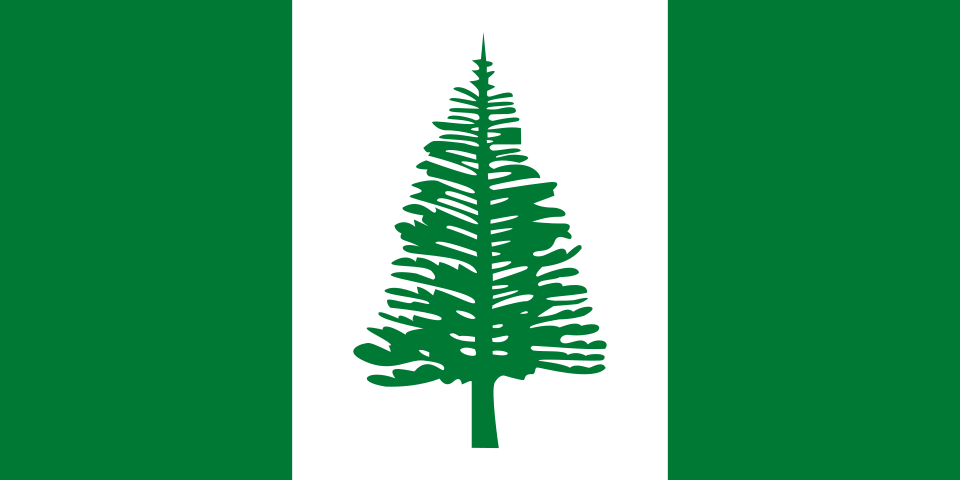
The flag is divided into three vertical panels of green, white and green. The central white area is bordered by two dark-green sections and contains a single green Norfolk Island pine. No stars, stripes, text or shield are present.
The simple arrangement makes it unusually easy to recognize in small flag icons. If a green pine appears on white between two solid green bands, the flag is likely Norfolk Island rather than a British Overseas Territory ensign.
What is the tree on Norfolk Island’s flag?
The tree is the Norfolk Island pine, Araucaria heterophylla, an evergreen conifer native to the island. It is famous for a tall, symmetrical silhouette with branches arranged in tiers, a form reflected in many flag illustrations.
Despite the everyday word ‘pine,’ it is not a true pine of the genus Pinus. It belongs to the family Araucariaceae. This botanical distinction helps explain why it is an especially specific symbol rather than a generic evergreen tree.
What do green and white represent?
The flag pairs a prominent green native tree with two matching green outer panels. The green suggests Norfolk Island’s abundant vegetation and distinctive conifer landscape, while the white centre provides clear visual contrast for the tree.
The Australian Government’s official symbols guide primarily records the design and the tree species. Additional claims that each panel legally represents a particular religious community or political division are not substantiated by that official description.
When did Norfolk Island adopt its flag?
The Norfolk Island flag was officially proclaimed on 11 January 1980. The Australian Government gives the date in both its symbol booklet and flag timeline.
The design has remained recognizable since that proclamation. It is important not to conflate the flag’s 1980 adoption with later changes to Norfolk Island’s internal administrative arrangements or constitutional status.
Why does Norfolk Island have a flag separate from Australia’s?
Norfolk Island is an Australian external territory, with its own history, culture and distinctive natural environment. The local pine-tree flag provides an emblem for that place.
The Australian national flag remains the sovereign-state flag, while Norfolk Island’s banner identifies the island community. A territory having its own local flag does not imply that it is a separate independent country.
How is the Norfolk Island pine recognized?
The species is known for its column-like shape, whorled horizontal branches and tapering upper crown. On the flag, the foliage and branching are simplified to form a distinctive tree silhouette that can be reproduced without showing individual needles.
Pines planted in parks and along coasts around the world are sometimes called Norfolk Island pines because they come from this island’s species. On the flag, however, the tree primarily identifies the island itself and its native flora.
Norfolk Island vs Christmas Island flags
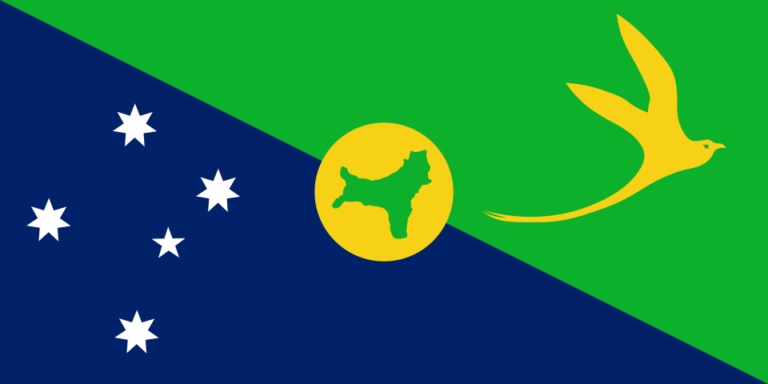
Christmas Island’s flag uses green and blue diagonal fields, a yellow golden bosun bird, white Southern Cross stars and a yellow disc with an island outline. Norfolk Island uses only green and white and a single pine tree.
Both territories are administered by Australia, but the difference in design reflects distinct environments: a recognizable native tree for Norfolk Island and combined bird, sea, constellation and mining-related symbols for Christmas Island.
How to draw and identify the Norfolk Island flag
Draw a rectangle and divide it into three vertical bands. Colour the left and right sections dark green. Leave the central section white, and draw a symmetrical green Norfolk Island pine centred within it, with a straight trunk and tiered branches.
Avoid using a palm tree, Christmas tree decorated with ornaments or a golden bosun bird. The identification clue ‘green-white-green vertical stripes with a pine tree’ refers to Norfolk Island.
Which other flags use a tree?
Tree emblems also appear on the flags of Lebanon and other regions, but Norfolk Island’s single green conifer on a white middle panel is distinctive. Lebanon uses a cedar with broad green-white-red horizontal bands, a different layout and tree species.
The safest way to identify tree flags is to compare background direction, number of colours and tree silhouette, rather than treating every green tree emblem as the same flag.
Frequently asked questions
What tree is on the Norfolk Island flag?
The Norfolk Island pine, Araucaria heterophylla.
When was the flag proclaimed?
11 January 1980.
What colours does it use?
Green and white, with green vertical outer panels and a white centre.
Is the tree a true pine?
No. Norfolk Island pine is an araucarian conifer, not a member of the genus Pinus.
Why does Norfolk Island have its own flag?
It is an Australian external territory with its own local identity and symbols.
Does the flag include the Union Jack?
No. It is a green-white-green flag with a central tree.
Is Norfolk Island the same as Christmas Island?
No. They are separate Australian external territories with completely different flag designs.
Can I use a generic Christmas tree silhouette to represent the flag?
For accuracy use the distinctive, tiered Norfolk Island pine design shown in official references.
Official sources and illustration credits
Australian Government — The symbols of Norfolk Island
Australian Government — Australian flag timeline
Australian Government — State and territory flags
The displayed PNG was rendered from the Wikimedia Commons vector: Norfolk Island flag. Flag artwork via Wikimedia Commons/Open Clip Art Library, public-domain CC0 version; not to be confused with the Cocos Islands’ separately copyrighted design.
The drawing is supplied for educational flag identification. It does not imply official endorsement. Content reviewed November 2026.