Curaçao Flag: Two White Stars, Yellow Stripe & Meaning
Curaçao’s dark-blue flag has a yellow stripe and two differently sized white stars. Learn what they stand for and why the island’s flag predates its 2010 country status.
Curaçao is a southern Caribbean island with a flag built around just three colours: dark blue, bright yellow and white. At a glance it resembles Aruba in its blue-and-yellow palette, but the two white stars make Curaçao instantly distinguishable.
The flag is defined by the Curaçao flag ordinance that came into effect on 2 July 1984. The Government of Curaçao’s legislation collection and the official holiday guide confirm the legal and commemorative context.
Curaçao flag at a glance
| Feature | Details |
|---|---|
| Place | Curaçao, Caribbean Sea |
| Status | Constituent country of the Kingdom of the Netherlands |
| Capital | Willemstad |
| Flag adopted | 2 July 1984 |
| Background | Dark blue |
| Stripe | One horizontal yellow band below centre |
| Stars | Two white five-pointed stars |
| Star meanings | Curaçao and Klein Curaçao |
These details describe the established flag design. They distinguish its historical adoption from later constitutional changes, and the original island symbolism from popular modern associations.
What does Curaçao’s flag look like?
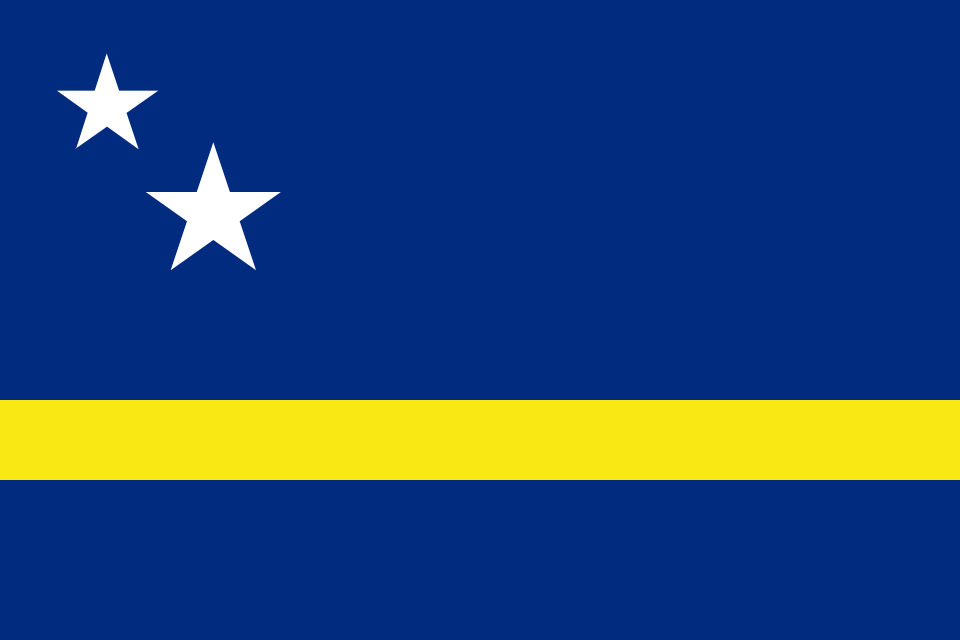
The flag is dark blue with a relatively narrow yellow band crossing the entire width just below the central line. Two white five-pointed stars sit above that stripe near the hoist. The larger star is below and to the right of the smaller one.
A precise description of the official layout gives the vertical band proportions as 5:1:2 from top to bottom. That is not the same as centring the yellow band, using two yellow stripes or placing two stars on equal horizontal levels.
What do the two white stars symbolize?
The larger white star represents the main island of Curaçao; the smaller white star represents the nearby small island of Klein Curaçao. They do not represent two present-day political countries.
Both are five-pointed. Traditional flag explanations associate those five points with the five inhabited continents from which Curaçao’s multicultural population draws its roots. The geographic and cultural readings complement rather than replace each other.
What do the blue and yellow colours represent?
The upper blue section recalls the sky, the lower blue section the surrounding Caribbean Sea, and the yellow horizontal stripe the island’s sunshine. These interpretations appear consistently in official and specialist educational descriptions.
The dark blue is different from Aruba’s lighter blue. The single yellow stripe symbolizes sunlight rather than representing a road or the border between independent states. In the flag’s proportions, a broad expanse of blue remains above the yellow.
When did Curaçao adopt its flag?
Curaçao’s flag was adopted on 2 July 1984, while the island was part of the former Netherlands Antilles. The same date is observed as Flag and Anthem Day and is listed among Curaçao’s official public holidays.
That history matters because on 10 October 2010 Curaçao became a separate constituent country within the Kingdom of the Netherlands, but it did not need to invent a new flag on that date.
Who designed the Curaçao flag?
The design was chosen through a local process to create a separate island flag. Histories commonly credit the work of Martin den Dulk, with the modern star and stripe design adopted after public deliberation in the early 1980s.
The legally prescribed geometry is more reliable than souvenir images with shifted stars or different stripe placement. When producing a printable version, start with a verified official flag file rather than redrawing it solely from a tiny icon.
What is Klein Curaçao, the smaller star?
Klein Curaçao, Dutch for ‘Little Curaçao’, is a small uninhabited island off Curaçao’s southeastern coast. Its smaller star shows how the flag represents the island group geographically even though only the larger island contains the main population centre.
Klein Curaçao is not a separate constituent country of the Kingdom. This is why the two stars should not be explained as a political division between two governments.
Curaçao vs Aruba and Bonaire flags
The Aruba flag has one red four-pointed star bordered white and two yellow horizontal stripes on lighter blue. Curaçao has two white five-pointed stars and one yellow stripe on dark blue.
The Bonaire flag uses a diagonal colour layout with one red six-pointed star inside a black compass. The three ABC islands have related geography, but their flag designs and political statuses are not identical.
How to draw and identify Curaçao’s flag
Draw a dark-blue horizontal rectangle. Add one narrow yellow band running across the width below the middle, leaving more blue above than below. In the upper-left blue area, draw two white five-pointed stars: a smaller one above-left and a larger one below-right.
For a quiz, the phrase ‘two white stars, one yellow stripe, dark blue‘ identifies Curaçao. Avoid duplicating Aruba’s two stripes or adding a red star.
Frequently asked questions
Why are there two stars on Curaçao’s flag?
The larger star represents Curaçao and the smaller Klein Curaçao.
What do the five points of the stars represent?
They are traditionally linked to five continents from which Curaçao’s population has roots.
When did Curaçao adopt its flag?
2 July 1984.
What is the yellow stripe for?
The yellow band symbolizes the sunshine over Curaçao.
Is Curaçao’s flag the same as Aruba’s?
No. Curaçao has two white stars and one yellow stripe; Aruba has one red star and two yellow stripes.
Does the flag mark Curaçao’s 2010 autonomy?
No. Its adoption predates the 2010 constitutional change by 26 years.
Is Klein Curaçao inhabited?
It is a small island with no permanent resident population.
Where is the yellow band positioned?
Below the middle, producing official blue-yellow-blue vertical proportions of 5:1:2.
Official references and image credit
Government of Curaçao — Flag legislation collection
Government of Curaçao — Flag and Anthem Day
Flags of the World — Curaçao flag history and specification
Netherlands Government — Constitutional structure
Image is rendered from the Wikimedia Commons vector of the Curaçao flag. Vector by David Benbennick, Wikimedia Commons. The simplified flag artwork is public-domain geometry; legal rules for official insignia may still apply.
Illustration provided for independent educational identification; no government endorsement is implied. Research reviewed November 2026.