American Samoa Flag: Eagle, Meaning, Colors and History
Explore the bald eagle, traditional Samoan symbols, flag history and differences from the flag of independent Samoa.
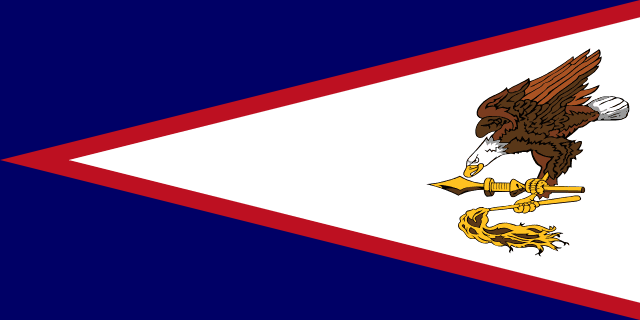
American Samoa’s flag is dark blue with a red-edged white triangle and a bald eagle carrying traditional Samoan symbols of authority. Introduced in 1960, it brings together the territory’s relationship with the United States and its Polynesian heritage. This guide explains how to identify it, understand its history and distinguish it from the flag of independent Samoa.
What does the American Samoa flag look like?
The American Samoa flag has a dark blue field and a large white triangle that narrows to a point at the hoist. A red band separates the triangle from the blue areas. Inside the white space, toward the fly end, an American bald eagle carries two objects associated with Samoan leadership.
The direction of the triangle is one of the design’s most useful identification clues. On an ordinary front-facing illustration with the pole on the left, the broad end of the white shape is on the right. Its point extends toward the pole, creating two blue sections above and below it. This is the opposite arrangement from a flag with a triangle extending outward from the hoist.
The bird is not a small central seal. It occupies a substantial part of the broad white area, where the lighter background makes its head, wings, claws and the objects it carries visible. Its head faces toward the hoist in the usual front view. The position of the eagle contributes to the balance of the design: the red-edged geometric shape leads the eye toward the pole while the larger illustration anchors the other end.
When identifying the flag in a photograph, begin with the large shapes rather than the fine details. The red-edged white triangle against a blue background is easier to recognize at a distance than the individual feathers or the items in the eagle’s claws. Move on to those details once you have narrowed down the possible flags.
The flag has a relatively long rectangular appearance. The illustration used on this page is twice as wide as it is high, but other reference drawings and manufactured flags can use slightly different proportions. A digital illustration’s dimensions are not by themselves proof of a legally prescribed ratio.
American Samoa flag facts at a glance
| Jurisdiction | American Samoa (U.S. territory) |
|---|---|
| Flag introduced | April 1960 |
| Annual Flag Day | April 17 |
| Main colors | Blue, white and red |
| Main emblem | Bald eagle carrying a club and fly whisk |
| Visual reference ratio | 1:2 in the image on this page |
| Geographic region | South Pacific, Oceania |
The year 1960 is important because it marks the introduction of a distinct territorial flag. It should not be confused with the earlier establishment of American administration in the eastern Samoan islands. A history question may ask about either event, and the answers are separated by several decades.
The main design combines geometric areas and a naturalistic emblem. In flag terminology, the field is the background, the hoist is the side nearest the flagpole, and the fly is the outer side. These terms make it possible to describe the design without relying on a picture being displayed in a particular orientation.
American Samoa is part of the United States’ insular areas, rather than a separate sovereign nation. Its territorial flag belongs to the same broad category of local governmental flags as those of Guam and the U.S. Virgin Islands. That does not imply that those territories have identical histories or systems of local government.
For research projects, record the year of introduction and the date of the annual Flag Day separately. This is especially helpful when consulting old newspapers, photographs or constitutional timelines, which may describe an announcement, ceremony or legal event using different dates.
What do the colors mean?
Red, white and blue dominate the flag. The combination makes the connection with the United States recognizable, but those colors are also present in the national flag of independent Samoa. This dual association is more informative than treating every color as an isolated symbol with a single universal meaning.
Blue forms the upper and lower areas of the design. It contrasts with the central white shape and creates a relatively simple background for an otherwise detailed flag. Dark blue fabric can appear almost black in a photograph taken against the sun, so identification should not depend on judging the exact shade from a single image.
The red edging provides a clear separation between the white triangle and the blue field. On a small icon, the border is one of the features that should remain visible even if the eagle is simplified. If the red is omitted, the resulting image loses part of the distinctive overall composition.
White provides the background for the eagle. Brown, white, yellow or gold, and darker details in the illustration give the bird and its attributes a recognizable form. These secondary artwork colors should not be counted as additional bands in a description of the flag’s main color arrangement.
Some sporting and specialist flag manuals supply digital or printing color values for their own purposes. These can be useful for consistent reproductions, but a palette from an event manual should not automatically be described as a binding territorial law. This guide uses the visual reference from a documented public-domain flag illustration and does not invent official color codes.
For an educational color exercise, compare the flag to another red, white and blue design without considering the eagle at first. The main difference is how the colors are arranged, not simply which colors are present. Identifying a flag by its palette alone is rarely reliable when several jurisdictions use the same combination.
Why is there an American bald eagle on the flag?
The bald eagle is the element that most directly signals American Samoa’s relationship with the United States. It also makes the flag distinct from the national flag of neighboring Samoa, where the principal emblem is a group of stars rather than an eagle.
There is a useful comparison with the Great Seal of the United States. In both designs a prominent eagle carries objects in its claws. The American Samoa flag does not copy the federal seal: it replaces the familiar federal attributes with objects from Samoan culture and places the eagle within a different geometric setting.
This is a particularly effective visual example of how a local flag can express more than one identity. The bird supplies an American association, while the objects it carries refer to institutions and customs that existed in Samoa independently of the establishment of American territorial government.
The illustration should be understood as a symbolic representation rather than a guide to the island’s wildlife. A bald eagle appears because of its political and heraldic associations. The presence of a species on a flag does not establish that it is a native animal of the place represented.
In detailed reproductions, the head and the white tail help distinguish the bald eagle from other stylized birds. Its wings and the arrangement of the two attributes are important when checking whether a proposed image accurately follows the reference design. A generic eagle clip-art image is not an adequate substitute for the specific flag artwork.
The Samoan club and fly whisk explained
The eagle carries a traditional club and a fly whisk, commonly identified in flag references as the fa’alaufa’i or uatogi and the fue. English descriptions differ in the terminology applied to the club, so it is worth retaining the local names when discussing the design.
The club refers to leadership and authority in traditional Samoan society. Its appearance on the flag is historical and symbolic. It should not be mistaken for the arrows depicted on the federal Great Seal, nor should it be replaced with an unrelated object when making an illustration.
The fue has a different association. It is a fly whisk, an object that has a practical use but also carries significance in formal Samoan life. The National Park Service illustrates its connection with the tulafale, or talking chiefs, who use it in the context of speechmaking. Understanding that role makes the small detail on the flag more intelligible.
Traditional leadership in Samoan communities includes the matai system, and oratory has an important place within it. The two attributes on the flag invite a broader discussion about how authority is expressed through established customs as well as through written laws and modern governmental institutions.
It would be misleading to describe the club and whisk simply as decorative accessories added to an American eagle. They are a key part of the design’s local meaning. Cover them in an image and the bird still signals an American connection, but much of the distinctively Samoan symbolism becomes less apparent.
In a classroom, use an enlarged detail of the flag when introducing the two objects. Ask students to match the objects to the words club and fly whisk, then discuss why a community might use familiar cultural objects rather than an abstract emblem to communicate identity. This gives the activity an objective beyond memorizing the flag’s colors.
History of the American Samoa flag
The Samoan archipelago shares a long Polynesian cultural history. The present political division of the islands is much more recent than the settlement of the region. Understanding that distinction prevents the modern flags of Samoa and American Samoa from being mistaken for evidence of two unrelated cultural traditions.
At the end of the nineteenth century, international agreements divided the interests of foreign powers in the archipelago. The eastern islands became associated with the United States. Local deeds of cession followed, beginning with Tutuila and Aunu’u in 1900 and the Manu’a group in 1904.
April 17, 1900 is remembered for the raising of the United States flag on Tutuila. The American flag subsequently represented the territory under United States administration. The date belongs to the history of the Stars and Stripes in the islands, not the first appearance of the modern eagle-and-triangle territorial design.
During the twentieth century the framework of local administration developed further. Administrative oversight moved from the U.S. Navy to the Department of the Interior in 1951. The following decade saw developments in local government that provide the setting for the introduction of a distinct flag.
A specialist design reference traces the flag to a student design competition in 1959 and credits Uinifareti Rapi Sotoa. This attribution is useful when researching the creative history, though it should be distinguished from the formal process by which the final artwork was selected and introduced.
The new territorial design appeared in 1960. A contemporary report in Pacific Islands Monthly describes the introduction of a flag alongside constitutional developments. The American Samoa Humanities Council’s historical timeline also provides context for those events.
Many references associate the first flag ceremony with April 17, 1960, the sixtieth anniversary of the earlier flag raising. Other flag references cite April 27 or another April date. The constitutional timeline itself distinguishes effective dates and formal promulgation, so the safest general historical statement is that the territorial flag was introduced in April 1960.
The design remains recognizable as the combination of the American eagle and Samoan symbols established in that period. Its historical importance lies partly in the way it presents a distinct local identity without abandoning the visual association with the United States.
What is American Samoa Flag Day?
Flag Day is observed on April 17 in American Samoa. The Department of the Interior describes the holiday as commemorating the historic raising of the American flag over Tutuila and Aunu’u in 1900. It is therefore a different observance from the United States national Flag Day on June 14.
The territorial flag introduced in 1960 has become part of this commemoration. The anniversary offers an opportunity to display the two flags and recognize the relationship between the islands and the United States, together with local cultural traditions.
Readers researching a particular year’s celebrations should consult the American Samoa Government’s current proclamations and event announcements. Public programs, locations and schedules may change from year to year. The recurring date of the holiday does not guarantee that every associated event occurs on the same day.
For a history lesson, draw a timeline with the 1900 flag raising on one end and the introduction of the territorial flag sixty years later on the other. Add the annual commemoration as a recurring event rather than treating it as another change in design. The resulting timeline makes the relationship between the two dates much clearer.
American Samoa flag vs Samoa flag
Despite their similar names, American Samoa and Samoa have visibly different flags. The independent country of Samoa has a predominantly red flag, with a blue rectangle in the upper hoist corner containing five white stars. Those stars depict the Southern Cross.
American Samoa instead uses blue as the main field color, a large white triangle bordered in red and a bald eagle. The two designs share red, white and blue but organize them in entirely different ways. Neither should be used as a substitute for the other on a map or in a country flag collection.
The political distinction matters as much as the visual one. Samoa is an independent country; American Samoa is a United States territory. Both belong to the Samoan archipelago and share cultural connections. The modern political boundary should not be used to imply that the cultural heritage on either side is completely separate.
When identifying a small flag icon, check whether it has a blue upper corner with stars or a broad white area containing a bird. That simple comparison usually resolves the confusion even when the image is too small to make out every detail.
Another useful comparison is Guam. Guam’s territorial flag also contains a large blue field and red details, but its red border runs around the entire perimeter and a pointed emblem depicts a coastal landscape. American Samoa’s red band follows diagonal edges, and its eagle occupies the white triangular area.
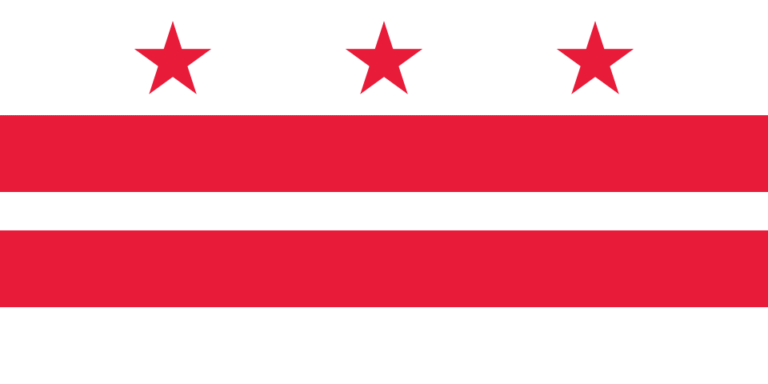
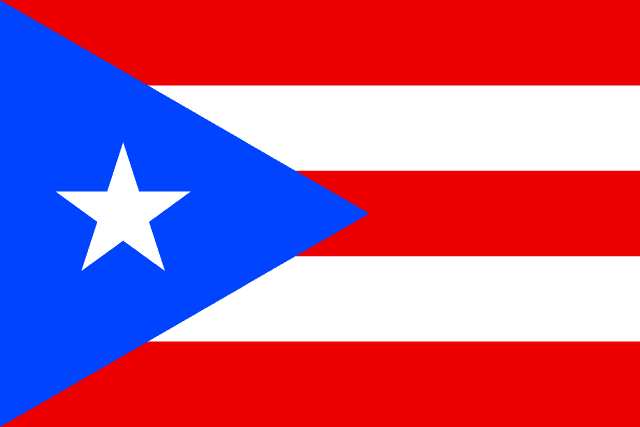
Puerto Rico and Washington, D.C. also use red, white and blue or red and white in their flags. Their broad stripes and stars are quite different from the fly-based triangle of American Samoa. These comparisons show why geometry is often a more reliable clue than color when sorting flags into a collection.
How to draw American Samoa’s flag
For a simple school illustration, draw a rectangle measuring twenty centimeters wide and ten centimeters high. These dimensions match the proportions of the public-domain illustration on this page and are convenient for a drawing exercise; they are not presented as a universal legal manufacturing specification.
Mark the middle of the left edge. From near that point, sketch the upper and lower diagonal lines that extend toward the right corners. Leave room for the narrow red band that separates the white area from the two blue fields. Use a ruler for the long straight edges, and compare the exact shape with the reference image before coloring.
Fill the two outer regions in dark blue. Make the diagonal border red and leave the central triangular area white. Do not place the point at the right edge: the usual front-facing design points toward the left-hand hoist.
Reserve the broad right-hand portion of the white area for the eagle. For a detailed drawing, study the reference at a larger size, concentrating first on the outline of the bird and then on the head, wings and claws. The club and the fly whisk should remain recognizable as different objects.
Younger students may find the eagle easier to reproduce by using an enlarged printed outline of a rights-cleared flag illustration. They can color the large geometric areas first and work on the smaller details afterward. Label simplified drawings as classroom interpretations rather than exact official reproductions.
Check the finished drawing against three criteria: the direction of the white triangle, the red border between white and blue, and the position of the eagle. If all three are correct, the flag should be readily distinguishable from Samoa’s star-bearing flag. For a more advanced exercise, compare the reverse side of a fabric flag with the standard front-facing illustration and discuss why the design appears mirrored.
Using the flag in geography and educational collections
A flag collection should tell readers what kind of entities it includes. If it contains only sovereign countries, American Samoa can appear in a separate territory section. If it covers places and jurisdictions worldwide, it can be listed alongside other Pacific territories with its status clearly identified.
When planning a United States flag worksheet, put American Samoa in a territorial flags group rather than adding it as a fifty-first state. The distinction can be reinforced by a second activity matching each territory to its location on a map.
In an Oceania lesson, American Samoa can be grouped with nearby islands geographically while retaining its territorial label. These two organizational approaches are complementary, not contradictory. Geography describes the location of the islands, whereas the territorial classification describes their political relationship.
The flag is useful in a lesson about symbols because the eagle and the two Samoan attributes represent different historical associations within one image. Students can compare this approach with other flags that combine inherited colors, a locally meaningful emblem and an administrative identity.
Use a documented image for educational materials and retain its source information when distributing a worksheet. An official-looking illustration should not imply sponsorship or government endorsement. The flag reproduced here is for independent educational reference, with a public-domain artwork source identified below.
Frequently asked questions
Is American Samoa’s flag the same as Samoa’s?
No. American Samoa uses an eagle and a red-edged white triangle; Samoa uses a red field with a blue canton containing five white stars.
When was American Samoa’s flag introduced?
April 1960. Some references differ on the precise date.
What does the eagle carry?
A traditional Samoan club and a fly whisk, or fue.
When is American Samoa Flag Day?
April 17, commemorating the 1900 raising of the United States flag.
Is American Samoa a U.S. state?
No. It is a United States territory.
Which way does the triangle point?
Toward the hoist, the pole side of the flag.
Sources and image credit
U.S. Congress, Our Flag — Territorial flag history and symbols.
U.S. Department of the Interior, American Samoa — Territorial history and deeds of cession.
National Park Service, People — Samoan leadership and community customs.
National Park Service, Stories — Talking chiefs and the fue.
American Samoa Humanities Council historical timeline — Constitutional and flag history.
U.S. Flags Design — Design attribution, geometry and variation.
Flags of the World — Alternative historical dates and flag references.
American Samoa Government proclamations — Annual Flag Day recognition.
U.S. Geological Survey flag reference — Public-domain flag reference.
Flagpedia artwork source — Public-domain image used in this guide.
Reviewed November 2026. Image: existing FlagExplorers media attachment 2084, credited to Flagpedia/FlagCDN as public domain. This is an independent educational guide.