Guadeloupe Flag: Black Sun, Sugar Cane & Fleur-de-Lis Meaning
The familiar Guadeloupe local flag shows a golden sun, green sugar cane and three fleurs-de-lis. Find out which flag is legally official and what the symbols mean.
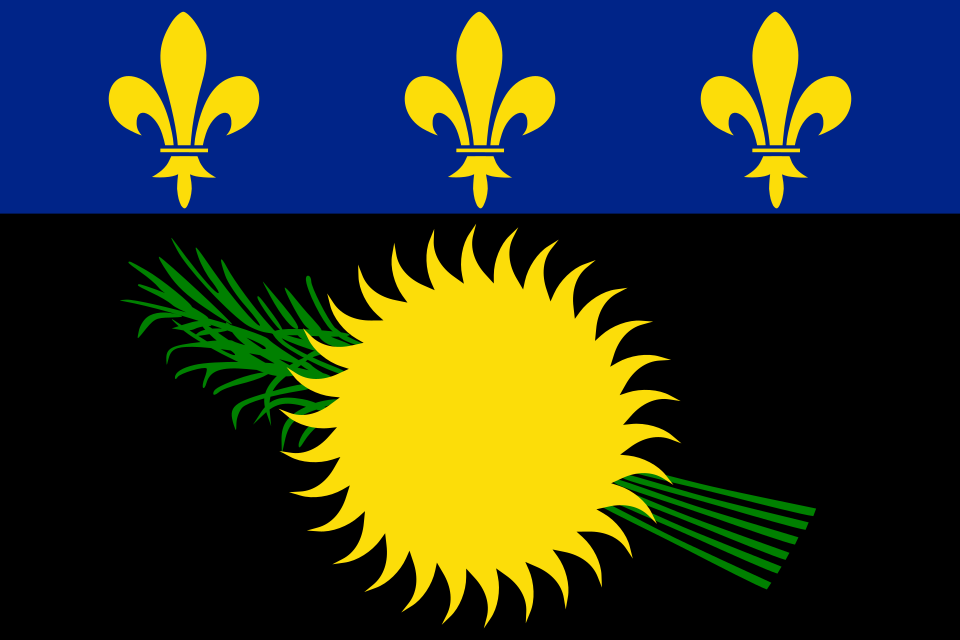
Guadeloupe is an overseas department and region of France in the Caribbean. A search for ‘Guadeloupe flag’ frequently produces a gold sun on black, but that image must not be confused with France’s national tricolour or with a legally adopted independent-country flag.
The blue-and-black design is one of several regional identity symbols. The specialist Guadeloupe flag register records variations, and contemporary Guadeloupe flag guidance distinguishes the French official flag, local sun-and-cane flag and other proposals.
Guadeloupe flag at a glance
| Feature | Details |
|---|---|
| Place | Guadeloupe, Caribbean |
| Constitutional status | Overseas department and region of France |
| Official national flag | French blue-white-red tricolour |
| Featured illustration | Unofficial local sun-and-cane flag |
| Top band | Blue with three yellow fleurs-de-lis |
| Main field | Black with golden sun |
| Vegetal motif | Green sugar-cane leaves |
| Other designs | Regional council banners and political movement flags |
French overseas territories may have well-known local emblems alongside France’s official tricolour. Symbolism, local display and constitutional legal status should be kept distinct; the references below indicate which type of flag is discussed.
What does the Guadeloupe sun-and-cane flag look like?
The top of the flag has a horizontal blue band with three gold fleurs-de-lis. Under it is a much larger black field, centred on a broad gold or yellow sun and green sugar-cane stalks or leaves. Artwork of the sun and plant may vary slightly between renderings.
The familiar local design is not a French tricolour with a badge inserted. Nor is it the independence movement’s red-yellow-green banner. Identifying which Guadeloupe design a photograph shows is a useful first step before discussing its symbolism.
What does the golden sun represent?
The radiating golden sun evokes the island’s tropical environment, warmth and place in the Caribbean. It contrasts sharply with the black field, making the motif highly recognizable even when the flag is seen at a distance.
Some interpretations link the light of the sun with hope or vitality. These are conventional symbolic readings rather than a colour code set out in a national Guadeloupe flag law. The practical visual clue is the circular sun on black.
Why is sugar cane on the Guadeloupe flag?
The sugar-cane plant points to an agricultural crop that profoundly shaped Guadeloupe’s economic and social history. Sugar plantations were central to the colonial economy, including the exploitation and enslavement of Africans who worked in that system.
This makes the motif historically layered: it is about more than tropical scenery or tourist agriculture. A responsible explanation should acknowledge sugar’s connection with slavery and plantation labour rather than presenting sugar cane as an entirely uncomplicated emblem of prosperity.
What do the three fleurs-de-lis mean?
The three golden fleurs-de-lis on blue echo historic French royal heraldry, visible in many traditional French arms and local emblems. They link the design to the island’s French historical connections.
The fleur-de-lis should not be described as a star, a tropical blossom chosen in modern times or a symbol of three municipalities. Its origins in European heraldry distinguish it from the sun and cane, which refer more directly to the Caribbean setting and its economic history.
Which flag is officially used in Guadeloupe?
Guadeloupe is part of the French Republic. The legally official national banner is therefore the French tricolour, flown at state buildings and in national institutional contexts.
The sun-and-cane design is often called the Guadeloupe flag in travel resources, flag collections and local displays, but that does not give it the same legal status as the French flag. Separately, the Guadeloupe Regional Council has used its own institutional branding and banners.
What other Guadeloupe flags may appear online?
Alongside the black sun-and-cane design, there are variants featuring a red field under a blue fleur-de-lis band, regional institutional banners, and red-yellow-green flags associated with Guadeloupean independence movements. They represent different historical or political uses.
A web image that simply says ‘flag of Guadeloupe’ may hide these distinctions. The regional council’s logo on a white field should not be presented as the same artwork as the sun-and-cane flag, nor should a movement flag be labelled politically neutral without explanation.
Guadeloupe vs Martinique flags
The Martinique flag now widely shown for local cultural identity is red, green and black with a red hoist triangle, adopted by its territorial assembly in 2023. Guadeloupe’s commonly displayed local flag is black and blue, with a large gold sun, sugar cane and fleurs-de-lis.
Both are French Caribbean territories, but their local symbols have different histories and institutional roles. Neither flag should be confused with the sovereign national flag of France.
Is Guadeloupe an independent country?
No. Guadeloupe is a French overseas department and region, represented in the institutions of the French Republic and integrated into the European Union as an outermost region.
The local flag is an expression of identity and history, not evidence of independent international sovereignty. The distinction matters for maps, classroom worksheets and reference databases: the symbol people associate with a place is not always its legally official national flag.
How to identify or draw the local Guadeloupe design
Draw a rectangular black field topped by a narrower blue stripe. Place three yellow fleurs-de-lis along that stripe. Below draw a large yellow sun and green sugar-cane leaves at its base.
Label the illustration ‘unofficial local flag of Guadeloupe’ rather than ‘official national flag’. For a flag quiz, the combination of black sun-and-cane motif and blue fleur-de-lis band points to Guadeloupe.
Frequently asked questions
What is the official flag of Guadeloupe?
The French national blue-white-red tricolour; Guadeloupe is part of France.
Is the black sun flag official?
It is a recognizable local but unofficial Guadeloupe flag.
What is the yellow sun for?
It refers to the island’s tropical climate and is commonly associated with light and vitality.
What do the green leaves mean?
They depict sugar cane, a crop deeply connected with Guadeloupe’s colonial and economic history.
Why are there three fleurs-de-lis?
They echo historic French royal heraldry.
Are the red-yellow-green and black-sun flags identical?
No. They are separate designs with different political or local associations.
Is Guadeloupe an independent country?
No. It is a French overseas department and region.
What is different about Martinique’s flag?
Martinique’s adopted local cultural flag is red, green and black with a red triangle.
References and illustration credits
Flags of the World — Guadeloupe local flags and variations
Guadeloupe flag reference — Official and local designs
Wikimedia Commons — Unofficial flag (local), historical artwork
PNG derived from the Wikimedia Commons source for the Guadeloupe local flag. Drawing by Pierre Gay, uploaded by Denelson83 via the xrmap flag collection; Commons marks the simple design public-domain/ineligible for copyright. Displaying it does not establish governmental status.
Flag images are provided for educational comparison, without claiming any association with governmental authorities. Research checked November 2026.