Saint Pierre and Miquelon Flag: Yellow Ship, Basque & Breton Symbols
The blue flag of Saint Pierre and Miquelon shows a yellow sailing ship and three small regional banners. Learn the Basque, Breton and Norman historical connections.
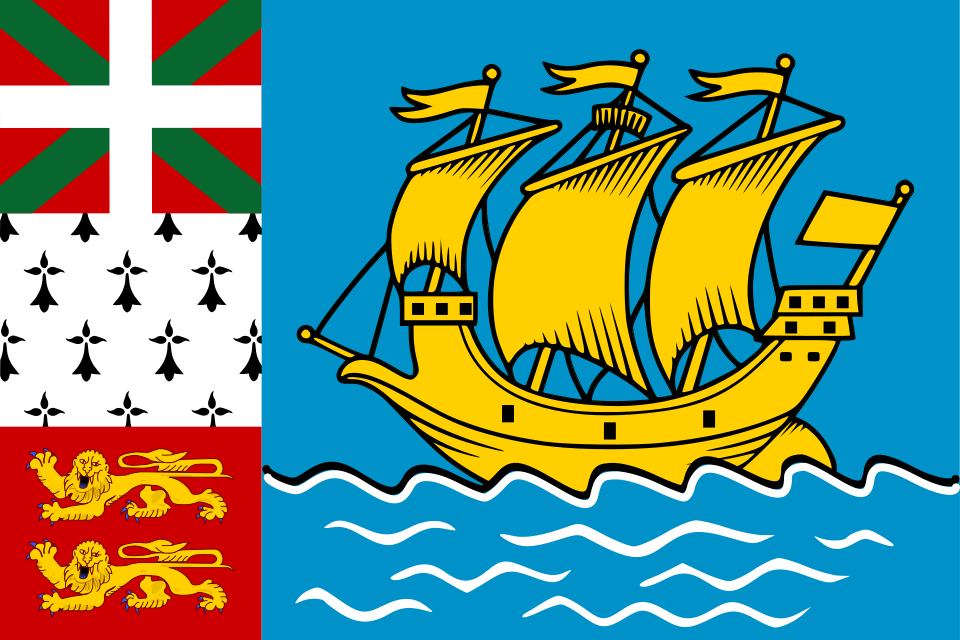
Saint Pierre and Miquelon is a small French overseas collectivity just south of Newfoundland, Canada. Its commonly photographed local flag tells a story about the archipelago’s seafaring past and links with regions of France and the Basque Country.
The specialist flag record and the Commons flag history identify the three regional patterns and the ship. The illustration is often described as an unofficial local flag that became prominent around 1982.
Saint Pierre and Miquelon flag at a glance
| Feature | Details |
|---|---|
| Place | Saint Pierre and Miquelon, southwest of Newfoundland |
| Constitutional status | French overseas collectivity |
| Official national flag | French tricolour |
| Featured banner | Unofficial local flag |
| Main field | Blue with golden sailing ship |
| Hoist top | Basque flag (Ikurriña) |
| Hoist middle | Breton ermine design |
| Hoist bottom | Norman two-lion banner |
| Approximate introduction | 1982 |
French overseas territories may have well-known local emblems alongside France’s official tricolour. Symbolism, local display and constitutional legal status should be kept distinct; the references below indicate which type of flag is discussed.
What does the local Saint Pierre and Miquelon flag look like?
Most of the flag is blue with a large yellow three-masted ship above white or light-blue stylized waves. Along the hoist side is a narrow column divided into three small panels: the Basque flag, a Breton ermine field, and a Norman red banner with two golden lions.
This composition is unusually detailed for a local territorial flag. The regional symbols are not three country flags on separate flagpoles: they are deliberately arranged in one vertical panel to reflect the archipelago’s different historical cultural ties.
What is the yellow ship on the flag?
The golden ship is traditionally identified with La Grande Hermine, a vessel used by Jacques Cartier during his 1535–1536 voyage. It represents the region’s long history of European navigation, fishing and settlement in the northwest Atlantic.
Cartier’s expeditions were part of French exploration in North America, but it would be wrong to use this emblem to claim that the modern banner was flown aboard his ship. The present local flag is much more recent, with historic imagery chosen retrospectively.
Why is there a Basque flag at the hoist?
At the top of the narrow hoist column is the Ikurriña, with a red field, green diagonal saltire and white cross. It represents important Basque seafaring and fishing connections in the archipelago’s history.
The Basque Country is a cultural and historical region in the western Pyrenees spanning parts of today’s France and Spain. Its flag here refers to that heritage, not to Saint Pierre and Miquelon becoming part of a sovereign Basque state.
What do the black ermine symbols represent?
The middle panel displays Breton ermine spots on white. Ermine is a traditional emblem of Brittany in northwest France and is visible on Breton heraldic flags and arms.
Breton sailors and settlers contributed to the identity of Saint Pierre and Miquelon. The ermine panel is therefore a cultural clue about origin and ancestry rather than a drawing of the small local wildlife of the islands.
What do the two golden lions represent?
The lower panel is red with two golden lions, a long-recognized symbol of Normandy. Together with the Basque and Breton panels, it summarizes the historical contributions of several seafaring and coastal populations.
The two lions should not be confused with the three lions on the royal arms of England. Regional heraldic symbols can look similar while referring to different places and histories.
Is this local flag official?
The French tricolour is the official national flag for Saint Pierre and Miquelon. The golden-ship flag is widely described in specialist references as a traditional or unofficial local banner, despite its extensive popular use.
Some sources call the design ‘semi-official’, which reflects customary or institutional display rather than an independent-country national-flag statute. When using it in a database, the safest label is unofficial local flag of Saint Pierre and Miquelon.
When did this local banner come into use?
The commonly used ship-and-region design is generally dated to around 1982. Its elements are much older—Cartier’s voyage in the sixteenth century and historic Basque, Breton and Norman heraldry—but the single composite flag is a relatively modern creation.
The date should not be misreported as a 1536 official adoption. As with many regional flags, traditional motifs and modern flag designs have different timelines.
Is Saint Pierre and Miquelon part of Canada?
No. The islands lie close to Newfoundland and Labrador, Canada, but they form a French overseas collectivity. French is the official language and France’s national flag is used for state purposes.
Its geographic location explains strong Atlantic maritime connections and why this cluster is catalogued under North American flags. A location on the North American continental shelf does not automatically make the islands part of the Canadian federation.
Saint Pierre and Miquelon compared with other French territories
The Guadeloupe local flag features a sun, sugar cane and fleurs-de-lis. Martinique’s local flag is red–green–black, while Réunion’s commonly used flag has a red volcano with yellow rays.
Saint Pierre and Miquelon stands apart through its yellow ship and three ancestral regional flags. The distinct symbols explain how French overseas regions can share the French national flag while having very different local identities.
How to draw or identify the local flag
Draw a blue rectangle. Add a large yellow sailing ship above stylized waves in most of the field. On the left, place a narrow vertical column containing the Ikurriña at top, Breton black ermine on white in the middle and Norman two golden lions on red at the bottom.
For accurate reproduction, use a credited vector of the composite flag; the tiny regional symbols are hard to draw from memory. Label the result ‘unofficial local flag’ to distinguish it from France’s tricolour.
Frequently asked questions
Which flag is official in Saint Pierre and Miquelon?
The French tricolour. The golden-ship composite flag is widely used locally but is not the sovereign national flag.
What is the ship on the local flag?
It is commonly identified as La Grande Hermine, associated with Jacques Cartier’s 1535–1536 voyage.
What are the three flags at the left?
Basque, Breton and Norman cultural emblems.
What does the Breton panel show?
Black ermine spots on white, an emblem of Brittany.
What do the two golden lions signify?
Normandy, a historic region of France.
When was the local design introduced?
It is generally dated to around 1982.
Are the islands part of Canada?
No. They are a French overseas collectivity near Newfoundland.
Is the flag’s ship HMS Bounty?
No. HMS Bounty is associated with the Pitcairn Islands, not this local North Atlantic flag.
References and illustration credits
Flags of the World — Saint Pierre and Miquelon
Wikimedia Commons — Saint-Pierre and Miquelon local flag and history
Saint Pierre and Miquelon — French Prefecture
PNG derived from the Wikimedia Commons source for the Saint Pierre and Miquelon local flag. Artwork attributed to André Paturel, subsequent digital modifications by Denelson83 and Commons contributors; Commons describes this graphic as a public-domain derivative. Subject to separate heraldic use considerations.
Flag images are provided for educational comparison, without claiming any association with governmental authorities. Research checked November 2026.