Nunavut Flag: Red Inuksuk, Blue North Star & Meaning
Why does Nunavut’s flag have a red inuksuk, blue star, and yellow-and-white background? Explore Inuit navigation, the design by Andrew Qappik and the 1999 creation of Canada’s newest territory.
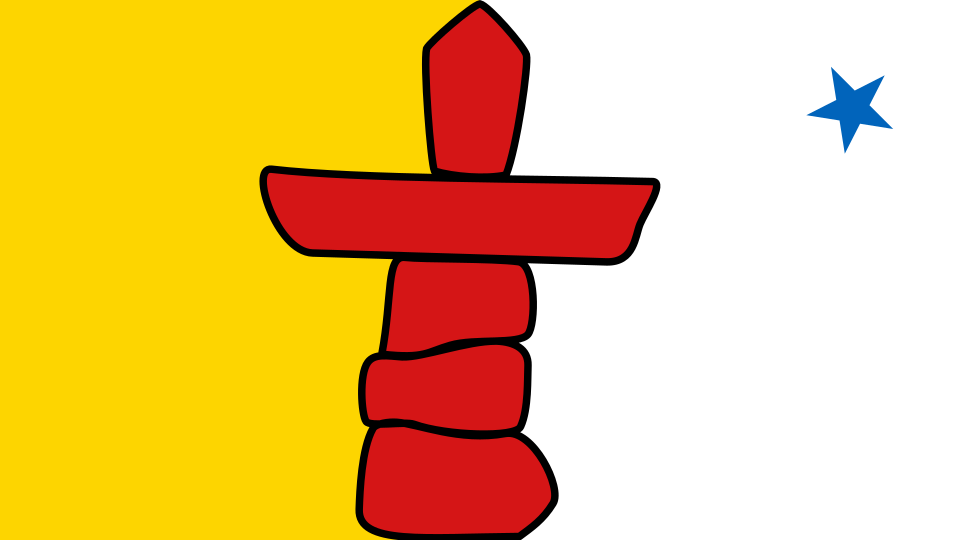
Nunavut’s flag is instantly distinctive among Canadian provinces and territories. A red stone structure stands against a yellow-and-white field, and one blue star appears high on the right. The visual language is closely connected with Inuit knowledge of the Arctic landscape.
The Nunavut Legislative Assembly explains the inuksuk and star and credits Andrew Qappik of Pangnirtung with the flag design. Canadian Heritage and the Canadian Heraldic Authority confirm the date: April 1, 1999, the day Nunavut formally became a separate Canadian territory.
This guide distinguishes Nunavut’s Inuit-centered official flag from banners of other northern territories. It also explains what an inuksuk is and why the North Star is more than a decorative five-pointed symbol.
Nunavut flag at a glance: red inuksuk and one blue star
Two major background colors divide the field vertically: golden yellow by the flagpole and white toward the fly. A large red inuksuk occupies the center division, with a blue star on the white upper-right area. The flag’s symbolism links land, sky, navigation and Nunavut’s place in Canada.
| Feature | What to know |
|---|---|
| Territory | Nunavut, Canada (capital Iqaluit) |
| Adopted | April 1, 1999 |
| Designer | Andrew Qappik, Pangnirtung |
| Hoist field | Gold/yellow |
| Fly field | White |
| Central symbol | Red inuksuk |
| Upper-right symbol | Blue North Star / Niqirtsuituq |
| Gold, white and blue | Riches of land, sea and sky |
| Red | Connection with Canada |
What is the red inuksuk on Nunavut’s flag?
An inuksuk is a stone structure created by Inuit and other people of the Arctic for purposes that can include guiding travel, marking routes, indicating significant sites or communicating information in a landscape with few trees. Different traditional arrangements can have different purposes.
On Nunavut’s flag, the central red inuksuk expresses guidance, landmarks and special places. The Nunavut Legislative Assembly specifically describes these functions, grounding the symbol in Inuit knowledge of the land.
Inuksuit (the plural of inuksuk) are not interchangeable with every human-shaped stack of stones. Traditional structures vary in form and purpose. The stylized device on the flag is an official emblem, not a precise drawing of one named stone monument that all communities use.
Does inuksuk mean a human-shaped statue?
The word and cultural concept are broader than that popular description. A stone landmark does not have to look exactly like a human body to be an inuksuk. Another term, inunnguaq, is often used for a figure made to resemble a person. The flag’s stylized central emblem is commonly described in official sources as an inuksuk.
Why is there one blue star in the upper-right?
The blue star represents Niqirtsuituq, the North Star, also called Polaris. In northern travel and navigation, it has long been a useful point of reference because its position is close to Earth’s north celestial pole.
The Legislative Assembly also explains the star as a symbol of the leadership of elders. This adds a social and cultural dimension: guidance is not only about the physical direction of travel, but about the knowledge and experience passed between generations.
The flag shows a single blue star in the upper-right area, not a constellation of five stars as on several Australian Blue Ensigns. The Nunavut star should not be identified as a European Union star or one of Canada’s provinces.
When drawing the flag for a quiz, a blue star high on the white fly field is one of the three essential elements, along with yellow-white background and red inuksuk.
What do yellow, white, blue and red symbolize?
The official explanation connects yellow (gold), white and blue with the richness of Nunavut’s land, sea and sky. The colors work as a group representing the Arctic environment, rather than a strict diagram assigning one separate element to every horizontal zone.
The red inuksuk also marks Nunavut’s connection with Canada, according to Canadian Heritage and the Nunavut Legislative Assembly. Red is a familiar color of the national Canadian maple-leaf flag, although Nunavut’s own flag is not based on a red ensign.
The precise orientation matters: viewed from the front with the flagpole at left, gold is on the left and white on the right. The inuksuk lies at their division, with the blue star within the white field.
Do not reverse the background colors or move the star into the yellow half in an educational representation claiming to show the official design.
Who designed the Nunavut flag?
The Nunavut Legislative Assembly credits Andrew Qappik, an Inuit artist from Pangnirtung, with the design. The flag emerged from a broader process of selecting public symbols for the new territory, involving consultation and development of imagery that reflected Inuit culture and the northern environment.
This matters because Nunavut’s red inuksuk and North Star were chosen specifically in connection with its identity, rather than adopted unchanged from a European colonial ensign or a medieval royal coat of arms.
Some accounts discuss collaboration among artists and the Canadian Heraldic Authority during the development of the flag and territorial arms. Crediting Qappik as the official flag designer does not mean those broader contributions should be erased; it is the attribution used by the Nunavut legislature.
What happened on April 1, 1999?
Nunavut was officially established as a Canadian territory on April 1, 1999, following a lengthy political and land-claims process. Its creation divided the former Northwest Territories into new administrative territories and gave Nunavut a government centered in Iqaluit.
The flag was granted and adopted on the same date. This makes 1999 both a key constitutional and symbolic milestone. The territory’s name, Nunavut, is commonly translated from Inuktitut as “our land.”
Canadian Heritage describes the land-claims agreement and the central role of Inuit advocacy in the territory’s creation. The history should not be reduced to a story that a new flag alone created Nunavut; the banner accompanied a broader settlement of longstanding self-government and land-rights issues.
Other Canadian provinces and territories adopted their flags at different times. For example, Yukon’s flag passed a territorial ordinance in 1967 and took effect in 1968, decades before Nunavut’s establishment.
How does the design reflect Inuit knowledge?
The inuksuk and North Star are related symbols of guidance and orientation in a northern environment. Inuksuit can mark routes or important places on land, while the North Star serves as a celestial reference. Their inclusion gives the flag a distinct cultural context rooted in Inuit relationships with the Arctic.
The star’s additional meaning—the guidance of elders—emphasizes community knowledge. It would be incomplete to describe the star only as an astronomical object without the official cultural explanation.
Nunavut’s official emblems also include a coat of arms with additional objects, including a qulliq, the traditional Inuit lamp. Those elements are related but should not be inserted into the separate territorial flag, which has only the large red inuksuk and blue star on the yellow-white field.
The flag is a civic symbol for the entire territory, but its design’s Inuit provenance and terminology deserve accurate pronunciation, spelling and context.
Nunavut vs. Yukon, Canada and other territorial flags
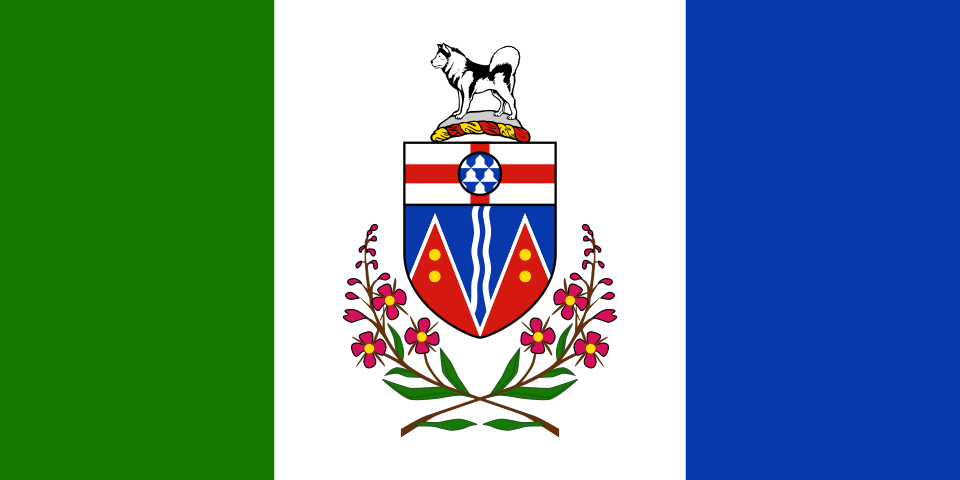
Nunavut uses a red inuksuk and blue North Star against yellow and white. Yukon uses vertical green, white and blue stripes with a territorial coat of arms and fireweed plants. The two flags are visually distinctive once those identifying symbols are recognized.
Canada’s national flag has a red maple leaf on white between red outer bands. Nunavut’s flag includes red as a connection to Canada but does not copy its maple leaf design. It expresses separate territorial identity within the same country.
A third Canadian territory, the Northwest Territories, uses a blue-white-blue vertical layout with a central heraldic shield. Its emblem is different from both Nunavut’s inuksuk and Yukon’s fireweed. For a classroom activity, identify these flags by center device rather than by their shared northern geography.
How to draw and identify the Nunavut flag
Draw a horizontal rectangle with a golden-yellow left half and a white right half. On the boundary draw the distinctive red inuksuk, a stone-like vertical form with a broad crosspiece. Add one blue star in the upper-right of the white area.
Use the official emblem as a guide rather than drawing any arbitrary rock pile. The red inuksuk should be the central element and the blue star should be clearly separated from it. There is no Union Jack, lion, coat-of-arms shield or maple leaf on the standard Nunavut flag.
A simple identification exercise asks which flag features a red inuksuk, the northern landmark, and the North Star: it is Nunavut, not Yukon or another Canadian province.
Frequently asked questions
What does the red symbol on Nunavut’s flag mean?
It is an inuksuk, a stone landmark associated with navigation and important places in Inuit traditions.
What is the blue star?
Niqirtsuituq, the North Star, signifying navigation and elders’ guidance.
What do the colors mean?
Gold, white and blue evoke the riches of land, sea and sky; red refers to Canada.
Who designed the Nunavut flag?
Inuit artist Andrew Qappik of Pangnirtung.
When was the flag adopted?
April 1, 1999, the day Nunavut became a Canadian territory.
Which side is yellow?
Yellow is at the hoist, left when viewed from the front; white is at the fly.
Is Nunavut a province?
No. Nunavut is one of Canada’s three territories.
Is the stone symbol an inuksuk or a person?
The official flag identifies it as an inuksuk, a traditional stone marker; not every inuksuk is human-shaped.
Is the same star on Yukon’s flag?
No. Yukon displays a coat of arms and fireweed on green-white-blue panels, not the blue North Star on a yellow-white field.
Official references and illustration credits
Nunavut Legislative Assembly — The Flag of Nunavut
Canadian Heraldic Authority — Territory of Nunavut
Canadian Heritage — Nunavut Symbols
Nunavut Legislative Assembly — Coat of Arms
Flag drawing imported from Wikimedia Commons and rendered from SVG as a PNG. Please check the original file’s creator and reuse license before redistributing. Comparison illustrations are from the credited Wikimedia Commons flags already used in linked FlagExplorers guides.
Official symbols may have specific institutional use requirements independent of copyright. Factual references reviewed November 2026.