Alabama State Flag: Crimson Cross & Meaning
The current Alabama state flag explained with a clear picture, historical context, design details and tips for identification.
Alabama state flag at a glance
| Detail | Answer |
|---|---|
| State | Alabama, United States |
| Adoption and updates | February 16, 1895 |
| Key feature | Why Alabama’s flag is a simple crimson diagonal cross |
| Image source | Flagpedia / Wikimedia Commons |
What does the Alabama state flag look like?
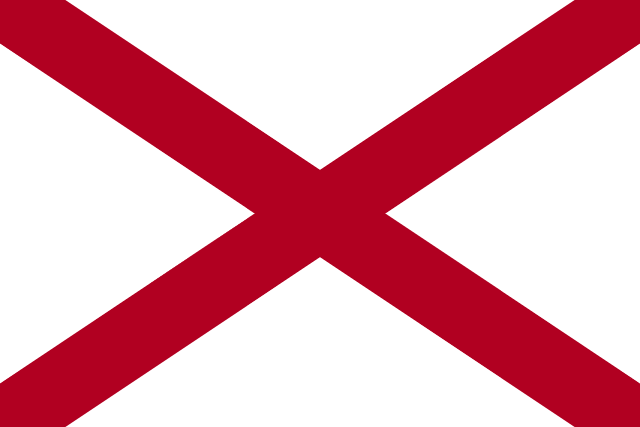
Alabama’s flag is a white rectangle crossed from corner to corner by two broad diagonal crimson-red bands. The design is a saltire, often called a St. Andrew’s cross. It has no central state seal, stars, inscriptions or vertical red stripe.
What do the symbols on Alabama’s flag mean?
The crimson saltire is the essential legally specified figure. The 1895 act calls for a crimson cross of St. Andrew on a field of white. Some later explanations assign symbolic virtues to the colors or point to similarities with Confederate banners, but such readings must be distinguished from the narrow wording of the law.
The most important details to notice
Alabama’s flag often gets mistaken for Florida’s because both use red saltires on white. Florida places its full-color state seal at the center, while Alabama’s two diagonal bands cross uninterrupted. The presence or absence of the circular seal is the quickest test.
When was the Alabama flag adopted?
Alabama adopted its recognizable saltire flag in 1895. Alabama had earlier emblems and flags during the Civil War, and the diagonal cross has been discussed in connection with Confederate battle-flag imagery and heraldic traditions. The surviving statutory description by itself does not establish one comprehensive interpretation of every design choice.
Why this design matters to Alabama’s history
Alabama’s design is unusually spare by American state-flag standards. Its official law gives a geometric form rather than a series of figures or phrases, making the flag easy to recognize even at very small sizes. The saltire is associated broadly with St. Andrew, but explanations about Civil War symbolism should take account of the specific act, timing and historical debate rather than claiming a single undisputed origin.
Colors, proportions and how to draw the flag
Draw a rectangle on a white page. From each corner run a broad crimson band diagonally across to the opposite corner, making a symmetrical X. Do not add text, a blue rectangle, or a center seal; that would turn it into a different flag.
For a classroom printout, keep the original aspect ratio of the official image instead of stretching it to fill a convenient box. Use a high-resolution or vector-derived source for detailed emblems. Commercial reproductions and governmental displays may require stricter specifications than educational illustrations, particularly where colors, lettering, dimensions or the seal artwork are defined by law.
How to identify Alabama in a state-flag quiz
Look for a complete crimson X across white. There is no vertical stripe, no blue square, no eagle and no lettering. This simplicity helps in a quiz: if you can see a small central state seal, you are likely looking at Florida rather than Alabama. A vertical red cross would suggest a different design again, so the diagonal orientation is important.
How is Alabama’s flag different from other U.S. state flags?
Florida is Alabama’s closest visual comparison. Its red diagonal arms run behind a detailed circular state seal, while Alabama’s uninterrupted saltire meets in the middle without additional artwork. Tennessee also uses red prominently, but with a blue circle containing three stars. The shape and placement of symbols distinguish these flags more reliably than color alone.
Quick study notes and common mistakes
For printable activities, Alabama is a good early exercise because the outline can be drawn with a ruler. Keep the X centered and extend each arm to the corners. A school drawing can demonstrate the shape without assigning speculative meanings to the individual red and white areas. If discussing Confederate associations, cite historical research and distinguish similarity from the wording of the adoption statute.
Frequently asked questions
When was the Alabama state flag adopted?
February 16, 1895
What is the most recognizable symbol on Alabama’s flag?
Why Alabama’s flag is a simple crimson diagonal cross.
What do the main emblems mean?
The crimson saltire is the essential legally specified figure. The 1895 act calls for a crimson cross of St. Andrew on a field of white. Some later explanations assign symbolic virtues to the colors or point to similarities with Confederate banners, but such readings must be distinguished from the narrow wording of the law.
Is the flag pictured here the current flag?
Yes. The image depicts the present official design as shown by the referenced flag illustration source. Historical or proposed alternatives are discussed separately when relevant.
Where can I find all 50 current state flags?
The FlagExplorers all 50 U.S. state flags gallery provides images, names and links to individual state guides.
Alabama is frequently confused with Florida because both use a crimson diagonal cross. For an illustrated explanation, see Alabama vs. Florida and nine other similar state-flag pairs.
Alabama Department of Archives and History — Fast Facts
Alabama Code — flag
Flagpedia — U.S. state flag illustrations
Flag artwork sourced from FlagCDN/Flagpedia, based on Wikimedia Commons vector graphics and reproduced in the FlagExplorers library. Information reviewed November 2026.