Martinique Flag: Red, Green & Black Meaning and 2023 Adoption
Martinique adopted a red, green and black identity flag in February 2023. Learn its triangular layout, historic meaning and differences from the snake and hummingbird flags.
Martinique is a French territorial collectivity in the Caribbean. Searches for ‘Martinique flag’ often return three very different designs: the red–green–black flag, a historic blue flag with four snakes, and a proposed hummingbird flag. Their status and history are not interchangeable.
The French Society of Vexillology documented the 2023 decision, while the Martinique Administrative Court’s 2024 account is important because the court annulled the anthem decision, not the red–green–black flag decision.
Martinique flag at a glance
| Feature | Details |
|---|---|
| Territory | Martinique, French Caribbean |
| Constitutional status | French territorial collectivity |
| French national flag | Blue-white-red tricolour |
| Local identity flag adopted | 2 February 2023 |
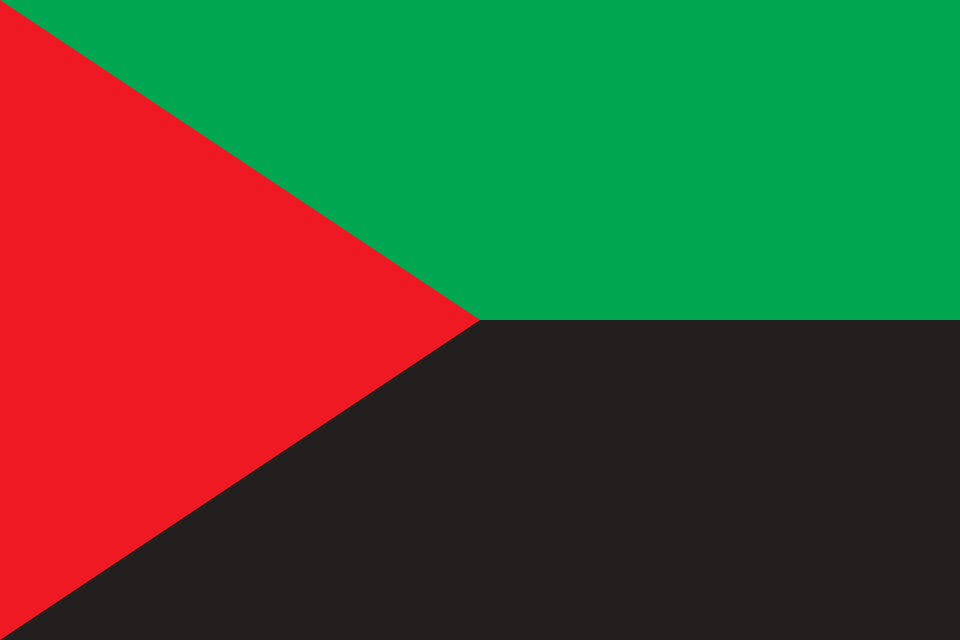
| Shape | Red hoist triangle and green-black horizontal bicolour |
| Green band | Upper half behind the triangle |
| Black band | Lower half behind the triangle |
| Earlier contentious flag | Blue snake flag, associated with colonial maritime history |
The flag’s historic adoption, its role in local identity and the territory’s constitutional status are distinct questions. Refer to the dated primary sources below where precise legal status matters.
What does Martinique’s red–green–black flag look like?
The left edge is the base of a red triangle pointing toward the fly side. The remaining flag is divided into two broad horizontal areas: green on top and black below. The red triangle overlays the left ends of both bands.
The three sections are solid colours, without a seal, circle, star or snake. The design is often called the Rouge–Vert–Noir, or RVN, flag. It is not the same as an upright red-green-black vertical tricolour; its red area is triangular.
What do the red, green and black colours mean?
Red, green and black have long been associated with Martiniquais social, cultural and anti-colonial movements. Red is commonly linked with historical struggle and sacrifice, green with land and hope, and black with the island’s African-descended identity and historical memory.
Those associations should be presented as historical and community interpretations rather than as three definitions fixed by a national law. Different activists and historians interpret their traditions in different ways, and the local flag has had a politically engaged past.
How old is Martinique’s red–green–black movement flag?
The red-green-black combination existed in Martinique’s political symbolism long before 2023. It became especially visible in twentieth-century nationalist and anti-colonial movements, including groups organized during the 1960s.
The flag’s political associations are part of its history, but it also became a recognizable symbol of Martiniquais identity for many islanders. It would be inaccurate to describe the exact 2023 territorial decision as a centuries-old government decree.
When was the red–green–black flag adopted?
The Assembly of Martinique voted on 2 February 2023 to adopt the red–green–black flag as the local symbol for cultural and sporting events. In March 2023 it was raised at the Collectivité Territoriale de Martinique (CTM) premises.
The flag represents an adopted regional identity symbol alongside the French national flag. The vote did not make Martinique an independent sovereign country, and it did not replace France’s tricolour in national constitutional use.
Did a court overturn Martinique’s flag in 2024?
On 14 May 2024, the Martinique Administrative Court annulled the part of the February 2023 decision relating to the anthem Ansanm, because of procedural problems with the public consultation. The flag decision itself was not overturned by that ruling.
This distinction matters because brief news headlines about a ‘flag and anthem controversy’ can give the wrong impression. The court’s published summary explicitly identifies the anthem as the annulled part.
What was the old blue flag with four snakes?
A widely reproduced older flag is blue with a white upright cross and four white snake-like figures. Its origins lie in an eighteenth-century French colonial maritime ensign associated with Martinique and Saint Lucia, rather than a modern vote of island residents.
Because of its colonial and slavery-era associations, this design is controversial and should not be presented as Martinique’s present adopted identity flag. It can be shown in an accurately labelled historical explanation, not used uncritically as the current local flag.
What happened to the 2019 hummingbird flag?
A separate blue-and-green design with a black hummingbird was introduced during a 2019 initiative to create an identity flag for Martinique. That initiative and the adoption process became the subject of controversy and legal challenge.
The 2023 red–green–black flag is a different design chosen later by the territorial assembly. When comparing web images, do not assume an attractive hummingbird flag is the current 2023 regional symbol.
Does Martinique use France’s flag too?
Yes. Martinique is part of the French Republic, so the national French tricolour has the constitutional national-flag role. The local red–green–black design expresses Martiniquais identity in the sporting and cultural contexts for which it was adopted.
The relationship resembles other regions that have their own cultural symbols while belonging to a larger state. Local flag recognition and national sovereignty are separate concepts and should always be stated clearly.
How to draw and identify the 2023 Martinique flag
Draw a rectangle. Fill the upper half green and the lower half black. Add a red triangular shape with its base occupying the hoist edge and its point aimed toward the centre of the flag.
Do not add serpents, a white cross, hummingbird or yellow sun to this specific design. For a flag identification exercise the clue is simply ‘red hoist triangle, green upper band, black lower band‘: Martinique’s 2023 identity flag.
Frequently asked questions
What is Martinique’s local flag today?
The red–green–black design, adopted by the territorial assembly in February 2023 for cultural and sporting representation.
Is the red–green–black flag the national flag of an independent country?
No. Martinique is part of France; the French tricolour is its national flag.
When did Martinique adopt the red–green–black flag?
2 February 2023.
Which colour is on top?
Green is the upper horizontal band and black the lower band, with a red triangle at the hoist.
Is the snake flag still the adopted local flag?
No. The blue snake design is a historic colonial ensign and should not be treated as the 2023 identity flag.
What was the hummingbird flag?
A different flag introduced in an earlier 2019 identity-symbol initiative.
Did the 2024 court ruling cancel the flag?
No. The court annulled the 2023 anthem adoption, not the red–green–black flag.
What does red–green–black symbolism recall?
The island’s cultural identity and historical social and anti-colonial movements; exact per-colour interpretations vary.
Official references and illustration credits
Société Française de Vexillologie — 2023 Martinique flag decision
Martinique Administrative Court — May 2024 anthem decision
France-Antilles — Martinique assembly approval
Flags of the World — Martinique history and local flags
The displayed PNG was rendered from the Wikimedia Commons flag vector for Martinique. Wikimedia Commons vector by MapGrid, HapHaxion, Femfem5 and Triton, based on work by Carport. The simple geometric design is marked public domain on Commons; image rendered as PNG without design changes.
Images provided for education and identification only; no government endorsement is implied. Source material reviewed November 2026.