French Polynesia Flag: Traditional Canoe, Five Archipelagos & Sun
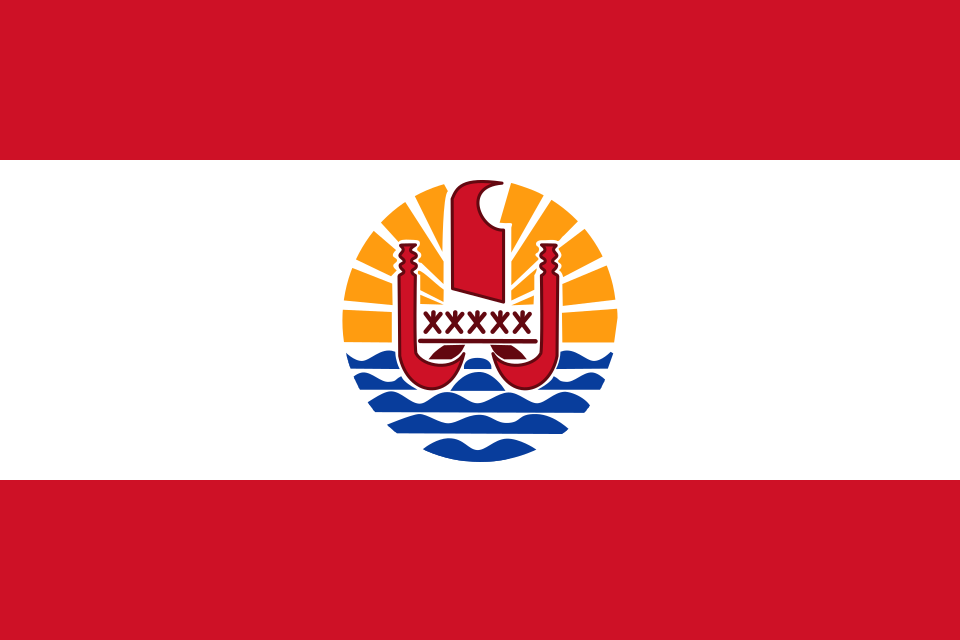
French Polynesia’s red-white-red flag features a traditional sailing canoe with five crew figures over waves and under a shining sun. Learn what they represent.
French Polynesia is an overseas collectivity of France in the South Pacific. The local flag is a separate territorial identity symbol, often seen alongside the French national tricolour and not a declaration of independent sovereignty.
The Assembly of French Polynesia’s history dates the flag and arms to 23 November 1984. The Australian Government’s territorial profile also confirms the adoption year and constitutional setting.
French Polynesia flag at a glance
| Feature | Details |
|---|---|
| Territory | French Polynesia (Polynésie française) |
| Political status | Overseas collectivity of France |
| Administrative centre | Papeete, Tahiti |
| Flag and arms adopted | 23 November 1984 |
| Flag layout | Red-white-red horizontal bands |
| Centre image | Polynesian canoe, sea waves, rising sun |
| Canoe crew | Five figures |
| Archipelagos | Society, Tuamotu, Gambier, Marquesas and Austral |
The flag’s historic adoption, its role in local identity and the territory’s constitutional status are distinct questions. Refer to the dated primary sources below where precise legal status matters.
What does the French Polynesia flag look like?
A wide white central band lies between two thinner red horizontal bands. The colour proportions are 1:2:1 from top to bottom. The centre contains a circular scene with an orange-gold sun rising above blue waves and a dark red canoe.
The official badge is much more detailed than a simple sun circle. A standard modern representation includes the canoe hull, its five crew figures and alternating blue-and-white waves. Without the central emblem, the tricolour resembles the simpler flag of Tahiti.
What does the traditional canoe represent?
The central vessel is a Polynesian double-hulled voyaging canoe, a symbol of settlement, maritime navigation, inter-island travel and the cultural skills that connect island communities across the Pacific.
It is not an ordinary European sailing ship or a modern ferry. Its shape reflects the region’s ocean-going traditions. The boat serves as a cultural emblem as well as a link between French Polynesia’s widely separated island groups.
Why are there five figures in the canoe?
The five stylised crew members represent the five principal archipelagos of French Polynesia: Society Islands, Tuamotu, Gambier, Marquesas and Austral Islands. Each is an island group rather than one sovereign state.
Some flag descriptions call the figures five stars or tiki-like figures because of their stylised heads; the central meaning is the representation of five archipelagos travelling together. A flag illustrator should preserve the five figures rather than arbitrarily drawing three or six passengers.
What do the rising sun and ocean waves mean?
The gold rising sun refers to warmth, light and the promise of life in the Pacific. The blue and white waves represent the ocean that surrounds, nourishes and connects the islands.
The canoe sits on the sea beneath the sun, making the emblem a unified natural and cultural scene. It would be misleading to replace the waves with a map or the sun with the Southern Cross: those belong to other Pacific flag designs.
Why does French Polynesia use red and white bands?
Red and white are traditional Polynesian colours and are prominent in Tahitian flag history. The modern territorial design uses them as a three-band foundation while adding its own emblem.
The two red bands are of equal height and the white centre is twice as high. This geometry is a useful identifying feature compared with the uniform red-white-red national flag of Austria, which has no canoe and three equal stripes.
When was French Polynesia’s flag adopted?
The local assembly adopted the flag and arms on 23 November 1984, following an autonomy reform under French law. The same period saw the codification of distinct territorial symbols for use in public life.
The flag’s creation should be distinguished from the much older settlement and navigation traditions that inspired its artwork. Likewise, its 1984 adoption did not mean French Polynesia became a separate independent nation.
French Polynesia flag vs the Tahiti flag
The Tahiti flag, in commonly displayed versions, has red-white-red horizontal bands without the central canoe emblem. French Polynesia’s territorial flag includes the circular sun–sea–canoe picture within the white band.
Tahiti is the largest and most populous island within French Polynesia, not a different sovereign country. The canoe badge provides the visual difference between the broader collectivity’s recognized emblem and simpler Tahitian red-and-white flags.
Does French Polynesia also use the French flag?
Yes. French Polynesia forms part of the French Republic as an overseas collectivity with a high degree of autonomy in local affairs. The French blue-white-red tricolour remains the national flag, while the red-white-red canoe design expresses local and regional identity.
For maps, sports materials and classroom worksheets, the canoe flag is often the most informative local symbol. It should be identified as the flag of French Polynesia, not as the flag of a new sovereign state.
French Polynesia vs Tokelau and New Caledonia flags
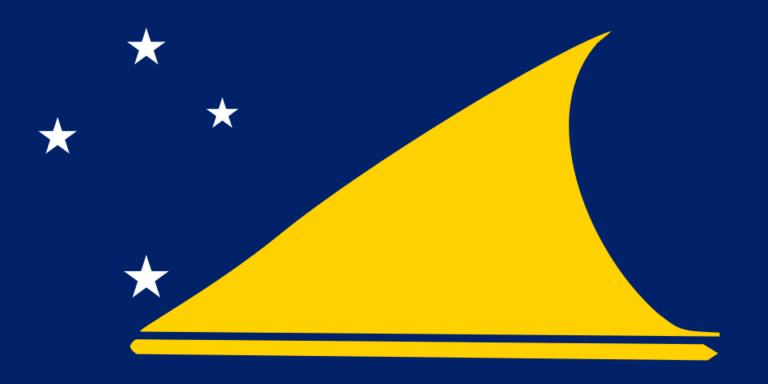
Tokelau also uses a traditional canoe, but its flag is solid dark blue with a yellow canoe and four white Southern Cross stars. French Polynesia has red-white-red bands, a central disc and five crew figures.
New Caledonia is different again: French and Kanak flags are often shown together, with the latter using blue, red and green and a yellow disc. Canoe imagery uniquely identifies French Polynesia and Tokelau among these comparisons.
How to draw the French Polynesia flag
Draw a rectangle in red, white and red horizontal bands with proportions 1:2:1. In the wide white band place a large circular scene. Draw blue-and-white waves, a red double-hulled canoe with five figures, and gold sun rays above.
For a finished image, use an appropriately licensed official-standard vector so that the detailed canoe design is recognizable. The quiz clue ‘red-white-red with a canoe and rising sun‘ identifies French Polynesia.
Frequently asked questions
When was the French Polynesia flag adopted?
23 November 1984.
What boat is on the flag?
A traditional Polynesian voyaging canoe.
Why are there five people in the canoe?
They symbolize the five island groups or archipelagos of French Polynesia.
What do the sun and waves mean?
Light and life in the Pacific, and the ocean linking the islands.
What are the stripe proportions?
Red-white-red with heights in the ratio 1:2:1.
Is French Polynesia an independent country?
No. It is an overseas collectivity of France with local autonomy.
Is the flag the same as Tahiti’s?
The colour bands are similar, but the French Polynesia territorial flag adds the central canoe emblem.
How is it different from Tokelau’s?
Tokelau has a yellow canoe on dark blue with four white Southern Cross stars.
Official references and illustration credits
Assembly of French Polynesia — History of territorial symbols
Australian Government — French Polynesia overview
French legal reference — Flag and arms adopted 23 November 1984
CIA World Factbook historical flag description
The displayed PNG was rendered from the Wikimedia Commons flag vector for French Polynesia. Flag illustration by Nightstallion from OpenClipart, published under CC0 1.0 / public domain and reproduced from Wikimedia Commons as a PNG. Government insignia rules may still apply.
Images provided for education and identification only; no government endorsement is implied. Source material reviewed November 2026.