Saskatchewan Flag: Western Red Lily, Green & Yellow Meaning
Why is Saskatchewan’s flag green and yellow, with a red lily and a shield? Learn its forests-and-grain symbolism, Anthony Drake’s winning design and September 1969 adoption.
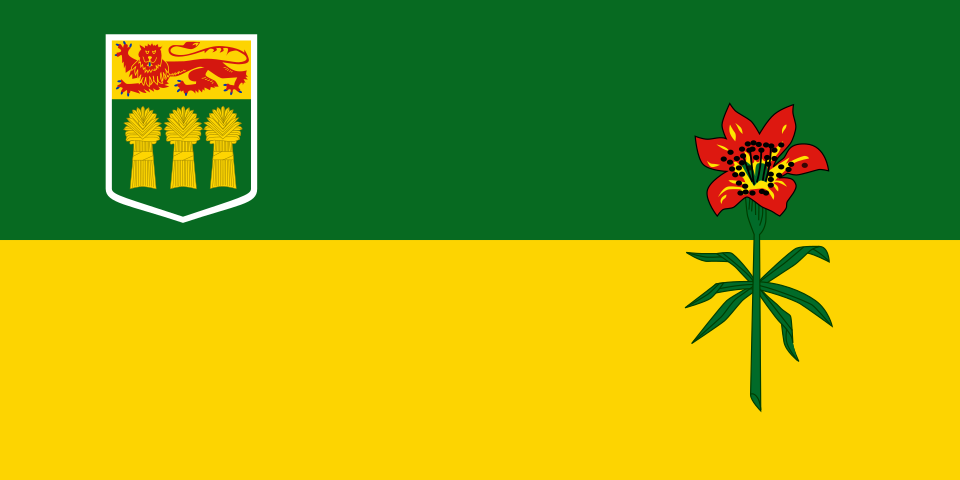
Saskatchewan is a Canadian Prairie province with Regina as its capital. Unlike Manitoba and Ontario, its flag has no Union Jack. Instead it uses nature-inspired bands of green and golden yellow, with a small heraldic shield on the upper hoist and a large red flower on the outer half.
The Government of Saskatchewan’s official emblems guide explains the colors directly: green stands for the northern forested areas, while gold reflects southern grain-growing lands. The Canadian Heraldic Authority names Anthony Drake as the original designer and records the September 1969 authorization dates.
This guide also explains why the flower is a western red lily rather than a generic red star, how the little shield relates to the full provincial coat of arms, and why 1969 is the correct modern adoption year.
Saskatchewan flag at a glance: two colors, a shield and a lily
The flag divides into a green upper half and a gold lower half. In the upper corner nearest the pole is the historic provincial shield of arms; toward the far end is the red-and-green western red lily. Its use of plants and colors connects the banner with Saskatchewan’s northern forests and agricultural Prairie south.
| Flag feature | Description |
|---|---|
| Province | Saskatchewan, Canada (capital Regina) |
| Upper half | Green, northern forested areas |
| Lower half | Gold/yellow, southern grain growing areas |
| Top hoist emblem | Provincial shield of arms |
| Fly emblem | Western red lily, the provincial flower |
| Designer | Anthony Drake |
| Flag authorized | Royal proclamation September 12, 1969 |
| Effective adoption | September 22, 1969 |
| Historic shield granted | August 25, 1906 |
What do green and yellow mean on Saskatchewan’s flag?
The official color explanation is straightforward. Green represents Saskatchewan’s northern forests, while gold represents the southern grain-growing area. The flag divides the colors into two equal horizontal bands, unlike a traditional three-stripe national flag.
Saskatchewan includes extensive forest and lake country as well as wide agricultural plains. The bands are a stylized representation of that contrast, not a literal two-color political map with an exact boundary drawn across the province.
The gold is often shown as bright yellow in fabric and digital diagrams. That does not mean it represents only sunflowers, canola or one specific grain. The official source identifies the general grain-growing area of southern Saskatchewan.
When teaching geography with the flag, ask which color represents the forests and which represents agriculture. The green upper panel and golden lower panel are intentionally simple enough to remember.
What is the red flower on Saskatchewan’s flag?
The red flower is the western red lily, Saskatchewan’s provincial floral emblem. It has a red or red-orange bloom with visible dark markings and green leaves and stem. Its botanical name is Lilium philadelphicum, often associated with the prairie lily.
It was selected as the province’s floral emblem in 1941, well before the provincial flag was adopted in 1969. This older emblem made the flower an established symbol available to the designer.
The western red lily on the flag is larger than the small shield and is positioned on the fly side. This placement contrasts with Manitoba’s bison, which is contained within a shield on a red ensign.
In a small flag image, the flower might look like a red star, but it is not a political star and should not be described as one. Use a larger official illustration or a clear alt-text description to identify its six tepals, markings and leaves.
What is the shield in the upper-left corner?
Saskatchewan’s historic shield of arms appears near the hoist in the green upper band. Its upper section is gold with a red lion, recalling British royal heraldry, and its lower green section bears three golden wheat sheaves, an agricultural emblem.
That shield was granted by King Edward VII on August 25, 1906. It is much older than the flag itself. The complete coat of arms later added other elements, including a beaver, supporters and a motto in 1986, but those do not appear on the normal provincial flag.
The wheat sheaves reinforce the agricultural meaning of the flag’s yellow lower panel. The lion is a heraldic device, not a real animal native to Saskatchewan. A flag drawing that puts a prairie bison in the Saskatchewan shield would confuse it with Manitoba’s symbol.
Who designed the Saskatchewan flag?
The winning design came from Anthony Drake, whose proposal was selected in a province-wide flag competition. The Canadian Heraldic Authority identifies him as the original creator, and Canadian Heritage confirms that the flag arose from a contest before its 1969 adoption.
The resulting flag offered a clear alternative to the British-derived Red Ensign designs used in some other Canadian provinces. Instead of centering the composition on a Union Jack, it highlighted the province’s green forests, golden farmland, floral emblem and historic provincial shield.
That mixture gives the design two kinds of identity: natural symbols that anyone can recognize, and heraldic continuity through the small shield. The flower is not decoration added later to an empty flag; it forms a central part of Drake’s recognized design.
Historical records of the flag competition are useful because they distinguish the modern flag’s actual creator from earlier heraldic artists who drew the 1906 shield.
When did Saskatchewan adopt its flag?
The provincial flag was approved and officially authorized in 1969. The Canadian Heraldic Authority records a Royal Proclamation dated September 12, 1969, effective September 22, 1969.
Saskatchewan had been a province since 1905, and its historic shield dates to 1906. These much earlier dates explain the coat-of-arms element but are not the flag’s adoption date. Other provincial emblems, including the western red lily adopted in 1941, also predate the flag.
On a classroom timeline, write 1905 for provincial establishment, 1906 for shield, 1941 for floral emblem, and 1969 for the modern flag. This makes it clear that the flag combined existing symbols in a newly adopted composition.
The Government of Saskatchewan lists the flag among its official emblems and distinguishes it from separate provincial banners, including the Fransaskois flag recognized in 2005 as a symbol of the province’s Francophone community.
Saskatchewan vs. Manitoba, Alberta and Canada flags
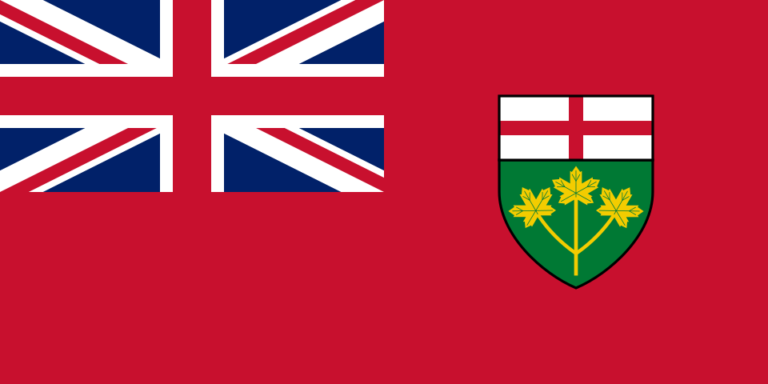
Compared with Manitoba’s provincial Red Ensign, Saskatchewan is much more immediately green-and-yellow. It has no Union Jack, and its large western red lily sits on the fly. Manitoba uses a red field, Union Jack canton and shield containing a bison.
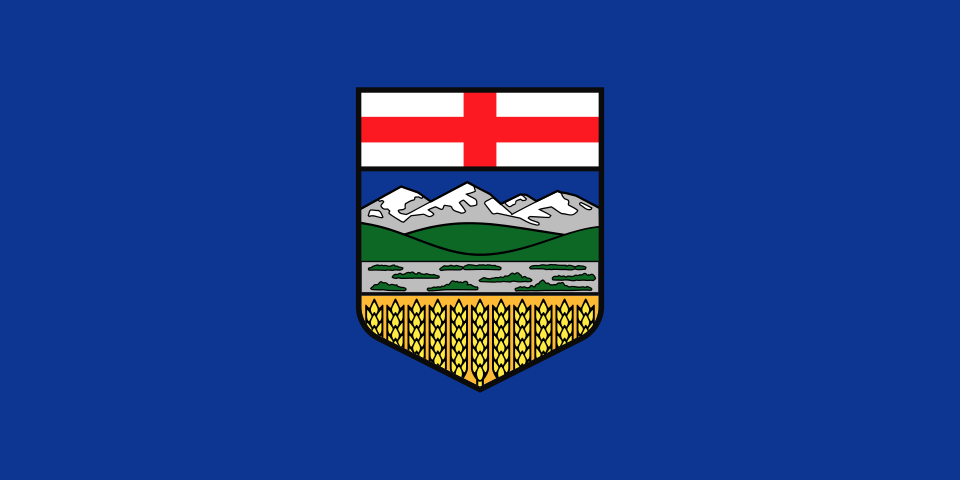
Compared with Alberta’s flag, Saskatchewan spreads its colors across the entire field rather than using a single small mountain-and-wheat landscape shield on blue. Alberta’s red St George cross is part of its central shield; Saskatchewan uses a red heraldic lion and three golden wheat sheaves.
The Canadian national flag is red and white with an eleven-pointed maple leaf, and Quebec’s Fleurdelisé is blue-and-white with four lilies. Canadian provincial flags therefore use a wide variety of designs even when they belong to the same country.
An especially useful visual test is to locate the large flower: if you see a western red lily against horizontal green and yellow, it is Saskatchewan.
How to draw or identify the Saskatchewan flag
Draw a wide rectangle and divide it horizontally into two equal sections. Color the top green and the bottom golden yellow. In the upper-left corner add the small provincial shield, with a red lion on gold above three wheat sheaves on green.
On the outer half add the western red lily, giving it a red flower and green stem and leaves. Use an official or accurately sourced outline so the floral shape does not become a generic star or rose.
For children learning Canadian flags, pair Saskatchewan with neighboring Alberta and Manitoba. Ask which flag features a red lily, which has a bison and which contains mountains and wheat. This is a more useful distinction than simply saying all three represent Canadian Prairie provinces.
Frequently asked questions
What colors are on the Saskatchewan flag?
Green across the upper half and gold or yellow across the lower half.
What does green represent?
Saskatchewan’s northern forested regions.
What does gold represent?
The southern grain-growing regions of the province.
What is the red flower on the flag?
The western red lily, Saskatchewan’s official provincial floral emblem.
Who designed Saskatchewan’s flag?
Anthony Drake, whose design was selected through a provincial competition.
When was Saskatchewan’s flag adopted?
Authorized in September 1969, effective September 22 of that year.
What is in the shield at the upper left?
A red heraldic lion above three gold wheat sheaves, from the historic provincial arms.
Does Saskatchewan’s flag have a Union Jack?
No. It uses a natural green-and-gold layout rather than a Red Ensign.
Is the flower the same as Quebec’s fleur-de-lis?
No. Saskatchewan features a red western red lily with a green stem; Quebec displays four white heraldic fleurs-de-lis.
Official sources and illustration credits
Government of Saskatchewan — Provincial emblems and flags
Canadian Heraldic Authority — Saskatchewan flag
Canadian Heritage — Saskatchewan symbols and flag history
Government of Canada — Saskatchewan emblem fact sheet
Wikimedia Commons — Flag of Saskatchewan vector
Saskatchewan provincial flag from Wikimedia Commons, rasterized to PNG. Alberta comparison from Commons. Legal adoption, designer and symbolism checked against the Canadian Heraldic Authority and Saskatchewan government.
Each illustration is a PNG rendition of a linked Wikimedia Commons vector imported into the FlagExplorers media library. Artwork reuse should follow its particular file-page license, and official coats of arms can have separate restrictions. Historical sources checked November 2026.