Faroe Islands Flag: Merkið, Red and Blue Cross & History
The Faroese flag, Merkið, features a red Nordic cross outlined in blue on white. Learn why its 1919, 1940 and 1948 milestones all matter.
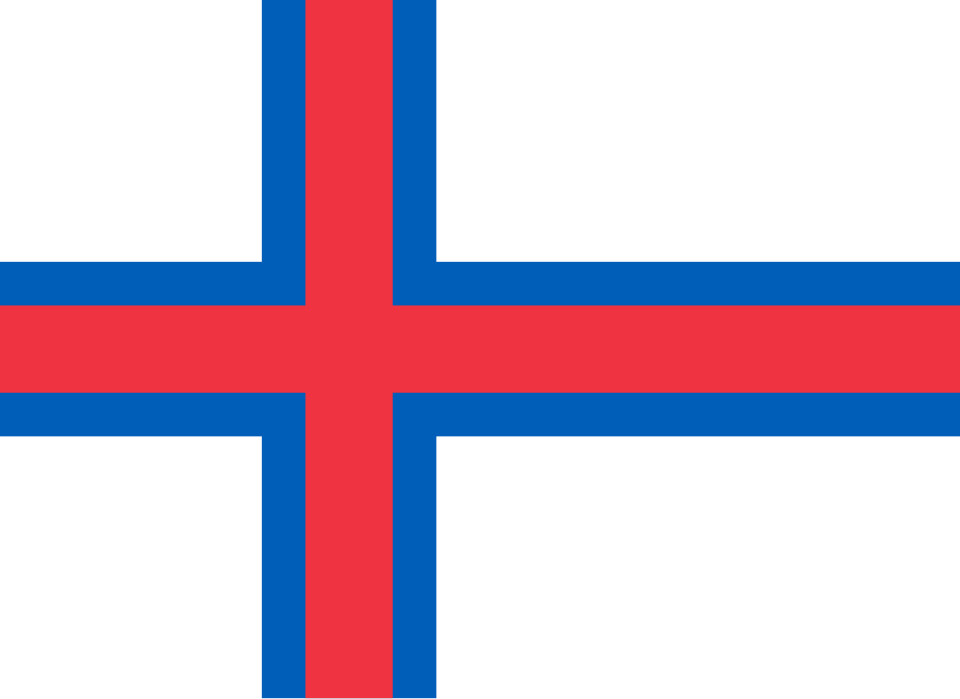
The Faroe Islands lie in the North Atlantic and form a self-governing territory within the Kingdom of Denmark. Their flag has the classic Nordic-cross shape but replaces the Danish red-and-white layout with three colours.
The official Faroese government history explains the flag’s symbols and chronology, including the often-confused distinction between its original use in 1919 and its wartime legal recognition in 1940.
Faroe Islands flag at a glance
| Feature | Details |
|---|---|
| Territory | Faroe Islands (Føroyar) |
| Status | Self-governing part of the Kingdom of Denmark |
| Capital | Tórshavn |
| Faroese name | Merkið |
| Colours | White, red and blue |
| First flown | 22 June 1919 |
| Maritime recognition | 25 April 1940 |
| Land and sea recognition | 1948 home-rule arrangement |
The table distinguishes historic design dates from later formal recognition, because the dates are not always identical. Refer to the official references below if you need a precisely standardized flag for institutional display or manufacture.
What does the Faroe Islands flag look like?
The background is white, with a red cross of the Scandinavian or Nordic cross pattern, its vertical arm closer to the flagpole than to the fly end. A narrow blue outline separates the red cross from the white field.
The official Faroese description calls the blue an azure blue border or fimbriation. The government describes its usual proportions as 5:7. A flag drawn with a centered cross or with a red field instead of white is not the standard Merkið design.
What do Merkið’s red, white and blue colours mean?
The government explains that the white field evokes both Christianity and the foam of the sea and clear, bright sky. The red and blue carry older Faroese colour associations and express ties with other Nordic nations.
The cross pattern also situates the Faroes in the wider family of Scandinavian flags. These are the official explanations; a claim that one stripe represents one particular island would be misleading, as the flag is used for the archipelago as a whole.
Who created the Faroese flag in 1919?
Faroese students living in Copenhagen developed Merkið at a time when demands for a distinct national symbol were growing. They took inspiration from Nordic flags and from Iceland’s developments in national recognition.
A student leader, Jens Oliver Lisberg, brought the new flag to the islands. The Faroese government’s history places its first raising in the village of Fámjin on 22 June 1919. It is more accurate to describe the creation as a student-led effort than as a Danish state commission.
Why did Britain recognize Merkið during World War II?
Denmark was occupied by Germany in April 1940, while British forces occupied the Faroe Islands. Shipping flying the Danish flag could create serious identification and safety problems in wartime waters, so Faroese sailors needed a clearly distinguishable ensign.
On 25 April 1940, British authorities formally recognized Merkið for Faroese vessels. The date became a celebrated milestone, although the flag’s creation and use were already more than twenty years old. The recognition reflected practical wartime circumstances and Faroese demands for their own banner.
What changed in 1948?
The Faroese Home Rule Act of 1948 recognized the flag on land and at sea. The official Faroese account dates this political settlement to 1948, following the flag’s earlier maritime recognition in 1940.
That is why three dates appear in flag histories: 1919 for the first use, 1940 for the British maritime decision, and 1948 for recognition through home rule. The Faroe Islands are still linked to the Danish Crown, and their own flag symbolizes autonomy without establishing a new fully independent sovereign state.
When is Faroese Flag Day?
Flag Day is April 25, commemorating the 1940 decision. The Faroese parliament selected that date as a day to celebrate Merkið; today it is marked with flag displays, ceremonies and community gatherings.
The Faroese Government, Nordic cooperation and official history all distinguish Flag Day from the date the flag was first raised in Fámjin. Do not mistake April 25 for its design date.
Faroe Islands flag vs Iceland, Norway and Greenland
The Faroese design is often compared with Iceland, which has a blue background and red cross edged white. Norway has a red background and blue cross edged white. The Faroes use the same three colours in another order: white background, red cross, blue border.
Greenland has no Nordic cross at all, using a red-and-white circle. Both Greenland and the Faroes are self-governing within Denmark, but the comparison shows why political relationships should not be used to infer identical flags.
How do you draw Merkið correctly?
Draw a white rectangle. Add a relatively broad Nordic cross offset toward the hoist: first the outer blue cross, then a narrower red cross inside it. The result is red separated from the white background by blue.
The flag does not have a Danish white-on-red cross and does not contain a ram or oystercatcher. Those animals belong to other Faroese symbolic traditions, not the standard national flag.
Frequently asked questions
What is the Faroe Islands flag called?
Merkið, the Faroese national flag.
What do the red, white and blue colours mean?
The white evokes Christianity, sea foam and bright sky; red and blue emphasize Faroese tradition and Nordic relationships.
When was Merkið first flown?
22 June 1919, at Fámjin.
Why is April 25 Faroese Flag Day?
It commemorates British recognition of Merkið as a Faroese maritime ensign on 25 April 1940.
When did Denmark recognize the Faroese flag?
It gained recognition for land and sea with the Home Rule Act of 1948.
Is the Faroe Islands flag the same as Iceland’s?
No. Merkið is white with a red-and-blue cross; Iceland’s is blue with a red cross edged white.
Is the Faroe Islands an independent country?
It is self-governing within the Kingdom of Denmark, not a separate fully sovereign state.
Where is the cross placed?
Offset toward the hoist in the Nordic-cross style.
Official sources and illustration credits
Government of the Faroe Islands — Flag history and meaning
Government of Faroe Islands in London — Flag history
Nordic cooperation — The Faroese flag
This PNG is a rendering of the Wikimedia Commons vector of the Faroe Islands flag. See the source file for licensing, creator and reuse details; official symbol rules can apply separately from copyright. Facts checked November 2026.