Åland Islands Flag: Blue, Yellow & Red Nordic Cross Explained
Why is Åland’s flag blue with a red Nordic cross outlined in yellow? Learn the island territory’s autonomous identity, the 1953–54 decision and flag day.
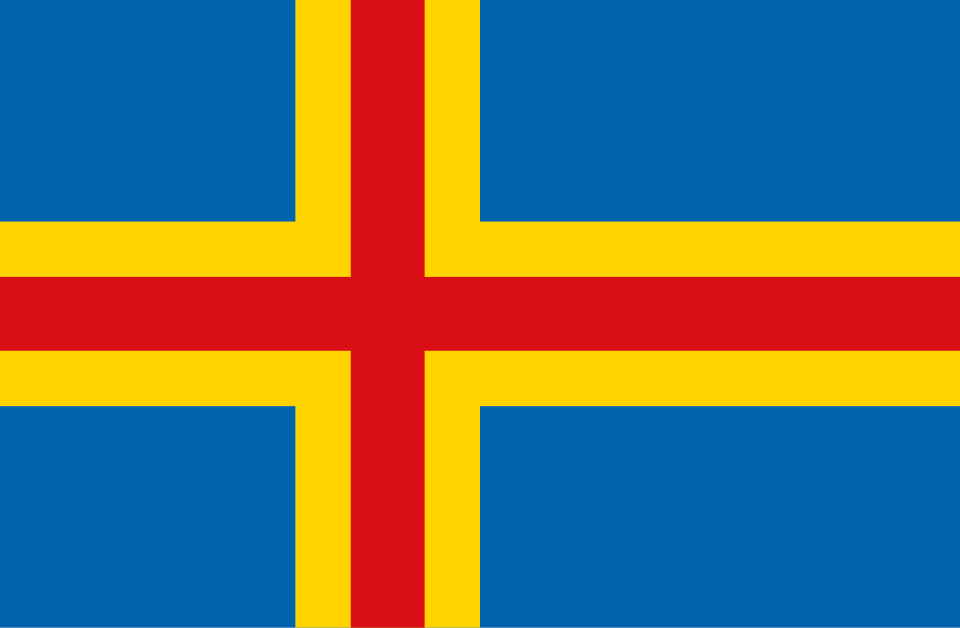
Åland (also written Aland without its Scandinavian letter) is an autonomous archipelago between Sweden and mainland Finland. Its flag combines familiar Nordic colours in a pattern unlike the sovereign flags of either neighbouring state.
The Nordic Council of Ministers confirms the design and official dates; Åland’s visitor heritage service explains the political and cultural context. The 1953 local decision and 1954 presidential confirmation are different stages and should not be collapsed into one.
Åland Islands flag at a glance
| Feature | Details |
|---|---|
| Region | Åland Islands (Ahvenanmaa in Finnish) |
| Status | Autonomous region of Finland |
| Capital | Mariehamn |
| Majority language | Swedish |
| Background | Blue |
| Cross | Red centred within yellow Nordic cross |
| Local adoption | 1953 |
| Presidential approval | 1954 |
The table distinguishes historic design dates from later formal recognition, because the dates are not always identical. Refer to the official references below if you need a precisely standardized flag for institutional display or manufacture.
What does the Åland flag look like?
A blue rectangular field carries a broad yellow Nordic cross with a narrower red cross running through its centre. Both crosses extend to the edges, and the vertical arm sits closer to the flagpole than to the far side.
This is not a flag with three ordinary vertical or horizontal stripes. The yellow edges remain visible on both sides of the red cross, creating the characteristic layered effect. If the red cross is removed the basic colours resemble Sweden’s national flag, but that is not the full Åland design.
Why does Åland use blue, yellow and red?
The blue and yellow closely recall Sweden’s flag and the Swedish-language cultural heritage of Åland. The red cross is associated with older Finnish and Åland heraldic traditions. As a combination, the colours emphasize Åland’s unique identity while acknowledging its historical connections.
The Nordic cooperation description identifies the colours and form but does not assign a separate precise natural feature—such as a named sea or forest—to each stripe. Such simple nature-based claims should be presented as personal associations, not official historical explanations.
When was the flag chosen and approved?
The Åland parliament chose the red-centred yellow cross on blue in 1953. Finland’s President approved the resulting flag in 1954, following debates about the islands’ right to their own symbols. The local decision and national approval explain why reliable sources cite both years.
The flag was first raised in Mariehamn on 3 April 1954, according to specialist Finnish flag histories. Åland’s flag history is connected with its self-government, not with Åland becoming an independent country.
Why does Åland have its own flag if it is part of Finland?
The Åland Islands are a self-governing Swedish-speaking region of Finland, with special constitutional arrangements and a regional legislature. Their right to use their own flag expresses that recognized autonomy.
Finland’s own national flag is a blue Nordic cross on white, while Åland’s flag is blue with a yellow-edged red cross. The different designs do not contradict Åland’s membership in Finland: an autonomous region and a sovereign state may each have official symbols.
When is Åland Flag Day celebrated?
Åland Flag Day is the last Sunday in April. This is a recurring calendar rule, not a fixed April 24 or April 30 date every year. The Nordic cooperation holiday guide lists the annual observance.
The first celebrations began in the 1950s following the creation of Åland’s flag. When comparing flag days across Nordic territories, do not confuse Åland’s late-April occasion with April 25 in the Faroe Islands or June 21 in Greenland.
Was there an earlier Åland flag?
Before the current flag was chosen, proposals and regional flag forms using blue and yellow circulated as part of Åland’s identity debates. The selection process in the early 1950s reflected the islands’ evolving constitutional position and longstanding Swedish-speaking culture.
The current layered Nordic cross was approved in 1954 rather than being an unchanged medieval flag. This distinction is important: the colours evoke historical links, while the actual official design is a modern autonomous-region symbol.
How is Åland’s flag different from Sweden’s and the Faroes’?
Sweden uses a single yellow Nordic cross on blue. Åland uses the same main colours but adds a thin red cross inside the yellow. The Faroes has a white field with red cross bordered blue.
The broad yellow around red is the quickest way to identify Åland. Unlike the flags of Greenland or Sweden, it has three colours. Unlike Norway, its background is blue rather than red.
How to draw and identify the Åland flag
Start with a blue rectangle. Add a broad yellow cross offset toward the hoist, keeping equal yellow border widths. Place a narrower red Nordic cross exactly along the centre of the yellow one so yellow remains visible on both sides.
In a flag quiz, ‘blue with a yellow border around a red Nordic cross’ identifies Åland. Another useful distinction is that Åland’s flag is not the Finnish blue cross on white.
Frequently asked questions
What does the Åland flag look like?
Blue with a yellow Nordic cross and a narrower red cross centred inside it.
When was the Åland Islands flag adopted?
Locally selected in 1953 and approved by Finland’s President in 1954.
Where are the Åland Islands?
Between Sweden and mainland Finland in the Baltic Sea; they form an autonomous Finnish region.
Why do the colours resemble Sweden’s?
Blue and yellow evoke Swedish cultural and historical connections; the red adds a distinct Åland heraldic element.
Is Åland independent?
No. Åland is an autonomous region of Finland.
When is Åland Flag Day?
The last Sunday of April.
How is Åland’s flag different from Sweden’s?
Åland has a red cross nested inside the yellow cross; Sweden has yellow alone.
What is the capital of Åland?
Mariehamn.
Official sources and illustration credits
Nordic cooperation — The Åland flag
Visit Åland — History of Åland flag (Swedish)
Nordic cooperation — Public holidays in Åland
Åland Government — Official graphic manual
This PNG is a rendering of the Wikimedia Commons vector of the Åland Islands flag. See the source file for licensing, creator and reuse details; official symbol rules can apply separately from copyright. Facts checked November 2026.