Liechtenstein Flag: Gold Crown, Colours, History & Facts
Why Liechtenstein added a gold princely crown after the 1936 Olympics, what its blue and red flag means, and how national symbols are defined by law.
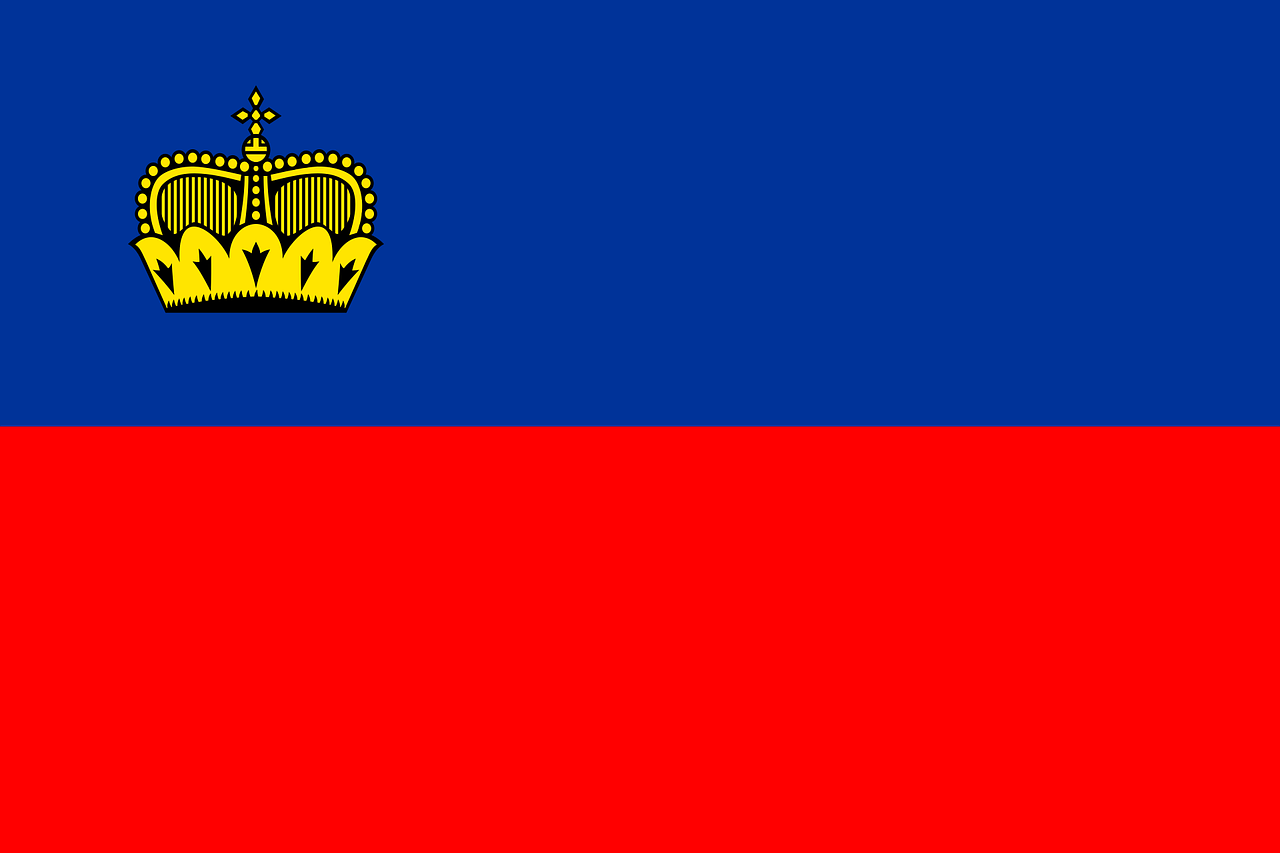
Liechtenstein’s national flag has two equal horizontal bands of blue and red with a gold princely hat near the upper-left corner. The crown-like symbol is especially significant because it was added in 1937 after officials realised that the plain bicolour closely resembled Haiti’s civil flag during the 1936 Summer Olympics.
The flag is also a statement of Liechtenstein’s status as an independent constitutional principality between Switzerland and Austria. Its legal history, different ceremonial forms and the distinction between national colours and the ruling family’s heraldic symbols make the subject richer than the Olympic anecdote alone. This guide explains the official design, symbolism, dated changes and practical ways to identify the flag.
What does Liechtenstein’s flag look like?
Liechtenstein’s national flag has two horizontal stripes of equal height: blue on top and red below. In the upper part of the blue stripe, close to the flagpole, appears a golden princely hat or crown. The emblem is not in the centre of the full flag, and it does not extend into the red band. The relatively simple arrangement is important because the same two colour fields without the crown were once used as the country’s banner.
Official government guidance identifies the crown as the Fürstenhut, the princely hat. Although English descriptions often call it a crown, it is a particular symbol of the reigning princely house, not a generic five-pointed royal crown. The Liechtenstein National Administration specifies blue above red and the golden hat near the hoist. Accurate educational artwork should reproduce the recognised shape, not insert an unrelated gold crown icon.
What does the gold crown mean?
The golden emblem represents the princely house and Liechtenstein’s constitutional monarchy. Its location on the national colours links the country’s institutions and historic dynasty with a common flag used by the state and its population. It is therefore more informative to identify it as a princely hat than to describe it only as a decoration added to fill empty space.
The sovereign Prince of Liechtenstein remains part of the country’s constitutional system, while the elected Landtag and government perform their own functions. The flag does not indicate that the country is ruled without a constitution or legislature. Symbols with crowns can exist in constitutional monarchies with many different institutional arrangements.
The princely house has separate heraldic symbols and colours, including gold and red. Those house colours should not be substituted for the blue-red national flag. The official government material distinguishes the national banner, the princely standard and the state’s coats of arms; they serve related but different purposes.
Why did the 1936 Olympics lead to a flag change?
At the 1936 Summer Olympics in Berlin, Liechtenstein’s representatives encountered the problem that their plain blue-over-red horizontal bicolour resembled Haiti’s civil flag. The duplication caused obvious difficulties for a small sovereign state seeking a clearly recognisable national symbol at an international sporting event. Liechtenstein’s government responded by introducing the gold princely emblem on its flag the following year.
The country’s own 1982 legislative history explicitly discusses the collision of colours at the 1936 Olympics and the resulting redesign. The story is therefore more than an internet anecdote. However, it is best described as a problem discovered through the 1936 Olympic context, rather than claiming that two flags were formally ruled identical in every legal and ceremonial setting.
The addition of the crown made Liechtenstein’s design recognisable even when the blue and red stripes were similar to those of another country. It also gave the flag a meaningful national emblem instead of changing the underlying colours.
When was the crown added to Liechtenstein’s flag?
The addition took effect in 1937, following the Olympic discovery in the previous year. Designs were developed with input from a heraldic institute in Vienna, and the princely hat was placed in gold in the upper blue field near the pole. The change differentiated the principality’s national flag from the plain bicolour associated with Haiti.
The crown has remained the principal distinguishing device since then, although its graphic representation has been refined. Historical flag images dated before 1937 may correctly show only two plain stripes, while those after the change ordinarily show a gold symbol. A picture of the 1936 Liechtenstein team should therefore not automatically be illustrated with a contemporary flag unless the caption says it is a modern reference image.
The 1937 redesign is useful for understanding how international visibility can shape national symbols. The country retained the blue and red that people already recognised, but added one element with a clear constitutional association.
What do the blue and red stripes symbolise?
Liechtenstein’s colours have received several traditional explanations. One account from the time of the 1937 flag redesign associated blue with the sky and red with the warm glow of fires at evening gatherings. The gold of the princely hat was presented as a sign of unity between the prince, country and people.
Such interpretations help explain the emotional meaning attached to the flag. They are not a replacement for its legal definition, which identifies the national colours as blue and red and describes how they appear on flags and other banners. The government’s official account is the appropriate source for the design; historical explanations should be attributed to their period rather than treated as timeless fact.
The red stripe has no flames or buildings printed on it, and the blue stripe does not contain mountains or clouds. The natural and domestic associations are symbolic readings of plain colours, not extra pictorial elements to draw.
How did the national colours develop before 1937?
Liechtenstein is a small principality between Switzerland and Austria, with a political history distinct from both neighbouring countries. Its sovereignty and princely institutions developed over centuries, and different state and dynastic symbols preceded the current flag. The princely house’s gold-and-red colours are not the same as the modern national blue-and-red pairing.
Blue and red became associated with the country’s flag during the nineteenth century. Different sources discuss the circumstances and exact dates of early adoption, including a change from older dynastic colours to a recognisable national bicolour. The safest description is that the plain national blue-red design long predated the crown’s addition in 1937.
Older examples should be dated and labelled according to their function. A princely standard bearing family heraldry and a blue-red national banner are not interchangeable, even if both appear in museums or publications about Liechtenstein.
What changed under the 1982 coat-of-arms law?
On 30 June 1982, Liechtenstein adopted a law on coats of arms, colours, seals and emblems. It entered into force later that year and provides a modern legal framework for the country’s national symbols. The legislation defines various flag forms and the right to use them, including the blue-red national colours and the golden princely hat.
The law also refined the approved representation of the crown-like emblem, which is why the version commonly seen today can differ in detail from early post-1937 illustrations. This does not mean the gold crown first appeared in 1982; the basic design had existed for decades.
The WIPO Lex record identifies the legal act and its entry into force. More recent consolidated versions should be consulted for questions about commercial use, authorised state emblems and ceremonial flags because statutory rules can be amended.
Are the flag, banner and princely standard identical?
No. Liechtenstein’s official descriptions distinguish a conventional rectangular flag, a flag attached differently to a pole, a vertically displayed banner, a triangular pennant and special standards for state authorities and the reigning Prince. These share elements of blue, red and gold, but their orientations and extra heraldic components can differ.
A vertical banner is especially easy to confuse with an incorrectly rotated horizontal flag. Official guidance describes the vertically hanging version with blue at the left and red at the right, with the emblem positioned appropriately. The princely standard has other heraldic features, including the large state coat of arms, and is not the normal flag shown in international country lists.
For a geography guide, show the rectangular blue-over-red flag with its gold princely hat first. When displaying special variants, add captions explaining their function rather than treating every version as a separate national flag.
Who can legally use Liechtenstein’s national flag?
Liechtenstein’s law and government guidance authorise the use of national colours by members of the princely house, public authorities, municipalities, private residents and diplomatic or consular representatives. Ordinary private use is therefore not reserved exclusively for government buildings. However, some official coats of arms, standards and commercial uses have their own restrictions.
The law on symbols distinguishes the national colours from the specially protected coat of arms and from the princely house’s separate gold-red colours. Permissions that apply to the simple national flag should not automatically be extended to a trademark containing official heraldic devices.
For a school worksheet or factual illustration, the important task is accurate identification. A company planning product packaging or an official ceremony should consult current regulations on emblem use. Separating ordinary national colours from state-owned or princely heraldic symbols reduces legal and design mistakes.
What are Liechtenstein’s flag proportions?
The familiar national flag is generally represented as a rectangular 3:5 design. A 30-centimetre-high example would thus be 50 centimetres long. The blue and red fields each occupy half the height, and the crown sits within the upper blue portion near the pole.
For formal reproduction, the dimensions and exact crown illustration should follow the most current official specimen because legislation distinguishes different flag types and attachment methods. A casual classroom drawing can use a 300 × 500-pixel rectangle with two 150-pixel-high stripes and the approved crown image in the upper hoist.
Do not automatically put the crown in the centre of the entire flag or allow it to overlap the two colour bands. Different online images can vary in their crown details, but an accurate article should use the country’s own visual standards wherever available.
How is Liechtenstein’s flag different from Haiti’s?
The flag of Haiti also uses blue above red, leading to the famous comparison discovered in 1936. Liechtenstein’s current flag is identifiable by its gold princely hat near the upper hoist. Haiti’s state flag includes its coat of arms on a white panel in the centre, while some civil-flag depictions use the plain two-colour form.
This distinction explains why historical and modern comparisons require care. The designs encountered at the 1936 Olympics lacked the differentiating crown on the Liechtenstein flag, but today’s official flags can be identified through their distinct emblems and specifications.
In a quiz, if a blue-red bicolour has a small gold crown toward the pole, it is Liechtenstein. If a central white panel contains a landscape-style state coat of arms, it is Haiti’s state flag. The two nations have entirely separate histories despite this memorable visual overlap.
Does Liechtenstein share a flag with Switzerland or Austria?
Liechtenstein lies between Switzerland and Austria, but its national flag is not a regional variation of either country’s banner. Switzerland uses a white, free-standing cross on red, usually on a square field. Austria uses three horizontal stripes in red-white-red order. Liechtenstein uses blue-red with a gold princely hat.
The geographical proximity is useful for a comparison chart because the three flags have simple backgrounds yet different key symbols. Liechtenstein’s constitutional monarchy and tiny territory should not lead readers to treat it as a Swiss canton or an Austrian province. The principality is an independent state with its own flag, laws and diplomatic representation.
Learning the gold emblem and the two-band layout is more reliable than comparing blue and red shades on a small screen. Where flags are folded, the crown may be hidden, so a flat reference illustration is important for accurate identification.
How should the flag be displayed and drawn?
For a practical drawing, make a rectangular field with equal horizontal blue and red halves. Add the gold princely hat toward the pole in the upper blue field. Use a clear illustration of the official hat because its shape is part of the nation’s identity; a generic crown with arbitrary points can look wrong.
When the flag is flying from a pole, the hoist side remains the reference for the emblem’s position. Digital graphics should maintain the original aspect ratio and avoid stretching the hat disproportionately. For a small website thumbnail, ensure the crown remains visible against the blue rather than being hidden by an aggressive crop.
For vertical banners, consult the separate official design rather than simply rotating the rectangular flag without checking orientation. State and princely standards include additional elements and should be labelled accordingly. Accessible alt text can say, “Liechtenstein flag, blue and red horizontal stripes with gold princely hat near the top left.”
Why does the crown remain important today?
The princely hat distinguishes Liechtenstein in international competitions, diplomatic settings, school flag charts and everyday civic life. It recalls the principality’s constitutional status and the practical decision made after the 1936 Olympics. The image has therefore acquired a story that is unusually easy to explain: one distinctive symbol solved an international identification problem.
At the same time, the flag represents the entire country, not simply the private household of the reigning prince. Its design is recognised by official institutions and private citizens. The 1982 legal framework keeps the connection between historic colours and contemporary state use clear, while distinguishing the national banner from special standards.
A well-written flag reference should provide both the memorable Olympic anecdote and the less familiar legal and historical context. The former attracts curiosity; the latter makes the explanation trustworthy and avoids a thin account that merely repeats the same story.
Liechtenstein flag quick facts
| Country | Principality of Liechtenstein |
|---|---|
| Colours | Blue above red |
| Band heights | Two equal horizontal fields |
| Distinctive emblem | Gold princely hat (Fürstenhut) |
| Emblem location | Upper hoist |
| Famous comparison | Haiti’s historic civil bicolour |
| Crown added | 1937 |
| Symbol-law milestone | 30 June 1982 |
| Political form | Constitutional principality |
Liechtenstein flag FAQ
What is the gold emblem on Liechtenstein’s flag?
A princely hat, also called a crown, representing the country’s reigning princely house.
Why did Liechtenstein add the crown?
After the 1936 Olympics highlighted the similarity between its plain blue-red flag and Haiti’s civil flag.
When was the crown introduced?
In 1937, with refinements to the official form in later legislation.
Is the flag identical to Haiti’s?
No. The current Liechtenstein flag carries the gold princely emblem; Haiti’s state flag uses a different coat of arms.
What do its blue and red bands mean?
Traditional accounts relate blue to the sky and red to the glow of hearth fires; the law defines them as the national colours.
Is Liechtenstein part of Switzerland?
No. It is an independent principality with its own flag, constitution and government.