Rutland Flag: Golden Horseshoe, Acorns & Oakham Castle Custom
Explore Rutland’s golden horseshoe on green, thirteen acorns, Oakham Castle’s ceremonial horseshoes and the difference between the 1950 grant and 2015 public use.
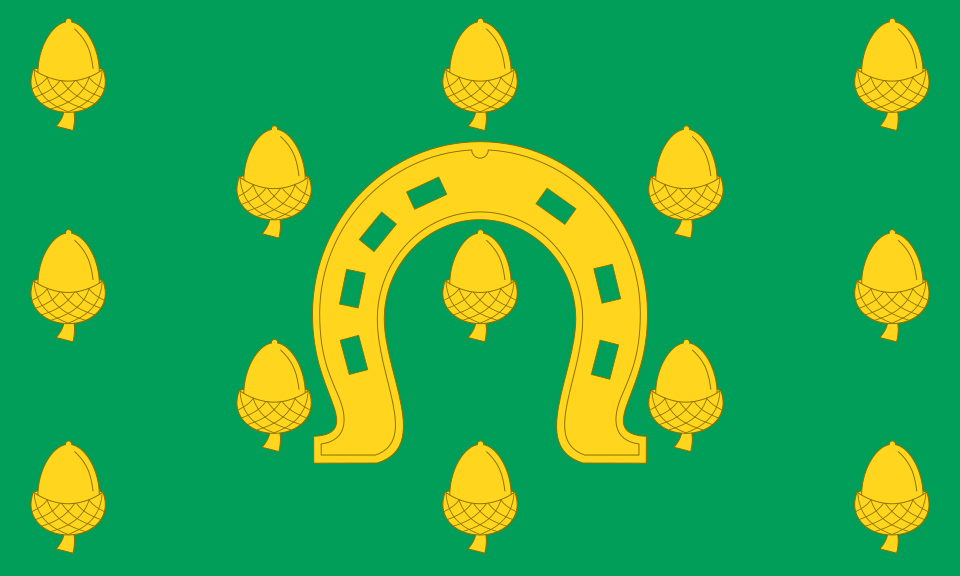
The Rutland county flag tells a distinctive part of England’s regional story. The design is a green field with a large golden inverted horseshoe in the centre, surrounded by thirteen golden acorns. This guide separates its visible elements, historical origins and modern public use, with the Flag Institute’s registered specification as the primary reference.
Rutland flag at a glance
| Feature | Details |
|---|---|
| County | Rutland, East Midlands, England |
| Flag type | Banner of county council arms for community use |
| Field | Green |
| Main emblem | Golden inverted horseshoe |
| Other devices | Thirteen golden acorns |
| Arms date | 1 May 1950 |
| Council rights waived | 9 November 2015 |
| Custom | Presentation of a horseshoe at Oakham Castle |
| Aspect ratio | 3:5 |
This is a county community flag, not an independent sovereign national flag. Historic heraldic emblems, council armorial grants and modern public flag adoption dates can describe different stages.
What does the Rutland flag look like?
The design is a green field with a large golden inverted horseshoe in the centre, surrounded by thirteen golden acorns.
The acorns are scattered evenly around the horseshoe, with one inside it. Neither an ordinary yellow ring nor a single oak leaf would reproduce the registered flag accurately.
Why does Rutland use a horseshoe?
Rutland’s golden horseshoe represents a long-standing local tradition associated with Oakham Castle. A peer of the realm making a first visit to the county is expected by custom to present a ceremonial horseshoe.
The Great Hall at Oakham Castle displays an extraordinary collection, with some examples dating back centuries. A horseshoe from Edward IV in 1470 is among the historic examples cited in accounts of the custom.
Why is the horseshoe turned upside down?
Unlike a household lucky horseshoe commonly shown with open ends upwards, Rutland’s device is an inverted or downward-opening horseshoe in the established heraldic drawing.
The direction is part of its recognizable historic form. A reversed illustration may still be identifiable, but it would not match the Flag Institute’s registered artwork and local arms.
Why are thirteen acorns around the horseshoe?
The golden acorns refer to the oak and the county’s history and landscape. The Flag Institute specifically links the scattered acorns with Rutland’s traditional standing as England’s smallest historic county.
The number and distribution of the acorns are features of the arms; there is no sound basis for claiming each one represents an individual parish or a named Oakham Castle visitor.
When was Rutland’s heraldic flag created?
The College of Arms granted Rutland County Council’s arms in 1950, and the flag derives from that banner of arms. The older horseshoe emblem predates the grant.
The Flag Institute notes use of the horseshoe as a Rutland emblem by at least 1784, showing that the historic symbol and its modern standardized green flag have different dates.
What changed in November 2015?
On 9 November 2015 the county council agreed to waive its rights in the banner design, allowing broader use as a public community flag.
This distinction matters when a reference gives both 1950 and 2015: the first refers to the coat of arms, and the second to making the same image freely available for local county identification.
Is Rutland still a county?
Yes. Rutland remains a historic and ceremonial county, and has unitary local government. Its small size is an important part of the county’s identity.
The flag represents a county within England, not a sovereign nation. It may appear at local events and historic heritage sites, alongside England’s red cross flag.
Rutland compared with nearby flags
Leicestershire has a running fox and cinquefoil on a jagged red-white background. Northamptonshire uses a maroon field with a gold cross and rose. Rutland’s green-and-gold horseshoe is unlike either.
The acorns help distinguish Rutland from similarly simple horns or horseshoes in other heraldic symbols, including Huntingdonshire’s green flag with a ribboned hunting horn.
How to draw Rutland’s flag
Use a green 3:5 field. Draw the broad golden horseshoe, open end downward, and position thirteen small gold acorns around and inside it following the registered vector.
Count the acorns before publishing: inaccurate reproductions can omit them or replace them with stars. The best quiz clue is gold horseshoe and acorns on green.
Frequently asked questions
What is the central symbol of Rutland’s flag?
An inverted golden horseshoe.
How many acorns are on the flag?
Thirteen.
Why does Rutland use a horseshoe?
It refers to the Oakham Castle custom requiring visiting peers to present a ceremonial horseshoe.
When were the arms granted?
1 May 1950.
What happened in 2015?
The council waived its rights to allow public use of the banner.
Does the horseshoe open upward?
No, the registered design opens downward.
What does green signify?
It provides the heraldic field and evokes Rutland’s rural identity.
Is Rutland a nation?
No, it is an English county.
Official references and illustration credits
Flag Institute — Rutland County Flag (UK Flag Registry)
Flag image attributionIllustration from Wikimedia Commons — Rutland flag vector, converted into a PNG without changes to the underlying design. The file page identifies the creator and licence conditions; follow its attribution and share-alike terms where applicable. Official insignia may carry additional restrictions.
Source-checked November 2026. Educational article; no Flag Institute endorsement is implied.