Greenland Flag: Red and White Circle, Erfalasorput Meaning & History
What does Greenland’s red-and-white flag mean, and why does it have a circle instead of a Nordic cross? Explore Erfalasorput, its designer and its 1985 adoption.
Greenland is a self-governing territory within the Kingdom of Denmark. Its flag is a rare Nordic design without the traditional Scandinavian cross, allowing it to be recognized among the flags of Denmark, Iceland and the Faroe Islands.
The Nordic Council of Ministers’ flag guide documents its adoption date, creator and main symbolism. That source is useful for separating the official reading of the red-and-white circle from familiar but sometimes simplified ‘iceberg’ interpretations.
Greenland flag at a glance
| Feature | Details |
|---|---|
| Territory | Greenland (Kalaallit Nunaat) |
| Constitutional status | Self-governing territory in Kingdom of Denmark |
| Capital | Nuuk |
| Greenlandic name | Erfalasorput (our flag) |
| Adopted | 21 June 1985 |
| Designer | Thue Christiansen |
| Colors | Red and white |
| Design | Horizontal bicolour with offset two-colour circle |
The table distinguishes historic design dates from later formal recognition, because the dates are not always identical. Refer to the official references below if you need a precisely standardized flag for institutional display or manufacture.
What does the Greenland flag look like?
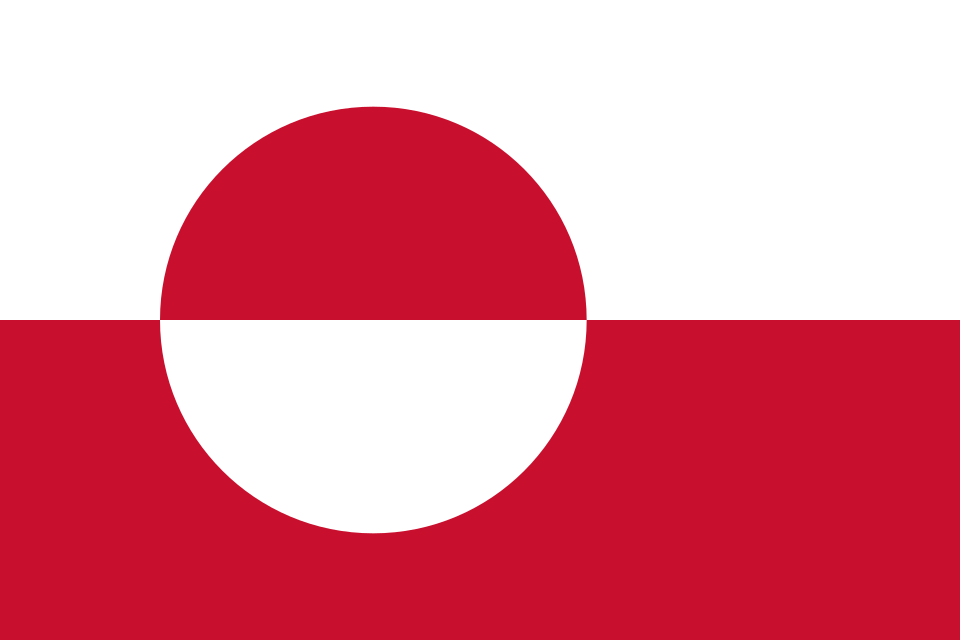
The upper half of the rectangular flag is white and the lower half is red. A large roundel straddles the dividing line slightly to the left of the centre. Inside that circle the colours switch: red lies above the horizontal midpoint and white below it.
The circle is an important part of the design, not a white sun entirely within the red band or a red dot entirely within the white band. When the flag is drawn correctly, both semicircles align on the central dividing line. There is no cross, crown, star or coat of arms.
What does the circle on Greenland’s flag mean?
The official Nordic cooperation explanation identifies the roundel with the sun setting on the horizon and the return of light and warmth at midsummer. The geography of Greenland makes the long northern summer and the sun’s seasonal movement particularly significant.
Another interpretation sometimes used in educational descriptions sees a white ice mass against a red sea or sky. That can be a helpful visual association, but the official explanation should not be replaced with a claim that the circle has one scientifically literal meaning, such as the exact shape of a single iceberg.
Why are the colours red and white?
The red-and-white palette recalls the colours of the Danish flag, expressing Greenland’s longstanding constitutional ties within the Kingdom of Denmark. Nordic cooperation also explains that Greenlandic red is known as Aappalaartoq, a traditional name or description connected with red.
Despite the shared colours, the Greenlandic flag’s layout is distinct. Denmark uses a white cross on red; Greenland uses two horizontal colour fields and a circle. This allows two flags to share a historical relationship without using the same national symbol.
Who designed the Greenland flag?
The selected design was created by Thue Christiansen, a Greenlandic artist who also served in public life. Greenland’s flag emerged from a long public discussion and the examination of proposed designs during the home-rule period.
It is more accurate to credit Christiansen with the official winning design than to assume the flag was invented by Denmark’s government. The decision to select a Greenlandic flag was an expression of the territory’s own political and cultural identity.
When was Erfalasorput adopted?
The flag was adopted and first raised on 21 June 1985. That day is Greenland’s National Day, making the adoption especially symbolic. The design predates Greenland’s later 2009 self-government arrangements and remains in use.
Greenland had gained home rule in 1979, so the flag followed an important change in self-government. That history is separate from independence: Greenland remains part of the Kingdom of Denmark. A map showing Greenland with its own flag does not mean it is a fully sovereign state.
Why doesn’t Greenland’s flag have a Nordic cross?
Denmark, Norway, Sweden, Finland, Iceland and the Faroe Islands all use cross-based designs. Greenland is a deliberate visual exception: its flag uses a circular emblem inspired by local landscape and seasonal light rather than a Christian Nordic-cross motif.
The Nordic cooperation guide notes that the absence of a cross illustrates Greenland’s political identity and relationship with other Inuit peoples around the Arctic. It is not evidence that Greenland is culturally unrelated to the Nordic region.
Greenland vs the Faroe Islands and Denmark flags
Greenland: red and white horizontal bands with an inverted-colour circle. Faroe Islands: white field with a red Nordic cross edged in blue. Denmark: solid red field with an off-centre white Nordic cross.
The Faroe Islands and Greenland are both self-governing parts of the Danish realm, but their flag designs and their adoption histories are separate. These are particularly useful examples for a Nordic geography quiz because the constitutional relationship does not dictate an identical pattern.
How to draw and identify the Greenland flag
Draw a horizontal rectangle. Fill its upper half white and lower half red. Place one large circle slightly nearer the flagpole than the fly edge, centred vertically on the horizontal boundary. Colour the circle’s upper semicircle red and lower semicircle white.
The question ‘Which red-and-white Nordic flag has a circle instead of a cross?’ identifies Greenland. Avoid moving the circle to the far right or changing the semicircles into a diagonal division.
Frequently asked questions
What is the Greenland flag called?
Erfalasorput, commonly translated as ‘our flag’.
When was the Greenland flag adopted?
21 June 1985, on Greenland’s National Day.
Who designed the flag of Greenland?
Greenlandic artist Thue Christiansen.
What does the circle mean?
The official Nordic explanation links it to the sun at the horizon and the return of summer light and warmth.
Why doesn’t the Greenland flag have a Nordic cross?
Its designers selected a distinct circular design rather than the cross common in other Nordic flags.
Is Greenland’s flag the same as Denmark’s?
No. Greenland has a red-and-white horizontal bicolour with a circle, while Denmark has a white cross on red.
Is Greenland independent?
No. Greenland is a self-governing territory within the Kingdom of Denmark.
Which way are the colours in the circle?
Red upper semicircle and white lower semicircle.
Official sources and illustration credits
Nordic cooperation — The Greenland flag
Erfalasorput — History of the flag selection
Danish encyclopedia Lex — Greenland flag history
This PNG is a rendering of the Wikimedia Commons vector of the Greenland flag. See the source file for licensing, creator and reuse details; official symbol rules can apply separately from copyright. Facts checked November 2026.