Shetland Flag: White Nordic Cross on Blue & 1969 History
Shetland’s white Scandinavian-style cross on blue combines Scotland’s colours with Nordic flag design. Learn its origin, 2005 recognition and how to distinguish Orkney.
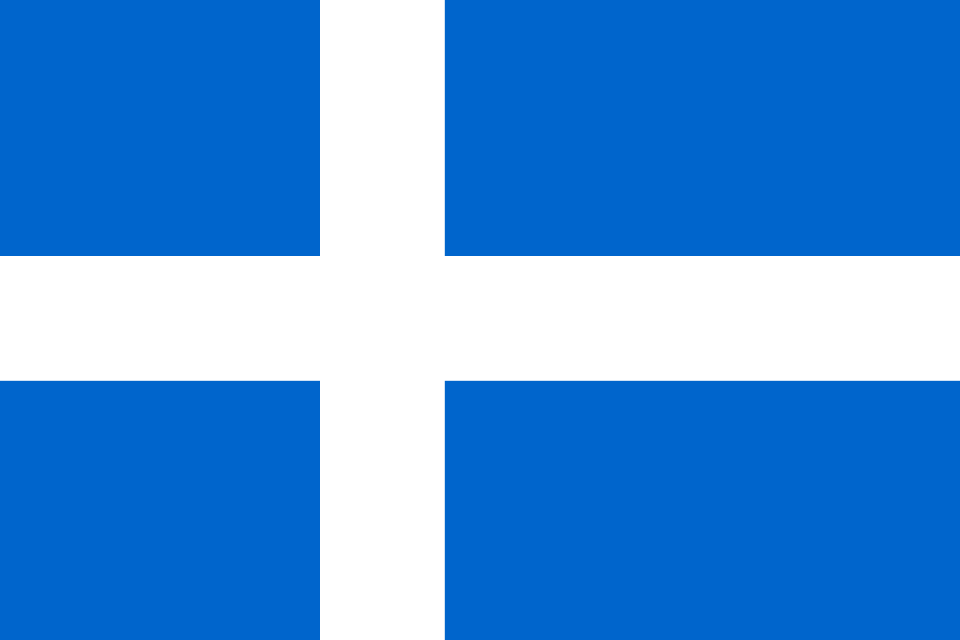
The Shetland Islands lie north of mainland Scotland and have strong ties to Scotland and Nordic history. Their flag reflects that dual heritage without borrowing the exact shape of Scotland’s diagonal Saltire.
The UK Flag Registry records the designers, historic context, pattern and registration. Shetland’s official tourism organisation also explains the 1969 creation and formal 2005 recognition.
Shetland flag at a glance
| Feature | Details |
|---|---|
| Place | Shetland Islands, Scotland |
| County flag | Shetland |
| Colours | Blue and white |
| Cross | White Nordic / Scandinavian cross |
| Designed | 1969 |
| Designers | Roy Grønneberg and Bill Adams |
| Recognized | 2005 |
| Registry ratio | 3:5 |
The table distinguishes historic design dates from later formal recognition, because the dates are not always identical. Refer to the official references below if you need a precisely standardized flag for institutional display or manufacture.
What does the Shetland flag look like?
The field is blue, crossed by a white upright cross whose vertical bar is closer to the hoist than to the fly. It is a Nordic cross, the same family of arrangements used in Denmark, Norway, Finland and other Scandinavian flags.
Because the cross is offset, its horizontal white bar is long across the fly side and shorter on the hoist side. This is distinct from a central upright cross and from a full diagonal X. The Flag Institute specifies a 3:5 ratio for the registered form.
What do the blue and white colours mean?
The colours come from Scotland’s blue field and white St Andrew’s saltire. The design deliberately preserves a visual link to Scotland by using its familiar two-colour pairing.
The cross shape comes from Scandinavian flag tradition, highlighting centuries of Norse influence in the Northern Isles. These two choices combine to express Shetland’s distinct island identity within Scotland. The colours are not officially described as one individual Shetland beach, sea route or snowfield.
Who designed the Shetland flag in 1969?
Roy Grønneberg and Bill Adams devised the flag in 1969 to mark the 500th anniversary of Shetland’s transition from Norwegian to Scottish rule in the late fifteenth century. The design was simple enough to be readily flown by communities and used in events.
The flag gained popularity over subsequent decades before formal recognition. It is therefore misleading to give only ‘1969’ as a legal adoption date without also explaining the later registration in 2005.
Why does Shetland use a Nordic cross?
Shetland’s Norse history shaped its place names, language traditions, culture and connections across the North Atlantic. The Nordic cross is a visible reminder of that history even though Shetland is now part of Scotland.
The Shetland.org heritage explanation directly links the cross to Scandinavian tradition. The cross should not be misidentified as Finland’s flag on a blue background: Finland’s design is blue on white.
When did the Shetland flag become official?
The Shetland flag received official recognition from the Lord Lyon King of Arms in 2005, around the time Shetland hosted the Island Games. This was decades after Grønneberg and Adams introduced it in 1969.
The Flag Institute lists its adoption route as Letters Patent. This identifies it as an officially recognized community or county flag, not the flag of a separate sovereign state. Shetland remains part of Scotland and the United Kingdom.
Shetland flag vs Scotland’s Saltire
Both flags are blue with a white cross. Scotland’s national Saltire has a diagonal white X running between all four corners. Shetland’s white cross is upright, with the vertical section shifted left toward the hoist.
A classroom identification rule is simple: white X on blue = Scotland; upright offset white cross on blue = Shetland. The meaning of the two flags is connected, but their geometry is different.
Shetland flag vs Orkney flag
Nearby Orkney uses a blue Nordic cross outlined in yellow on red, a three-colour design selected in 2007. Shetland uses only blue and white, with a white cross on a blue background.
Both island groups combine Scottish and Norse references but selected distinctive flag designs and adopted them through different historical processes. Do not use Orkney’s red-and-gold background for Shetland.
How to draw the Shetland flag
Draw a blue rectangle. Add a broad white horizontal stripe through the centre, then a white vertical stripe nearer the left side, reaching from top to bottom. The crossing should be square and the white arms continuous.
You do not need stars, a coat of arms or an extra coloured outline. For an identification quiz, a Nordic-style white cross on blue is Shetland’s defining combination.
Frequently asked questions
What does the Shetland flag look like?
A white Scandinavian or Nordic cross offset toward the hoist on a blue field.
Who designed the Shetland flag?
Roy Grønneberg and Bill Adams.
When was it designed?
1969, for the five-hundredth anniversary of Shetland’s transition from Norway to Scotland.
When did the Shetland flag become officially recognized?
2005, through the Lord Lyon King of Arms.
Why are its colours blue and white?
They recall Scotland’s national Saltire while the shape reflects Norse heritage.
How is it different from Scotland’s flag?
Shetland has an upright offset cross; Scotland uses a diagonal white X.
Is Shetland independent?
No. It is part of Scotland and the United Kingdom.
What flag is Orkney’s?
A red field bearing a blue Nordic cross bordered by yellow, recognized in 2007.
Official sources and illustration credits
Flag Institute — Shetland flag, UK Flag Registry
Shetland.org — Norse influence on Shetland culture
Shetland Council — Shetland in Statistics
This PNG is a rendering of the Wikimedia Commons vector of the Shetland flag. See the source file for licensing, creator and reuse details; official symbol rules can apply separately from copyright. Facts checked November 2026.