East Lothian Flag: Gold Hollow Saltire, Lion & Athelstaneford
What does East Lothian’s blue flag with a hollow gold saltire and rampant lion mean? Discover Athelstaneford, local rivers and Archie Martin’s 2018 design.
What does East Lothian’s blue flag with a hollow gold saltire and rampant lion mean? Discover Athelstaneford, local rivers and Archie Martin’s 2018 design. This guide identifies the precise flag pattern and distinguishes documented contemporary symbols from older legend or heraldic tradition.
The principal reference is the Flag Institute UK Flag Registry, which records the design, proportions and historical description. Public flag registration and governmental national-flag recognition are different categories.
East Lothian flag at a glance
| Feature | Details |
|---|---|
| Historic county | East Lothian, southeastern Scotland |
| Adopted | 13 December 2018 |
| Designer | Archie Martin |
| Field | Sky blue |
| Main shape | Hollow or voided gold saltire |
| Central emblem | Golden lion rampant inside diamond |
| Historical references | Athelstaneford and Earls of Dunbar |
| Adoption route | Lord Lyon and public vote |
| Registry code | UNKG7461 |
| Ratio | 3:5 |
The regional or island designation used here follows the UK Flag Registry’s own categorization. The flag can be recognized and displayed as a community symbol without changing the region’s constitutional status.
appearance
What does the East Lothian flag look like?
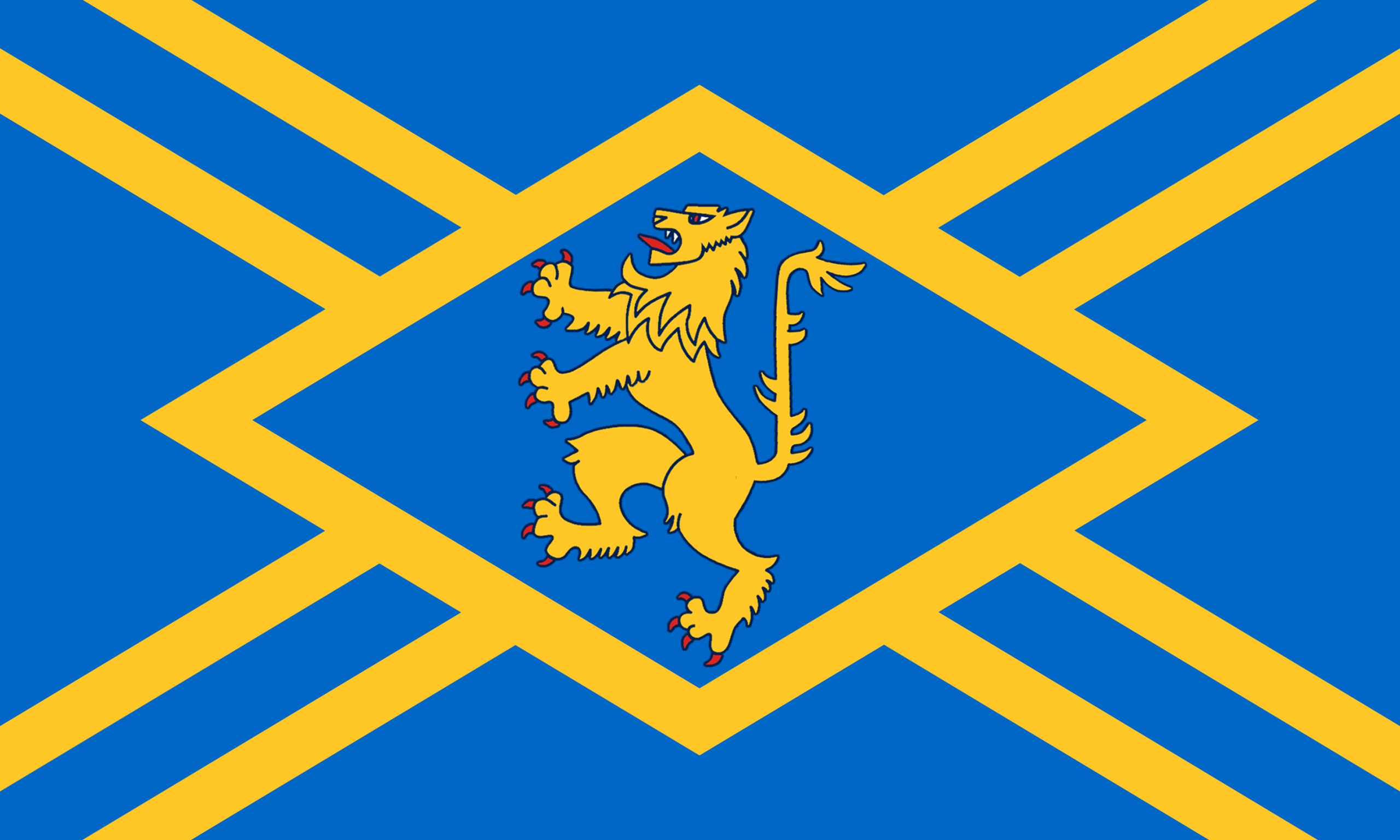
The flag uses a blue field with a hollow gold diagonal saltire whose yellow lines form a distinct cross outline rather than a single solid X. In the centre, a blue diamond carries a rampant yellow lion.
saltire
Why is there a gold saltire?
The saltire refers to Athelstaneford, a village in East Lothian traditionally associated with the legendary origins of Scotland’s national Saltire flag.
lion
What does the golden lion represent?
The central gold lion rampant connects the flag with East Lothian’s medieval history, including local nobility and the Earls of Dunbar or March.
blue
Why is the background blue?
Blue links the county flag with Scotland’s own national saltire and also evokes the rivers Esk and Tyne.
gold
What does the gold colour signify?
Gold symbolizes East Lothian’s agricultural richness, often described as the granary of Scotland. It also references the sun traditionally used in Lothian symbolism.
designer
Who designed the flag and when?
The winning design was made by Archie Martin, whose entry succeeded in a contest that attracted more than 600 submissions and 1,500 votes.
athelstaneford
What is Athelstaneford’s connection with Scottish flags?
Athelstaneford is traditionally identified as the place where a white saltire appeared as a divine sign in a story about an early medieval Scottish victory.
comparison
East Lothian vs Caithness and Berwickshire
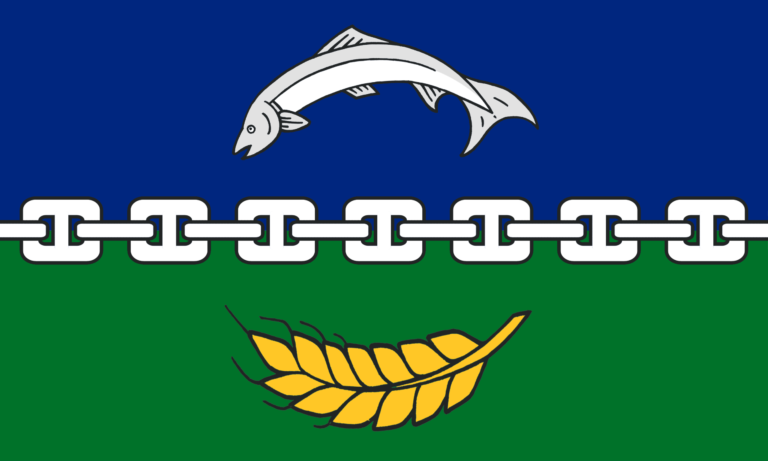
Caithness uses a blue Nordic cross outlined gold on black, plus a Viking galley. Berwickshire features salmon, barley and a chain on blue and green.
drawing
How to draw the East Lothian flag
Fill a rectangle sky blue. Draw a thin hollow yellow saltire, leaving blue inside the crossing arms. Frame a central blue diamond and add a gold lion rampant.
Frequently asked questions
When was East Lothian’s flag adopted?
13 December 2018.
Who designed it?
Archie Martin.
What does the gold saltire reference?
Athelstaneford and Scotland’s national saltire tradition.
What is the animal in the centre?
A golden lion rampant.
What do blue and gold symbolize?
Scottish identity, local rivers, agriculture and Lothian sun traditions.
Is it identical to Scotland’s national flag?
No; it has a hollow gold cross and a central lion.
Which nobles are linked to the lion?
The Earls of Dunbar or March.
What is the background colour?
Blue.
References and image credits
Flag Institute — East Lothian flag, UK Flag Registry
Featured flag artworkRegistered PNG artwork reproduced from the same Flag Institute flag page. The Registry states its illustrations are free to download and reuse. Used for educational flag identification, without any implied governmental endorsement.
Factual review dated November 2026. Historical and symbolic claims are attributed to the Registry and, where relevant, labelled as tradition.