England Flag: St George’s Red Cross, Meaning & History
England’s flag is a red upright St George’s Cross on white—not the Union Jack. Explore its medieval origins, modern use and connections with other flags.
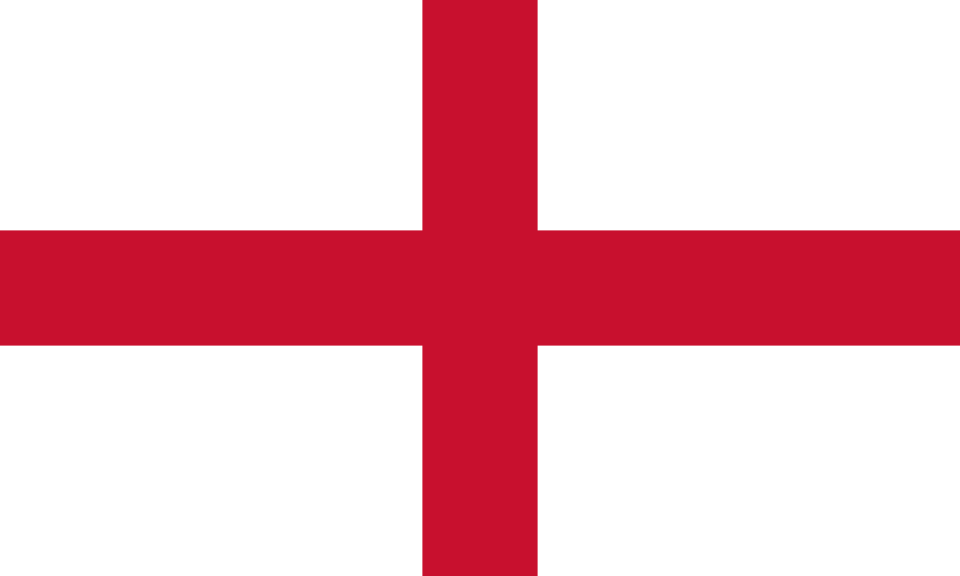
The flag of England is one of the simplest national designs to recognize: an even red cross reaches the edges of a white rectangle. It has no stars, crown, coat of arms or extra diagonal stripes.
England is one of the four constituent nations of the United Kingdom. Its individual flag remains familiar at England sports matches and national celebrations. The UK Government’s flag-flying guide expressly recognizes St George’s cross as the national flag of England.
England flag at a glance
| Feature | Details |
|---|---|
| Nation | England, constituent country of the UK |
| Flag name | St George’s Cross |
| Design | Red upright cross on white |
| Cross type | Upright St George’s Cross with arms reaching all four edges |
| Patron saint | St George |
| Saint’s day | April 23 |
| Origins | Medieval emblem; no single definitive modern adoption date |
| Distinguish from | Union Jack, Scotland, Guernsey and Cornwall |
These features describe the recognized flag. The official and specialist sources linked below help distinguish documented history and heraldry from popular traditions and later interpretations.
What does the England flag look like?
England’s flag is white with a red upright cross whose vertical and horizontal arms pass through the centre. The red bands reach the four edges. The white areas form four rectangles around the cross; the design has no lettering or additional badges.
It is a common identification mistake to substitute a red diagonal X or a red cross on blue. A diagonal X is a saltire, found in different forms on the Scottish and Jersey flags. England’s flag specifically uses an upright cross.
What does the St George’s Cross represent?
The central red cross is associated with Saint George, a Christian martyr whose cult became important in medieval England. George came to be recognized as England’s patron saint; the emblem was used in military, religious and civic contexts before becoming a familiar national banner.
A white field with a red cross is not a diagram assigning the cross to every English county. It is a heraldic and religious symbol later embraced for English national identity. Its identification as St George’s cross is secure even though the circumstances of its earliest use are complex.
How old is the English flag?
Red crosses were used in medieval European warfare and religious display, and English association with St George’s cross developed over several centuries. Descriptions that supply one exact year for the ‘invention’ of England’s flag can be misleading: flags, coats of arms and military insignia changed gradually.
By the late medieval and early modern periods, the white flag with a red cross had become an established English emblem. The historical flag remained recognizable even after the Union Flag developed following the union of England and Scotland’s crowns in 1603. The combined Union Flag was introduced in 1606 and revised to its current form in 1801.
England flag vs Union Jack: what’s the difference?
The Union Jack is the flag of the United Kingdom, not of England alone. It combines England’s red St George’s cross with Scotland’s white St Andrew’s saltire and Ireland’s red St Patrick’s saltire. The result is a layered red, white and blue design.
England’s own flag has only red and white and only one upright cross. A practical quiz test is to look for blue: if there is blue and diagonal red-white detailing, you may be looking at the Union Flag; if there is a plain red plus on white, it is England’s flag.
When is St George’s Day and how is the flag used?
St George’s Day falls on April 23. England flags commonly appear at local events, celebrations and sporting fixtures. Public buildings may also fly the St George’s cross according to their own flag policies.
UK planning guidance recognizes England’s national flag for display without planning consent under normal conditions, although safety, landowner permission and certain local rules still matter. For exact flag-flying requirements consult current GOV.UK guidance, not an unofficial internet infographic.
Which other flags look similar to England’s?
Guernsey’s modern flag is closely related: it keeps a red upright St George’s cross on white but adds a smaller golden Norman cross over it. See the Guernsey flag guide for its 1985 redesign.
The Cornwall flag also has one upright cross but its colours are reversed to white on black. The Scottish Saltire has a white diagonal X on blue, while Wales features a red dragon. Recognizing cross orientation and background colour is more reliable than guessing from geographic proximity.
Was Saint George English?
Saint George is generally understood to have been a Christian martyr from the eastern Mediterranean or Roman world, not a historical person born in England. His connection with England arose through medieval religious and political tradition.
That distinction explains how a saint who lived far from Britain became the namesake of England’s flag. A national patron saint need not have been born in the modern country that later adopted the patronage.
How to draw the English St George’s Cross correctly
Start with a white rectangular flag. Add a straight red vertical stripe down its centre and a straight red horizontal stripe across the middle, forming a single continuous upright cross. Both bands should extend fully to the edges and be of equal thickness.
Do not add the golden cross of Guernsey, the extra saltires of the Union Jack or the dragon of Wales. For a classroom identification activity, ask learners to name the nation represented by a red upright cross on white: the answer is England.
Frequently asked questions
What is the England flag called?
St George’s Cross, a red upright cross on a white field.
Why is there a red cross on England’s flag?
It is associated with Saint George, England’s patron saint, and medieval heraldic traditions.
Is England’s flag the Union Jack?
No. The Union Jack represents the United Kingdom and combines several historic crosses.
When is St George’s Day?
April 23.
What colours are on the English flag?
Red and white only.
Is St George’s flag the same as Guernsey’s?
No. Guernsey has a smaller golden Norman cross over the red one.
Does Scotland have the same flag?
No. Scotland has a white diagonal X on a blue background.
References and illustration credits
GOV.UK — Flying flags: a plain English guide
GOV.UK — Flying England’s national flag
College of Arms — Flag-flying days 2026
The flag illustration is a PNG rendering of England flag artwork from Wikimedia Commons. See the source file page for the contributor and copyright/licence notice; government symbol use may be subject to separate rules. History reviewed November 2026.