Scotland Flag: White Saltire, St Andrew & Blue Cross History
Scotland’s national Saltire is among the simplest flags to recognize: a white diagonal X on blue. Its story combines heraldry, St Andrew and a famous legend.
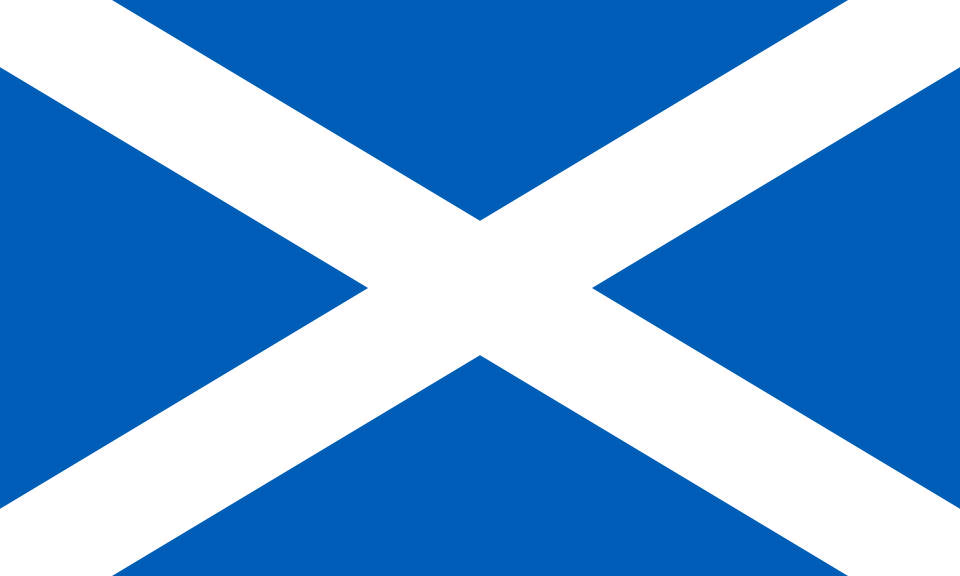
The Scottish Saltire appears at sporting events, on public buildings and within the design of the United Kingdom’s Union Flag. Its striking white diagonal cross makes it different from the red upright cross of England’s flag.
Official Scottish Government flag guidance and the Scottish Parliament flag policy establish its modern use. The traditional story about a cross appearing in a sky should be treated as a legend, not a securely documented battle report.
Scotland flag at a glance
| Feature | What to know |
|---|---|
| Country | Scotland, constituent nation of UK |
| Capital | Edinburgh |
| Name | Saltire / St Andrew’s Cross |
| Design | White diagonal X on blue |
| Patron saint | St Andrew |
| National day | November 30 |
| Modern blue guidance | Often Pantone 300 |
| Not the same as | The royal Lion Rampant banner |
The details above describe the recognized flag, not a proposed alternative design. Use the linked official references and artwork source if you need exact proportions, colour or emblem geometry.
What does the flag of Scotland look like?
The national flag has a solid blue rectangular background crossed diagonally by a broad white saltire, forming an X from corner to corner. It does not have a central emblem, a vertical upright cross, a lion or stars.
A 3:5 illustration is commonly used. Different manufacturers may sell different dimensions; if exact official display is needed, follow the relevant government or flag-authority guidance. The defining feature is the white St Andrew’s Cross on blue, not a particular decorative shade or border.
Why is the white X called St Andrew’s Cross?
A diagonal cross is called a saltire in heraldry. Christianity associates this cross form with Saint Andrew, whose martyrdom was traditionally represented on an X-shaped cross. Andrew is Scotland’s patron saint, and his emblem became a national sign.
The cross’s white colour against blue has become a symbol of Scottish identity far beyond religious ceremonies. On St Andrew’s Day, November 30, the Saltire is especially prominent. It is also used regularly throughout the year.
What is the Battle of Athelstaneford legend?
According to Scottish tradition, a leader named Angus faced an opposing army near Athelstaneford in East Lothian. A white saltire was said to appear against a blue sky, inspiring his forces and later being remembered as the origin of Scotland’s flag.
The Scottish Flag Trust relates this famous narrative. It is an important part of national folklore, but the dramatic sky appearance is not established historical fact. Historical use of saltire imagery and the flag’s later development are separate questions from whether that apparition occurred.
How did the Saltire become a Scottish national flag?
The connection between St Andrew and Scotland developed in the medieval period, and the diagonal cross became an enduring heraldic motif. Military and civic usage evolved over many centuries, with the saltire becoming increasingly recognizable as Scotland’s flag.
When the crowns and later political institutions of Britain were united, the Scottish white diagonal cross was combined with the crosses of other patron saints in the Union Flag. Scotland nonetheless retained the Saltire as its own national flag, which the Scottish Government continues to fly.
What shade of blue should the Scottish Saltire use?
Historical depictions vary from lighter sky blue to deeper blue, leading to disagreement over colour. Modern Scottish guidance often recommends Pantone 300 as a suitable shade. The guidance is best described as a standardizing recommendation, not proof that every medieval Saltire had exactly that hue.
For an accurate modern graphic, use an established official or public-domain vector rather than choosing unrelated shades in different sections of one illustration. The white cross should remain clearly legible and touch all four corners of the blue field.
Is the Lion Rampant the flag of Scotland?
The red Lion Rampant on a gold field is often seen at matches and parades, but it is not Scotland’s ordinary national flag. The Scottish Parliament identifies it as the King’s official banner in Scotland, associated with the Royal Arms.
The two banners are visually distinct: the national Saltire is a white X on blue, whereas the royal banner has a red upright lion inside a decorative double border on gold. Do not use a Lion Rampant picture when a quiz asks for the national flag of Scotland.
How is Scotland’s flag used in the Union Jack?
The United Kingdom’s Union Flag incorporates the white St Andrew’s saltire together with St George’s red upright cross and St Patrick’s red diagonal cross. The layered crosses produce the familiar red, white and blue Union Flag.
The individual Saltire still exists in its simple form. Wales’ red dragon does not appear in the Union Flag: its historical development differs from the crosses combined in the UK design. Scotland’s Saltire also differs from Galicia’s flag, which has only one blue diagonal stripe on white rather than a full white X on blue.
How to draw the Scottish Saltire correctly
Draw a wide blue rectangle. Add two white diagonal bands: one joining the upper-left and lower-right corners, and the other joining the lower-left and upper-right. Where they meet, the bands form a white X without an extra central picture.
Do not change the X to a plus-shaped cross—that would create a different design. In a classroom comparison, Scotland’s Saltire contrasts with the English St George’s Cross and the red Welsh dragon flag.
Frequently asked questions
What is the Scottish flag called?
The Saltire or St Andrew’s Cross.
What do the Scottish flag’s colours and cross mean?
A white diagonal cross linked to Scotland’s patron saint, St Andrew, on a blue field.
Is Scotland’s flag the Lion Rampant?
No. The Lion Rampant is the monarch’s royal banner in Scotland; the national flag is the Saltire.
What is the Scottish flag’s blue colour?
Pantone 300 is often recommended in modern guidance, although historical shades varied.
What happened at Athelstaneford?
A traditional legend describes a white cross appearing against a blue sky before a battle; the apparition is not verified historical fact.
Is the Scottish flag part of the Union Jack?
Yes. The white St Andrew’s cross is one of the elements combined in the Union Flag.
When is St Andrew’s Day?
November 30.
Official references and illustration credits
Scottish Government — Flag flying guidance
Scottish Parliament — Flag flying policy
Scottish Flag Trust — The legend of the Saltire
Scottish Parliament — 2003 discussion of Saltire blue
The flag illustration is a PNG rendering of the Wikimedia Commons vector file for Scotland. Consult the linked file page for the original author’s attribution and stated licence, and official guidance for rules on use of government insignia. Article facts checked November 2026.