Cornwall Flag: St Piran’s White Cross on Black Explained
A bold white cross on black marks Cornwall’s distinctive identity. Learn the story of St Piran, the tin interpretation and the flag’s recorded history.
Cornwall is a historic county at the southwestern end of England with a distinct Cornish culture and language heritage. Its black-and-white banner is widely seen on buildings, at events and during St Piran’s Day celebrations.
The Flag Institute’s UK Flag Registry identifies the design as a traditional community and county flag and lists a 3:5 aspect ratio. The Cornwall National Landscape heritage guide documents the saint’s cultural importance and the widely repeated tin symbolism.
Cornwall flag at a glance
| Feature | Details |
|---|---|
| Region | Cornwall, southwestern England |
| Cornish name | Baner Peran |
| Common English name | St Piran’s Flag |
| Design | White upright cross on black |
| Traditional period | Documented by 19th-century sources |
| Flag Institute ratio | 3:5 |
| Patron saint | St Piran, patron of Cornish tin miners |
| St Piran’s Day | March 5 |
These features describe the recognized flag. The official and specialist sources linked below help distinguish documented history and heraldry from popular traditions and later interpretations.
What does Cornwall’s black-and-white flag look like?
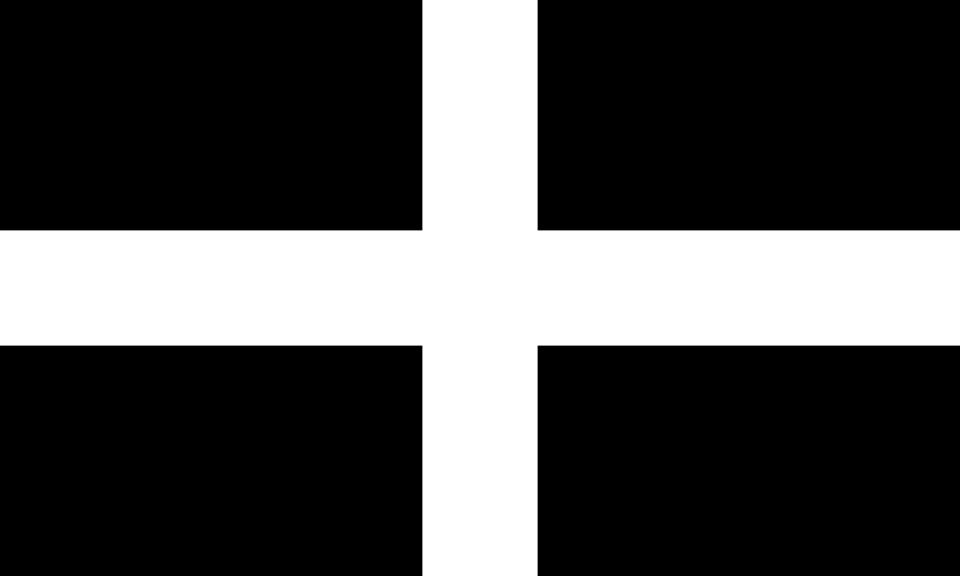
St Piran’s Flag has a single upright white cross centred on a completely black rectangular field. The white horizontal arm stretches to both side edges and the vertical arm reaches top and bottom. It contains no shield, animals or diagonal bars.
The Flag Institute lists the conventional form at 3:5. In drawings, the essential feature is the high contrast of the white cross against a black background. A black cross on white would reverse the actual design.
Why is the Cornwall flag black and white?
A popular reading associates white with pure or molten tin and black with tin-bearing rock or ore. Mining shaped Cornish communities for centuries, making this explanation culturally resonant. The Flag Institute describes the interpretation as something the colours may represent, rather than assigning a proved medieval proclamation.
Cornwall National Landscape also recounts a tradition connecting white tin from dark ore with St Piran. The image is an effective classroom memory device, but should be labelled traditional symbolism rather than treated as established evidence of a specific historic designer.
Who was St Piran?
St Piran is a patron saint strongly connected with Cornwall, particularly with tin miners. His medieval cult and legends are linked with sites around Perranporth, including the remains of St Piran’s Oratory.
Folklore tells of Piran arriving in Cornwall from Ireland and of tin emerging from a heated dark stone. Versions of the story differ and are not a factual reconstruction of the history of Cornish mining. The saint and his banner nevertheless became important expressions of regional heritage.
How old is St Piran’s Cross as a flag?
The banner’s exact starting date cannot be securely pinned to a single medieval year. Nineteenth-century writing already describes a white cross on black as a banner of St Piran and a standard of Cornwall. These written references are firmer evidence than an unsupported claim that the current flag was officially adopted in the fifth century.
By the time of modern Cornish cultural revival, the white cross on black had become an accessible, recognizable flag for the county. The UK Flag Registry calls its date 19th century and its adoption route traditional. That describes its recorded flag history without denying older folklore.
When is St Piran’s Day?
St Piran’s Day is March 5. Cornish communities use the occasion for parades, music, language, cultural celebrations and the display of the black-and-white flag. It is one of the most visible dates on the flag’s annual calendar.
The same banner may be seen year-round at festivals, cultural gatherings and sporting fixtures. Its use expresses Cornish identity within the United Kingdom; it is not a declaration that Cornwall is a separate sovereign state.
Is the Cornwall flag an official national or county flag?
The Flag Institute records Cornwall’s design in the UK Flag Registry as a county/community flag. People sometimes call it a Cornish national flag in a cultural sense, reflecting the distinctive Cornish identity and recognition of the Cornish as a national minority.
In constitutional terms, Cornwall remains within England and the United Kingdom. Distinguish that administrative status from how Cornish people describe their own cultural heritage. The flag belongs to a longstanding regional tradition rather than the flag of a separate independent state.
How is Cornwall’s flag different from England’s and Brittany’s?
The flag of England is a red upright cross on white. Cornwall’s has the same upright cross form but a white cross on black. Scotland’s blue field has a diagonal white X, a different type of cross.
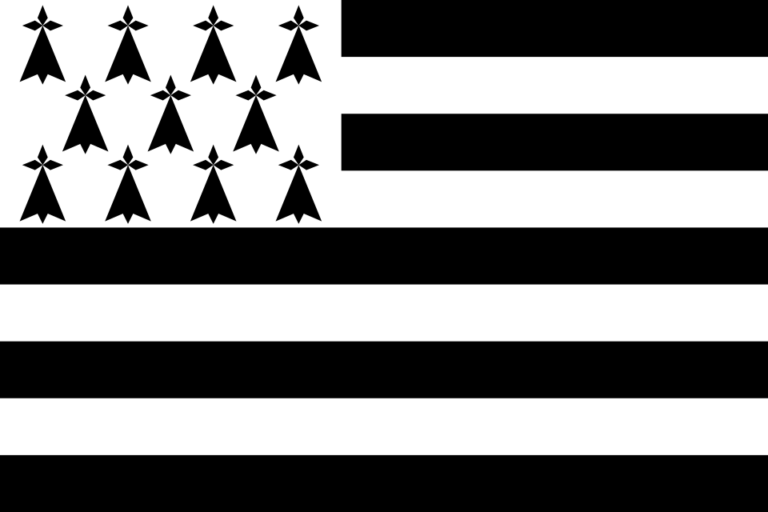
Cornwall also has cultural connections with Celtic Brittany, but Brittany’s Gwenn ha Du uses alternating black-and-white stripes and an ermine canton. The shared black-and-white palette does not make the two flags interchangeable.
How to draw the Cornwall flag
Draw a black rectangle and then add a centered white vertical bar from top to bottom and a white horizontal bar from left to right. Make both bars visibly thick and of equal width. The result is a single white upright cross.
For an easy flag quiz, ask what place is represented by a white cross on black, associated with St Piran and tin mining. The answer is Cornwall. A white cross on blue would not be the Cornish design.
Frequently asked questions
What is the Cornwall flag called?
St Piran’s Flag, also called Baner Peran in Cornish.
What do the black and white colours mean?
Traditionally, black is linked with tin-bearing ore and white with refined or molten tin; the origin of that interpretation is not firmly proved.
When is St Piran’s Day?
March 5.
Is Cornwall’s flag a national flag?
It is a traditional Cornish county/community flag, often called national in a cultural sense; Cornwall is not a sovereign state.
Is Cornwall’s flag the opposite of England’s?
They share an upright cross shape but use different colours: Cornwall white on black, England red on white.
Does the Cornwall flag have a dragon?
No. It is a plain white cross on black.
What ratio does the Flag Institute record?
3:5.
References and illustration credits
Flag Institute — Cornwall Flag (UK Flag Registry)
Cornwall National Landscape — St Piran’s Oratory
British County Flags — Cornwall and historic sources
The flag illustration is a PNG rendering of Cornwall flag artwork from Wikimedia Commons. See the source file page for the contributor and copyright/licence notice; government symbol use may be subject to separate rules. History reviewed November 2026.