Isle of Man Flag: Three Legs, Triskelion & Motto Meaning
Three joined armoured legs on a red field make the Isle of Man flag instantly recognizable. Explore the triskelion, history and famous Latin motto.
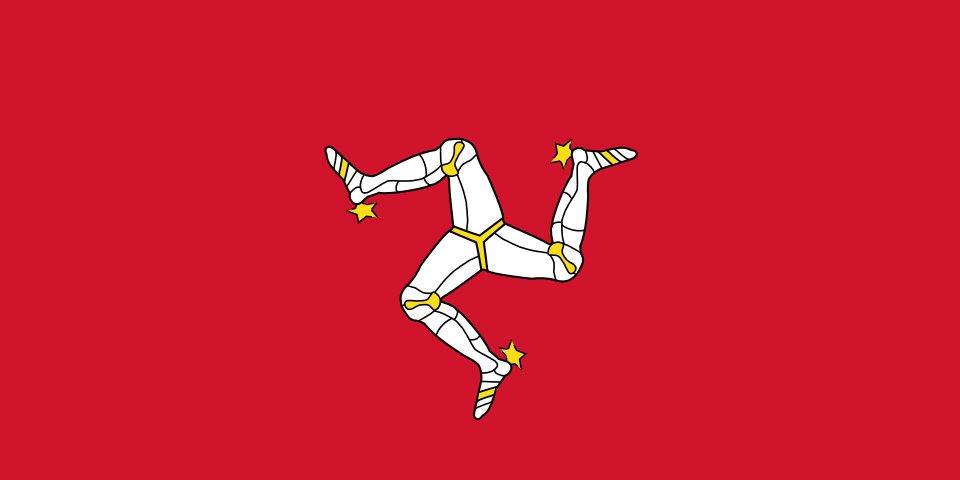
The Isle of Man sits in the Irish Sea between Great Britain and Ireland. It is a self-governing Crown Dependency, not a constituent country of the UK. Its red flag has no Union Jack, diagonal cross or coat-of-arms shield: three bent legs are its central picture.
The Manx National Heritage explanation traces the motif to medieval royal use and warns that its earlier origin cannot be proved conclusively. The Flag Institute confirms its modern status as the Crown Dependency’s flag.
Isle of Man flag at a glance
| Feature | Details |
|---|---|
| Place | Isle of Man, Irish Sea |
| Status | Self-governing Crown Dependency |
| Capital | Douglas |
| Field | Solid red |
| Central emblem | Three silver armoured legs with gold spurs |
| Emblem name | Three Legs of Mann / triskelion |
| Historical roots | Manx royal arms in 13th century |
| Motto | Quocunque Jeceris Stabit |
These features describe the recognized flag. The official and specialist sources linked below help distinguish documented history and heraldry from popular traditions and later interpretations.
What does the Isle of Man flag look like?
The whole background is red. In the centre, three bent, silver-coloured armoured legs radiate from one central point. Their gold spurs and detailing give the emblem a heraldic appearance. There is no lion, moon, star or diagonal stripe.
A threefold rotating motif is known as a triskelion or triskele. On the Manx flag it is specifically made of armoured legs. The Three Legs of Mann are recognizable even when the flag is shown small.
Why does the Isle of Man flag have three legs?
Manx National Heritage records the Three Legs emblem as the arms of kings ruling the Isle of Man and other western islands in the thirteenth century. It appeared on official symbols, including the medieval Manx Sword of State, and later on coins.
The reason medieval rulers originally selected the emblem is not known with certainty. Suggestions include older solar or triskelion imagery, or motifs known through Norse contacts. Treat these as historical theories, not a proven single explanation that the legs represent three named kingdoms or three political branches.
What does Quocunque Jeceris Stabit mean?
The Latin motto most often associated with the Three Legs is Quocunque Jeceris Stabit. It is commonly translated as ‘Whichever way you throw it, it will stand’ or ‘Wherever you throw it, it will stand’. Its imagery suggests steadiness and resilience regardless of how the symbol turns.
Manx National Heritage says the motto has been associated with the Three Legs since about 1300. Importantly, the words do not appear on the ordinary flag. They may be printed alongside the emblem on souvenirs or in related arms, but not as part of the standard flag design.
When did the Isle of Man begin using the triskelion?
The triskelion is older as an artistic pattern than the modern flag. The Manx-specific three-armoured-legs emblem is securely associated with medieval rulers, and the Island kept the motif when sovereignty over it changed. It continues as a civic emblem in modern times.
Many flag references date the official red-background flag to the twentieth century, commonly 1932, while the emblem itself is far older. Do not interpret the date of the modern flag form as the birth date of Manx identity or of the historic Three Legs.
Does the direction of the three legs matter?
In typical official renderings the three bent legs form a clockwise-running triskelion, with feet and spurs arranged in a repeating circle. Manx National Heritage notes that early depictions also showed the legs running towards the sun. Such details matter when comparing actual artwork.
A reversed or mirrored illustration may still look like a triskelion to a casual viewer, but should not be represented as an exact official image without checking a reference. For a classroom sketch, prioritize three joined armoured legs on red before attempting minute armour or spur details.
Is the Isle of Man part of the United Kingdom?
The Isle of Man is a Crown Dependency, with its own legislature and domestic self-government and a direct constitutional relationship with the Crown. It is not one of the UK’s four constituent countries and does not use the Union Jack as its primary island flag.
Jersey and Guernsey are also Crown Dependencies, but their flags use crosses instead of legs. Comparing all three helps readers understand how constitutional links to the British Crown do not require the same national flag design.
Is the Isle of Man flag the same as Sicily’s?
Both the Isle of Man and Sicily use a three-legged motif, but their flags are different. The Sicilian flag has a yellow-and-red diagonal background and a central Trinacria with a head and three legs. The Manx flag is solid red with three armoured legs and no head.
The similarity is a useful example of how ancient threefold symbols appear in several European traditions. It does not prove that one flag was directly copied from the other; theories of the triskelion’s spread should be separated from documented modern flag designs.
How to draw and identify the Isle of Man flag
Draw a solid red horizontal rectangle. In the middle, arrange three silver or white bent armoured legs, radiating evenly around a single joint, with small yellow-gold spurs at the feet. The group should read as a rotating three-legged wheel.
For a quiz, ask which Crown Dependency’s flag uses three armoured legs on red. Answer: the Isle of Man. Jersey uses a red saltire and crowned shield, while Guernsey has layered upright crosses.
Frequently asked questions
What do the three legs on the Isle of Man flag mean?
They form the traditional Three Legs of Mann, a medieval royal emblem whose exact original inspiration is uncertain.
What is the Manx triskelion?
Three bent armoured legs joined at a central point.
What is the Latin motto?
Quocunque Jeceris Stabit: ‘Whichever way you throw it, it will stand.’
Does the motto appear on the flag?
No. The standard flag shows only the three-legged emblem on red.
Is the Isle of Man part of the UK?
No. It is a self-governing Crown Dependency.
Is it the same flag as Sicily?
No. Sicily’s Trinacria includes a central head on a diagonally red-and-yellow field.
When did the three legs become a Manx emblem?
Manx royal heraldic uses are documented in the thirteenth century.
References and illustration credits
Manx National Heritage — Three Legs of Mann
Flag Institute — Isle of Man Flag
Tynwald — Official Manx legislature
The flag illustration is a PNG rendering of Isle of Man flag artwork from Wikimedia Commons. See the source file page for the contributor and copyright/licence notice; government symbol use may be subject to separate rules. History reviewed November 2026.