Bavaria Flag: Blue-White Diamonds vs Stripes Explained
Why are there two official Bavarian flags? Compare the white-and-blue diamond pattern with the white-over-blue striped flag, and learn their medieval heraldic origins.
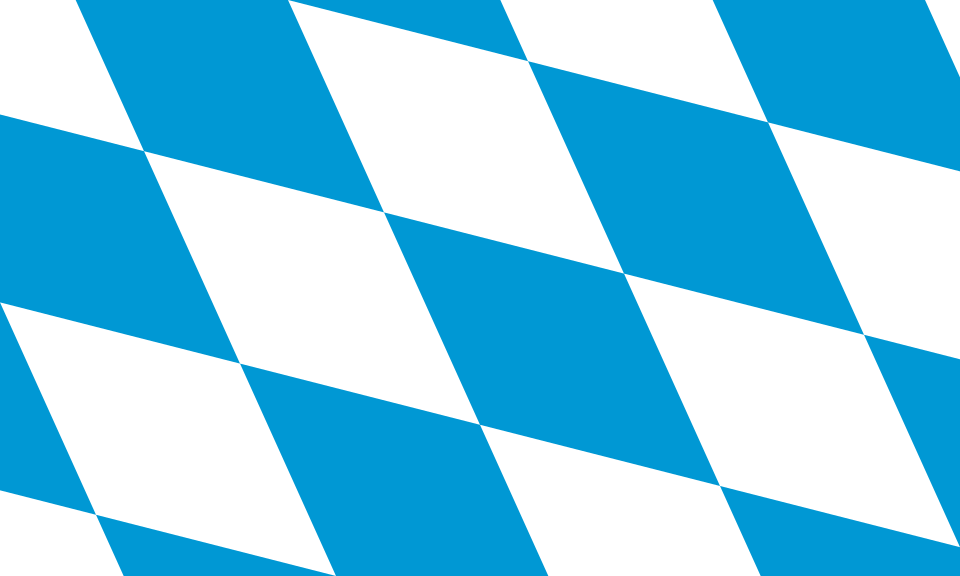
Blue and white are instantly recognizable as Bavaria’s colors, from public buildings in Munich to sports and festivals. But not every Bavarian flag uses the familiar diamond pattern. A simple white-over-blue bicolour is equally official under Bavarian flag rules, and many modern graphics with an added coat of arms are unofficial variants.
These distinctions are established by the Bavarian State Parliament, which lists the two official forms and explains the historic blue-and-white heraldry. This makes the article more useful than a generic description of the diamonds as an Oktoberfest decoration.
Bavaria is a federal state within Germany. Its regional flags are distinct from Germany’s black-red-gold national flag; see the Germany flag history and meanings guide for that national context.
Bavaria flag design: both official versions compared
Bavaria’s constitution identifies white and blue as its state colors. Official practice allows both the lozengy rhombus flag and the simple striped bicolour without a coat of arms. Their use is not confined to different seasons or political parties.
| Flag detail | What to know |
|---|---|
| Federal state | Bavaria (Bayern), Germany |
| State colors | White and blue |
| Official flag A | White-blue diamonds (lozenges) |
| Official flag B | White upper stripe, blue lower stripe |
| Legal equality | Both coequal since 1953 |
| Diamond count | At least 21, including truncated diamonds |
| Heraldic roots | Counts of Bogen and Wittelsbach family, thirteenth century |

What do the blue and white diamonds represent?
The diamond shapes are called lozenges, rhombuses or Rauten in German. They were part of the heraldic shield of the medieval Counts of Bogen, whose line was later linked to the House of Wittelsbach. They became closely associated with the rulers of Bavaria and eventually with the state as a whole.
The Bavarian parliament identifies the 1242 transfer of this heraldic tradition to the Wittelsbach family as an important turning point. From then onward the white-and-blue lozenges developed into one of Bavaria’s most recognizable emblems. They appear in modern symbols, coats of arms and flag designs.
The diamonds do not each stand for one Bavarian district or beer style. Their repetition is a heraldic pattern, not a pictogram containing an independent message for every shape.
Are they diamonds or triangles?
The shapes are diamond-like rhombuses, slanting across the fabric. When cropped by the edge of the flag they can appear triangular, but those incomplete pieces still count when the minimum-number rule is applied. A viewer should see a continuous diagonal lozenge pattern rather than a checkerboard of upright squares.
How many lozenges must the Bavarian flag contain?
The official requirement is a minimum of 21 white and blue lozenges, including those cut at the edges. An image of only a handful of large diamonds may be a decorative imitation rather than a faithful representation of the official flag.
The rule does not demand exactly twenty-one perfectly complete shapes in every size. More lozenges may be used, and partially visible pieces count in the total. The Bavarian State Parliament also states that when viewed from the front, the lozenge at the upper-left corner should be white.
This is useful for graphic designers recreating the Bavarian banner. A scalable vector pattern should keep a white lozenge at the upper-left and enough repetitions to meet the minimum. Changes in aspect ratio can influence how many partial diamonds are visible, but do not change the state colors.
What is the second official Bavaria flag?
The other official flag uses two equal horizontal stripes: white at the top and blue at the bottom. There is no separate shield or emblem in the middle. It is often less familiar internationally because the diamond pattern dominates tourism imagery, but the striped form is equally legitimate for state flag identification.
The Bavaria Parliament says the two flags have been coequal since 1953. They are not successive designs where one replaced the other, nor are they restricted to supporters of competing groups. Different state offices, public events and private displays may use either form.
A blue-over-white bicolour reverses the official horizontal order and should not be identified as the standard striped flag in an educational diagram. The official design specifies white over blue.
Can either official flag include the Bavarian coat of arms?
The two simple state flag forms are described without any coat of arms. Flags with a central shield, crest, lions or elaborate coat-of-arms graphics appear as souvenir and decorative variants, but the added emblem does not make them the standard official state flag defined by the parliamentary guidance.
The medieval origins of Bavaria’s white and blue
The Counts of Bogen used the white-and-blue pattern before it became a signature of the Wittelsbach house. When the last male member of that line died in the thirteenth century, the relevant heraldic tradition passed into Wittelsbach use. Later Bavarian rulers continued to display these colors as their political territories changed.
As the Bavarian state developed, royal and administrative symbols incorporated the lozenges in different heraldic arrangements. Their present-day association with the entire state is stronger than their origins in a specific medieval dynasty. The region’s official coat of arms still incorporates the traditional Bavarian shield.
The state constitution of December 2, 1946 expressly identifies white and blue as Bavarian state colors. The two flags’ equal modern status followed in 1953. Thus, the medieval tradition explains the emblem, while postwar law explains the current official use.
Why are blue and white diamonds everywhere at Oktoberfest?
Blue-and-white decoration is closely connected with Bavarian identity, so it is common in festival tents, tourism branding and merchandise associated with Munich and Oktoberfest. A lozenge pattern instantly suggests Bavaria even when it is printed on tablecloths rather than flown as a flag.
Those commercial patterns can depart from official proportions, use simplified rhombuses or contain too few diamonds. That does not necessarily cause confusion at a festival, but it matters when an educational site promises to show the official flag.
Also note that Oktoberfest is an event in Bavaria, not the source of the state’s heraldic colors. The white-and-blue motif predates the nineteenth-century festival by centuries. The region’s official history traces it back to medieval arms, not to beer or modern marketing.
Bavaria flag vs. Germany flag and other blue-white flags
Germany’s national flag uses three horizontal stripes in black, red and gold. Neither Bavarian state flag uses that national color sequence. The distinction makes Bavaria easy to identify beside federal institutions, where both German and state flags may be visible.
The striped Bavarian flag can resemble other white-blue bicolours when viewed at a distance; the lozenge pattern is far more distinctive. Count the diamonds and check the colors rather than assuming that every white-blue banner is Bavarian.
Bavaria is not a sovereign country and its flag is not an alternative German national flag. It is the flag of a state within the Federal Republic. Another regional example is the Catalonia Senyera, whose different red-on-gold stripes derive from medieval heraldry.
How to draw and identify a correct Bavaria flag
For the striped version, draw a rectangle and divide it into two equal horizontal halves. Make the upper band white and the lower band blue. No central coat of arms is needed. This is the simplest construction exercise.
For the lozenge flag, fill the rectangle with diagonal white-and-blue diamonds, including partial shapes along the edges. Make the visible upper-left corner white and include at least 21 lozenges overall. Avoid filling the field with only six large rhombuses if the drawing is meant to represent the official specification.
The official parliament page contains a visual example and a written explanation. For identification tests, show the two forms together and ask readers which is official. The correct answer is both, not only the more widely photographed lozenge pattern.
Frequently asked questions
What colors are the Bavaria flag?
White and blue, the constitutionally recognized Bavarian state colors.
Why are there blue and white diamonds on Bavaria’s flag?
They are inherited heraldic lozenges associated with the medieval Counts of Bogen and the Wittelsbach dynasty.
Does Bavaria have two official flags?
Yes. The white-blue diamond flag and the white-over-blue horizontal striped flag have equal official status.
How many diamonds must a Bavarian flag have?
The lozenge flag must show at least 21 white and blue diamonds, including incomplete ones at the edges.
Which color is at the upper-left corner of the diamond flag?
White, according to the Bavarian State Parliament’s official description.
Which stripe is on top of the official striped Bavarian flag?
White is on top; blue is below.
Is a Bavaria flag with a coat of arms the official state flag?
The two official basic flag types are described without coats of arms. Versions with added shields are variants and should not be confused with the prescribed simple designs.
Is Bavaria a country?
Bavaria is a federal state of Germany. Its white-blue state flags are not substitutes for Germany’s national black-red-gold flag.
Did the Bavarian flag come from Oktoberfest?
No. Its lozenge heraldry dates to medieval dynastic arms, centuries before the modern festival.
Sources and image credits
Bavarian State Parliament — State Flag (English)
State of Bavaria — The Free State of Bavaria
Wikimedia Commons — lozengy flag
Wikimedia Commons — striped flag
Blue-white diamond illustration from Wikimedia Commons lozengy flag; white-over-blue bicolour from Wikimedia Commons striped flag. PNG renderings imported; consult original Commons license notices and Bavarian emblem rules.
Flag artwork was imported as PNG renderings of linked Wikimedia Commons source files. Official emblem use may be restricted independently of image copyright. Checked November 2026.