Juneteenth Flag: Meaning, Colors, Starburst & History
Identify the red, white and blue Juneteenth flag and understand its five-pointed star, nova burst and rising horizon. Discover why it was created in 1997, how it commemorates June 19, 1865, and how it differs from the Pan-African flag.

Juneteenth celebrates a landmark in African American history: the announcement and enforcement of freedom for enslaved people in Galveston, Texas, during the closing months of the American Civil War. The date grew into a major annual celebration of emancipation, Black history and community. Its purpose is not identical to Independence Day, even though both are now national observances in the United States.
Because multiple flags appear at Juneteenth events, photographs can be confusing. The modern commemorative Juneteenth flag uses a red-and-blue field and white bursting star. The Pan-African flag, frequently displayed at the same events, uses red, black and green horizontal stripes. This guide distinguishes them and explains what the Juneteenth flag’s designers intended.
For the 33-, 34-, 35- and 36-star national U.S. flags of the Civil War era, see our separate history article. Those official flags are related to the events of emancipation but are not the modern Juneteenth symbol.
What does the Juneteenth flag look like?
The design has a blue area above and red below, divided by a shallow curved line. At or near the center sits a five-pointed white star, surrounded by a larger irregular white starburst. The burst resembles an expanding ring of points or rays. It gives the flag a distinctive emblem even at a distance, where the small center star may not be immediately visible.
Unlike the fifty-star American national flag, this banner does not contain thirteen horizontal stripes. Unlike the Texas state flag, it does not put one white star on a vertical blue stripe at the hoist. Its symbol is centrally placed, emphasizing the burst of freedom and the horizon behind it.
Some physical flags have the text “June 19, 1865” along one side. Others omit all writing. In either case the central starburst, red-blue field and horizon make the design recognizable. Small differences in the exact curvature, the proportions of the burst or lettering reflect versions and manufacturing practices; they should not be presented as separate historical flags without evidence of a design change.
What do the Juneteenth flag colors, star and nova mean?
North Carolina’s Office of State Human Resources and the Smithsonian’s National Museum of African American History and Culture explain the main symbolism consistently: the red, white and blue palette connects the commemorated freedom to the United States; the star recalls Texas and wider emancipation; the nova conveys a new beginning; and the curve is a new horizon.
| Flag feature | Meaning |
|---|---|
| Blue upper field | Echoes the colors of the U.S. flag. The red, white and blue choice emphasizes that the people emancipated from slavery were Americans and that the national promise of freedom belongs to them. |
| Red lower field | Works with blue and white as a reference to American national colors. Unlike a simple two-color political banner, this design places a curved red-blue horizon behind the star. |
| White five-pointed star | References Texas, the Lone Star State, where Juneteenth originated, and the wider significance of freedom for Black Americans across the United States. |
| White starburst or nova | An explosive burst around the star symbolizes a new beginning, a new day and freedom radiating beyond Texas. |
| Curved division or arc | Represents a new horizon: possibilities, hope and an unfinished journey toward full equality. |
| Optional printed date | “June 19, 1865” identifies the historical Galveston announcement. Some versions include it, many omit it. |
Why red, white and blue rather than red, black and green?
Ben Haith deliberately chose the familiar colors of the American national flag. The symbolism emphasizes that enslaved Black Americans and their descendants belong to the country whose independence and promises of liberty the national flag represents. It is an expression of citizenship, memory and the continuing effort to make freedom meaningful, not an attempt to erase African American cultural identity.
Red, black and green carry a separate tradition associated with Pan-Africanism and Black liberation. Both color systems can be important within Juneteenth celebrations. They do not contradict each other, and one set should not be treated as the only acceptable palette for commemorating emancipation.
Why does the flag have one big star?
Texas is known as the Lone Star State. The Juneteenth story is rooted in Galveston, where Union General Gordon Granger issued General Order No. 3 on June 19, 1865. The central white star therefore links the design to Texas. The Smithsonian additionally explains that the symbol carries the significance of freedom spreading beyond one place to the entire country.
The individual star is not assigned to one of today’s fifty states as a position in a grid. It is a symbolic lone star within a burst. The Texas state flag also has one star, but its different geometry and color blocks make it easy to distinguish from the Juneteenth flag.
What does the white starburst mean?
The white outline has the visual energy of an expanding celestial burst, often called a “nova” in explanations of the design. It represents a new beginning and the spread of emancipation, suggesting that freedom did not belong only to one city or state. This is not a precise astronomy diagram or an official count of twelve or thirteen states. Do not assign a meaning to every point without a historical source.
What does the curved horizon symbolize?
The sweeping boundary between red and blue resembles the distant horizon and the rising possibility of a different future. After slavery, newly freed people faced profound obstacles, including continued violence and discrimination. The horizon therefore represents both hope and a longer unfinished process rather than declaring that equality was immediately achieved on a single day.
Who designed the Juneteenth flag?
Ben Haith’s design in 1997
Ben Haith, often known as “Boston Ben,” founded the National Juneteenth Celebration Foundation and sought an easily recognizable symbol for Juneteenth events. In 1997 he developed an original flag with collaborators. The Smithsonian’s “Juneteenth: Freedom on the Rise” exhibition credits Haith directly and describes his red, white and blue palette, Texas star and radiating nova as the central symbolic features.
Early work involved several contributors, including collaborators named Verlene Hines and Azim in published accounts. Later in the design process, illustrator and graphic designer Lisa Jeanne Graf worked with Haith to refine the flag’s appearance. The familiar contemporary form is associated with changes around 2000. Crediting both Haith’s original vision and Graf’s refinement is more accurate than saying a single unidentified person created the final image in 1865.
Haith has described the nova idea as inspired by a television science program, suggesting a dramatic new star. The story reinforces the flag’s emphasis on a new beginning. It does not mean Juneteenth is an astronomical holiday; the bursting star is a metaphor for the transformative importance of freedom.
When was the commemorative date added?
Some designs include “June 19, 1865.” North Carolina’s government Juneteenth guide notes that the date was added in 2007. Both dated and undated versions are in circulation. A flag without the date is not automatically counterfeit or a different political emblem; the star and arc remain the most reliable identification clues.
This is a modern design: a photograph showing the Juneteenth flag in a nineteenth-century setting would therefore be a reconstruction, digitally altered image or contemporary historical reenactment. The flag was not carried in Galveston when Granger made the original announcement in 1865.
Why is June 19, 1865 important?
President Abraham Lincoln’s Emancipation Proclamation took effect January 1, 1863. It declared freedom for enslaved people in designated areas in rebellion against the United States, but its enforcement depended in large part on the advance of Union military power. Texas remained a particularly difficult place for federal forces to enforce the proclamation while the Civil War continued.
On June 19, 1865, Union General Gordon Granger announced General Order No. 3 in Galveston. The order publicly confirmed freedom for enslaved people in Texas and became the pivotal event commemorated by Juneteenth. News and the real exercise of freedom did not necessarily reach every person immediately, and emancipation had already been experienced in other parts of the South as Union forces advanced.
Juneteenth should not be reduced to the claim that the last enslaved person in the entire United States became free precisely that morning. Slavery remained lawful in certain places, including Union border states that had been excluded from the Emancipation Proclamation, until the Thirteenth Amendment’s ratification in December 1865. Juneteenth marks a landmark in the longer history of emancipation, not a magical instant when the consequences of slavery disappeared.
How did the celebration spread?
Formerly enslaved Texans and their communities began commemorating the anniversary with gatherings, religious observances, music, food, remembrance and education. As African Americans moved to other parts of the United States, they carried these customs with them. The observance grew from regional celebration into one recognized nationally.
On June 17, 2021, President Joe Biden signed the Juneteenth National Independence Day Act into law, making June 19 a U.S. federal holiday. The federal recognition is distinct from the creation of the flag: the celebration commemorates 1865, the modern commemorative design began in 1997, and the federal holiday was established in 2021.
The Emancipation Proclamation takes effect in the areas specified by the executive order.
General Granger announces General Order No. 3 in Galveston, Texas.
The Thirteenth Amendment is ratified, abolishing slavery and involuntary servitude, except as punishment for a crime.
Ben Haith and collaborators develop the first Juneteenth flag design.
The design is refined; a dated form is introduced in 2007.
Juneteenth becomes a federal holiday under the Juneteenth National Independence Day Act.
Juneteenth flag vs. Pan-African flag
Two different flag designs often appear in Juneteenth celebrations. The first is the specific Juneteenth flag designed by Haith and collaborators, with red, white and blue fields and a starburst. The other is the red, black and green Pan-African flag, historically associated with Marcus Garvey’s Universal Negro Improvement Association and adopted as a symbol in 1920.
| Feature | Juneteenth flag | Pan-African flag |
|---|---|---|
| Principal colors | Red, white and blue | Red, black and green |
| Main graphic | White star with radiating burst and curved red-blue horizon | Three simple horizontal stripes |
| Modern adoption | 1997, subsequently refined | 1920, associated with UNIA |
| Primary association | Juneteenth and emancipation in Texas, with national significance | Pan-African identity, Black liberation and unity |
| Use at Juneteenth events | Widely displayed | Also frequently displayed |
Neither one replaces the United States national flag under federal flag law, and neither should be described as the only correct flag for every Black American community. A photo with a red, black and green horizontal tricolor is not a miscolored Juneteenth starburst flag; it depicts a different recognized emblem.
For another comparison, the United States national flag has fifty white stars and thirteen red and white stripes, and the Texas flag has one white star on a blue vertical band. The Juneteenth design borrows a palette and the idea of a lone star, but its layout and commemorative purpose remain distinct.
Why do some Juneteenth flags include a date and others do not?
The undated design focuses on the starburst and curved horizon, allowing the entire field to work as a single visual symbol. A dated version adds “June 19, 1865,” often vertically near the hoist or fly end depending on the product and design rendition. The date identifies the moment being commemorated and reinforces the name Juneteenth.
In this case a date is a specific historical reference, not a count of stars, flags or states. Designs with additional decorative words, different typefaces, altered bursts or commemorative graphics should be identified as adaptations. Before reusing or modifying such artwork, confirm the relevant creator’s permissions because the modern flag artwork has a documented copyright registration.
For ordinary recognition, check the central starburst and the red-blue arc rather than requiring one exact text placement. Educational materials should also include the flag creator’s name and avoid implying that the current graphic came from the Civil War itself.
Is the Juneteenth flag an official U.S. government flag?
Juneteenth is a federal holiday, but the commemorative Juneteenth flag is not a replacement for the United States national flag and is not one of the officially adopted historical star-count versions of the Stars and Stripes. Federal agencies, schools, local authorities and community organizations may raise or display Juneteenth flags during commemorative events, as the documentary photographs below show.


Federal photography records the events and shows how the holiday is celebrated, but it does not assign the Juneteenth design the same legal function as the Stars and Stripes. Anyone planning a formal display at a government building or school should consult that institution’s policies and any applicable laws rather than assume the same rules apply to all commemorative banners.
Like other cultural and historical flags, the Juneteenth flag can carry deep meaning independent of its legal status. Its authority comes from the history it commemorates, its creators and its use within communities, not from a statute naming it the U.S. national flag.
When and how is the Juneteenth flag displayed?
Juneteenth takes place each year on June 19. Community events and flag-raising ceremonies may occur on or near that date, especially when organizers choose a nearby weekday or weekend. Some institutions display the commemorative flag throughout June to highlight African American history and emancipation; others use it during one ceremony.
The flag can be used at educational events, museums, local celebrations, civic gatherings and school programs. No single private design owner or public agency requires all Juneteenth participants to use an identical display arrangement. Organizers may instead choose other symbols, including the Pan-African flag and historical photographs connected to emancipation.
In an educational setting, it is useful to explain the original historic event first, then introduce the flag as a later symbolic response. The modern flag should not be placed in a historical photograph of 1865 without a clear notice that it is an illustrative reconstruction.
Four misconceptions to avoid
“This flag was first flown in Galveston in 1865.”
False. The modern design emerged in 1997. The historical event it honors took place in 1865, and those dates must not be merged.
“Juneteenth means slavery vanished everywhere in the United States that day.”
Misleading. The Texas announcement was pivotal and widely commemorated, but the history of emancipation was uneven and continued beyond June 19, including ratification of the Thirteenth Amendment later that year.
“The Juneteenth flag is simply the Pan-African flag.”
False. The red, white and blue starburst design and the red-black-green tricolor are distinct symbols with different creators, dates and histories, even though both may appear at the same celebration.
“Because a photo is public domain, the flag artwork is automatically free for commercial reproduction.”
Not necessarily. A photograph and the illustrated design pictured within it can have separate rights. This page provides appropriately credited editorial photos while linking to the historical sources and acknowledging the flag design’s registered copyright claim.
How to identify a Juneteenth flag in a picture
Look for a blue upper field and a red lower field meeting in a sweeping curve. Then find the central white five-pointed star, surrounded by sharp white rays. Those are the most distinctive design elements. If the flag instead consists solely of red, black and green stripes, it is the Pan-African tricolor.
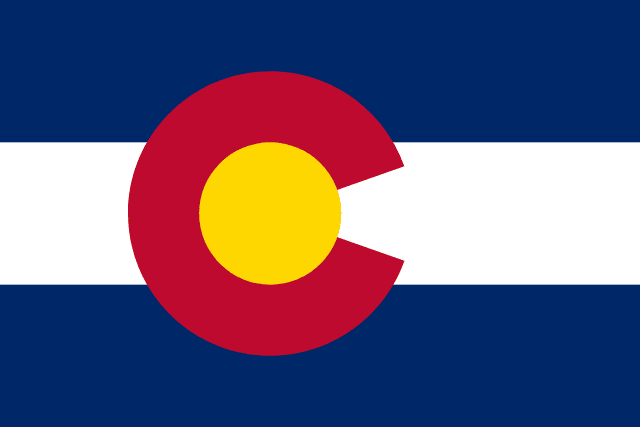
To distinguish it from Texas, check the star’s placement. Texas’s star sits in a separate blue band beside two horizontal colored stripes. The Juneteenth star is central and surrounded by a burst. To distinguish it from the regular U.S. national flag, remember that the Juneteenth design does not display a group of fifty stars or alternating red-white stripes.
Finally, do not date an image based only on a printed “June 19, 1865.” It is the event commemorated, not the flag’s date of manufacture. A modern photograph may display that nineteenth-century date on a banner designed in the late twentieth century.
Frequently asked questions
What colors are on the Juneteenth flag?
The familiar Juneteenth flag is red, white and blue. These colors echo the United States national flag and affirm the American citizenship and belonging of people once enslaved and their descendants.
Why is there a star on the Juneteenth flag?
The central five-pointed white star recalls Texas, the Lone Star State, where General Order No. 3 was announced in Galveston on June 19, 1865. It also signifies freedom extending across the United States.
What does the white burst around the star represent?
The jagged white outline is commonly described as a nova, suggesting a new star or new beginning and the spread of freedom. It is a symbolic device, not an instruction that every illustrated burst must have an identical number of points.
What does the curved red-and-blue division mean?
The arc represents a new horizon: hope, opportunities and a future beyond slavery. The original creator’s design deliberately used a curved horizon rather than a plain straight horizontal division.
Who created the Juneteenth flag?
Activist Ben Haith developed the flag in 1997 with collaborators. Illustrator and graphic designer Lisa Jeanne Graf later refined the design, associated with its 2000 form. Other early contributors are acknowledged by historical sources.
When was the Juneteenth flag created?
The flag design dates to 1997 and its familiar form was refined around 2000. Juneteenth commemorates events in 1865, but this specific flag did not exist in the nineteenth century.
Does the flag need to include June 19, 1865?
No. Both dated and undated versions appear. An update in 2007 added the commemorative date to some official-style designs, but many current representations omit the written date.
Is the Juneteenth flag the same as the Pan-African flag?
No. The Pan-African flag uses horizontal red, black and green bands and was adopted by Marcus Garvey’s Universal Negro Improvement Association in 1920. The Juneteenth flag has red and blue fields with a white central starburst.
Does Juneteenth celebrate the exact day slavery ended everywhere in the U.S.?
Not exactly. June 19, 1865 commemorates an important announcement and enforcement of emancipation in Texas. Slavery continued legally in some other places until the Thirteenth Amendment was ratified in December 1865, and freedom was not immediately realized equally by all people.
When did Juneteenth become a federal holiday?
The Juneteenth National Independence Day Act became law on June 17, 2021, establishing June 19 as a U.S. federal holiday. That law did not make the commemorative flag the national flag.
Can Juneteenth and Pan-African flags be displayed together?
Yes. They have different histories and meanings, and communities may display one or both. Neither should be incorrectly described as an exclusive or mandatory flag for Juneteenth events.
Can I freely download and reproduce the exact Juneteenth flag graphic?
Do not assume so. The Juneteenth flag design has a registered U.S. copyright claim. The documentary photographs on this page carry their own photo licenses or government public-domain status, but those notices do not automatically grant rights to reproduce the underlying graphic as a standalone commercial design.
Did General Gordon Granger invent the Juneteenth flag in 1865?
No. His June 19, 1865 General Order No. 3 is part of the history the flag commemorates. The modern commemorative design was created in 1997 by Ben Haith and collaborators.
How can I quickly tell the Juneteenth flag apart from Texas’s flag?
Texas has one white star in a vertical blue band at the hoist, plus one white and one red horizontal stripe. The Juneteenth flag centers its white star inside a radiating white outline over a curved red-and-blue field.
Historical sources and photograph credits
Smithsonian NMAAHC — Juneteenth: Freedom on the Rise
Smithsonian NMAAHC — Historical Legacy of Juneteenth
Smithsonian NMAAHC — What is Juneteenth?
North Carolina Office of State Human Resources — Juneteenth Flag Meanings
Howard University — Juneteenth Through the Eyes of a Texan Historian
PBS — What Does Juneteenth Celebrate?
National Archives — Juneteenth, a Historical Perspective
United States Congress — Juneteenth National Independence Day Act, 2021
Associated Press — Juneteenth history and observance
Wikimedia Commons — Copyright rules and flag registrations
Juneteenth flag flying outside a home, 2021 — Photo by Yngve Roennike, 26 June 2021, CC BY 2.0 (photograph). The 2021 photograph is displayed without modification.
A Juneteenth observance at NASA, 2023 — Photo: NASA / Keegan Barber, U.S. government public domain. The government image documents a Juneteenth observance.
A federal Juneteenth observance, 2024 — Photo: DHS / Tia Dufour, U.S. government public domain. The government image documents a Juneteenth observance.
Copyright clarification: The documentary photo licenses apply to their respective photographs; they do not promise a license to reproduce the underlying Juneteenth graphic as standalone commercial artwork. The flag is attributed to Ben Haith and his collaborators, with later design refinement credited to Lisa Jeanne Graf. Historical and design facts checked November 2026.