Revolutionary War Flags: Gadsden, Pine Tree & Moultrie Explained
Why did Revolutionary Americans fly a coiled rattlesnake, a green pine tree and a white crescent? Compare three famous flags, examine their documented origins and learn which historical claims remain uncertain.


The American Revolution did not begin under one universally accepted Stars and Stripes banner. Local militias, colonial governments and armed vessels used different symbols as resistance to British rule turned into a war for independence. Rattlesnakes, pine trees, crescents and slogans appeared on flags because they communicated identity and purpose to people who could not always identify a unit by its uniform.
This illustrated guide focuses on three historically important examples: Christopher Gadsden’s yellow standard, the New England Pine Tree flag, and the blue flag created for William Moultrie’s South Carolina troops. Each has a documented Revolutionary-era connection, although the exact appearance and some later stories deserve careful qualification.
For the earlier Grand Union, Betsy Ross and Bennington flag comparison, see our companion guide. For the evolution of national stars and stripes, use the complete U.S. flag star-count timeline. Those resources deal with different questions and help separate local military banners from national designs.
Compare the three Revolutionary War flags
Start with the simplest identification clues: the background color, the central symbol and any words printed on the flag. A yellow flag with a snake is not a variant of the blue Moultrie banner, and a white pine-tree flag is not the same as the later blue field of the modern U.S. flag.
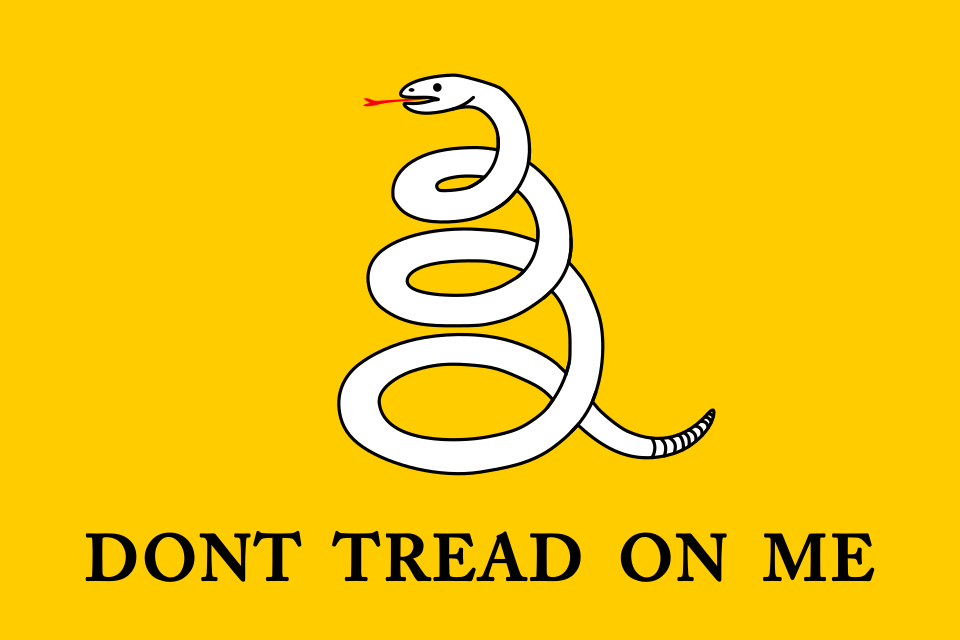
Yellow field, coiled rattlesnake and the warning DON’T TREAD ON ME.
White field, single green pine and the words AN APPEAL TO HEAVEN.
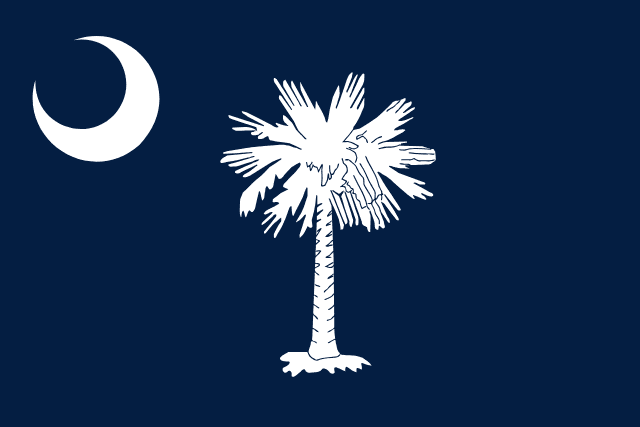
Solid dark-blue field with a white crescent at the upper hoist.
| Flag | How to recognize it | 1770s role | Historical caution |
|---|---|---|---|
| Gadsden flag | Yellow field, coiled rattlesnake and the warning DON’T TREAD ON ME | Patriot standard associated with Christopher Gadsden and Esek Hopkins | The yellow Gadsden standard is documented; the striped-snake first Navy jack story is disputed. |
| Pine Tree / An Appeal to Heaven flag | White field, single green pine and the words AN APPEAL TO HEAVEN | Signal and naval banner on New England vessels | The basic design is documented in contemporary descriptions; surviving exact artwork is not. |
| Moultrie flag | Solid dark-blue field with a white crescent at the upper hoist | South Carolina regimental and Fort Sullivan garrison flag | Its blue field and crescent are documented; decorative text varies across later reconstructions. |
The flags share a theme of resistance but were created for different settings. Gadsden’s standard is strongly associated with the early Continental Navy leadership. The Pine Tree flag is most securely tied to New England vessels and Massachusetts maritime service. Moultrie’s flag belonged to a South Carolina regiment and the defense of Charleston Harbor.
Gadsden flag: the rattlesnake and “Don’t Tread on Me”
Who created the yellow rattlesnake flag?
Christopher Gadsden was a South Carolina Patriot and a member of the Continental Congress’s Naval Committee. By early 1776 he had supplied a yellow rattlesnake standard associated with Esek Hopkins, commander of the Continental fleet. The journal of the South Carolina Provincial Congress records Gadsden presenting a similar standard on February 9, 1776.
The contemporary description calls for a yellow field, a snake poised to strike, and the words “Don’t Tread on Me.” These details establish a strong historical basis for the recognizable image. Modern versions may differ in the snake’s coils, tongue, lettering, punctuation or exact yellow tone, so those graphic variations do not automatically identify a particular authentic 1775 banner.
Why a rattlesnake?
The rattlesnake was already familiar as an American political symbol before independence. In 1754 Benjamin Franklin used the segmented snake and the phrase “Join, or Die” in a newspaper cartoon urging colonial cooperation. By the 1770s, snakes appeared in political prints, military objects and banners as warnings against coercion and calls for collective action.
A coiled rattlesnake suggests an animal that generally does not attack unless threatened, yet responds forcefully when provoked. That makes the warning beneath it understandable as a political image of defensive resistance. Some contemporary descriptions linked the number of rattles to the colonies. Avoid claiming that every reconstruction has a universally prescribed number of coils or segments.
Was it the first Continental Navy jack?
A persistent story says the Continental Navy’s first jack was red-and-white striped with a rattlesnake crossing the bands. Naval History and Heritage Command notes that evidence for that exact design as the first jack is inconclusive. The surviving instructions call it a “strip’d jack” but do not describe a snake on the stripes.
This is distinct from the better-established yellow Gadsden standard used by Hopkins. It is appropriate to describe that yellow flag as historically documented, while explaining that a familiar modern striped-snake “first Navy jack” image involves an unresolved historical claim. Treating the two as a single proven original flag would be misleading.
How is the Gadsden flag used today?
The image continues to appear in historical education, museums, political demonstrations and other modern settings. Modern adoption by different people or groups does not establish what Christopher Gadsden or every Revolutionary soldier intended in 1775. This article describes the original design and its documentary evidence, not the political views of present-day users.
Pine Tree flag: “An Appeal to Heaven” and Washington’s vessels
What does the pine-tree design show?
The best-known Pine Tree flag has a white background with a single green pine tree and the inscription “An Appeal to Heaven.” It is also described as a flag used by vessels operating under George Washington’s authority and by the Massachusetts state navy. The pine was a meaningful New England symbol connected to its forests, timber trade and maritime economy.
Unlike the yellow Gadsden flag, the visual focus is not an animal warning an adversary. The tree identifies New England, while the motto expresses a claim about the limits of political authority. Some surviving period texts describe the pine and motto without specifying all the precise design details that appear in today’s popular digital flag.
What is the best historical evidence?
Joseph Reed wrote to John Glover and Stephen Moylan on October 20, 1775, proposing a white flag with a pine tree and an appeal-to-heaven inscription as a recognition signal for vessels. A British report dated January 6, 1776 described a captured American vessel’s colors as white with a green pine tree and the motto.
Massachusetts lawmakers then specified white naval colors with a green pine tree and “Appeal to Heaven” in July 1776. These separate contemporary references are unusually helpful: they show a real maritime tradition rather than merely an image invented by modern flag sellers. However, no surviving original from Washington’s fleet establishes every stitch and letter of a single universal version.
What does “An Appeal to Heaven” mean?
The phrase is closely associated with the English philosopher John Locke’s discussion of political resistance. In his account, people unable to obtain justice through ordinary institutions might seek an ultimate moral judgment beyond those institutions. Eighteenth-century Patriots adopted that language to express the legitimacy they believed their cause had.
The pine itself should not be confused with a religious icon carrying one officially prescribed theological meaning. It was a regional symbol as well as a practical identification device. It also appears on other early New England flags whose fields and canton symbols differ from this familiar white-background version.
Is it the current flag of Maine or Massachusetts?
No. The eighteenth-century appeal-to-heaven banner is distinct from current state flags. Maine’s modern official state flag includes its coat of arms on blue, even though pine-tree imagery plays an important role in the state’s visual identity. Our Maine flag guide separates the current state design from the historic pine-tree proposals and related symbolism.
Moultrie flag: the blue field and South Carolina crescent
Why did William Moultrie choose a crescent?
William Moultrie commanded South Carolina troops during the defense of Charleston Harbor. In his memoirs he explained that the troops wore blue uniforms and a silver crescent badge on their caps. He designed a large blue flag with a crescent in the upper hoist corner to match their appearance and provide a visible signal for the garrison.
Because it was a military badge, the crescent should not automatically be presented as an astronomical moon or as a religious symbol. The most direct historical explanation is the cap ornament described by Moultrie himself. Some reconstructed flags add the word “Liberty” to the crescent or elsewhere; the text’s precise position is less secure than the documented blue field and crescent.
What happened at the Battle of Sullivan’s Island?
On June 28, 1776, British warships attacked the unfinished fort on Sullivan’s Island, at the entrance to Charleston Harbor. The defenders fought from fortifications built largely of palmetto logs and sand, materials that helped absorb cannon fire. The engagement became an important early American victory, later commemorated in South Carolina history.
During the attack, the flagstaff was damaged by British fire. Sergeant William Jasper recovered the flag and raised it again on the fort’s ramparts. This incident was celebrated as an act of courage and helped make the crescent flag a long-lived state symbol. Sources describe the episode with some variation, so it is prudent to distinguish the documented recovery from the more elaborate details of later patriotic paintings.
How does it relate to South Carolina’s current flag?
The present South Carolina state flag carries a white palmetto tree and crescent on a dark-blue background. The crescent and blue field recall Moultrie’s regimental banner, while the palmetto tree commemorates the fort’s successful defense. The palmetto was not on the basic original Moultrie blue-and-crescent design.
South Carolina’s legislature adopted the palmetto-and-crescent arrangement in January 1861, at the beginning of the state’s secession from the Union, drawing on the earlier 1776 imagery. That later historical setting matters when explaining the state flag’s adoption. See our South Carolina flag guide for the full modern design and its history.
Were Gadsden, Pine Tree and Moultrie official national flags?
Not in the same sense as the Stars and Stripes specified by the Continental Congress in June 1777. These three flags belonged to the varied military and naval culture of the Revolutionary period. A banner might be recognized by a regiment, state navy or particular commander without becoming a nationwide legal design.
The Grand Union flag, another early Continental banner, combined thirteen red-and-white stripes with the older British Union flag. After June 14, 1777, the national flag resolution required thirteen alternating stripes and thirteen white stars on blue. Even then, the arrangement of those stars was not uniformly specified.
That chronology explains why several genuinely historic flags can be associated with 1775 and 1776 but still differ sharply in appearance. Avoid an infographic that labels all three as successive versions of the American national flag. Our early American flag comparison explains the Grand Union and popular thirteen-star arrangements, while the star-count chart tracks later changes under federal law.
Revolutionary War flag timeline: 1754–1777
Benjamin Franklin’s segmented snake cartoon uses “Join, or Die” to encourage cooperation. It was not itself the Gadsden flag, but it helped establish the rattlesnake as a recognizable political symbol.
Joseph Reed’s October correspondence records the pine tree and “Appeal to Heaven” as a recognition proposal for colonial vessels. The choice built on New England pine-tree symbolism already present on other banners.
Christopher Gadsden’s rattlesnake standard becomes associated with Continental fleet commander Esek Hopkins. South Carolina’s Provincial Congress records a presentation of the flag on February 9, 1776.
The South Carolina garrison flies its blue-and-crescent colors while defending a palmetto-log fort. William Jasper’s recovery of the flag becomes part of the battle’s remembered history.
The Massachusetts General Court describes a white flag, a green pine tree and an “Appeal to Heaven” inscription for its state navy.
The national resolution introduces thirteen white stars in blue alongside thirteen red-and-white stripes. These flag traditions overlap historically, rather than disappearing overnight when Congress acts.
Dates describe documented references, official decisions or battles—not the exact day each modern illustration was drawn. The Gadsden, Pine Tree and Moultrie designs are often labeled simply “1775” or “1776” in commercial flag catalogs, which can hide these important distinctions.
Symbols, historical certainty and common myths
Three symbols, three historical functions
A rattlesnake warned of the consequences of attack; a pine tree connected a vessel to New England and a claim of political legitimacy; a crescent identified South Carolina soldiers by an emblem already present on their uniforms. Their designs show how a recognizable symbol could identify a cause, origin or military group even when no uniform national flag had emerged.
All three flags also carry associations that developed later. Gadsden’s rattlesnake has been adopted in modern politics; the Pine Tree motto appears in contemporary public discourse; South Carolina’s crescent became part of a state flag adopted in a later and very different political period. Those subsequent uses do not rewrite the specific eighteenth-century documents describing each banner.
What is securely documented?
The yellow Gadsden flag is described in a South Carolina legislative journal, and its connection to Hopkins’s standard is accepted by U.S. naval historians. The pine-tree design appears in Joseph Reed’s correspondence, a British capture report and Massachusetts legislation. The Moultrie flag’s blue field and crescent are described in the commander’s memoir, alongside later accounts of the 1776 defense.
Less certain details include the exact snake shape on an original flag, a single authoritative pine-tree silhouette, the positioning of any “Liberty” lettering on the Moultrie flag, and whether the Continental Navy’s earliest striped jack bore a snake. These uncertainties are not reasons to discard the flags’ history; they simply call for accurate captions.
Why do modern illustrations sometimes disagree?
Most images in an online flag gallery are vector reconstructions created long after the Revolution. They use the colors and symbols described in documents but may choose their own proportions, letterforms and drawing style. In classroom and web publishing, label these as historical illustrations rather than asserting they are photographs of one known surviving original.
How to identify Revolutionary flags in a classroom activity
Cover the names beneath the three illustrations above. Ask students to describe one feature without guessing: a coiled animal, a tree with writing, or a white crescent. Then ask which banner would be most helpful for a New England ship, a South Carolina fort or a leader in the early Continental fleet. Matching each image to its context teaches more than memorizing the flag name.
For a second round, compare the Moultrie flag with the modern South Carolina state flag. The blue field and crescent remain recognizable, but the later palmetto tree is a major difference. Compare the Pine Tree flag with Maine’s current state flag to illustrate how a shared regional symbol can appear in distinct legal designs.
Finish by sorting claims into “documented” and “not conclusively documented.” The February 1776 Gadsden standard, the October 1775 Pine Tree correspondence and the June 1776 fort battle are documented events. Saying the striped snake was definitely the first Navy jack or that every surviving drawing depicts an exact original is not justified by the available sources. This method works for historical flags beyond the American Revolution.
Frequently asked questions about Revolutionary War flags
What are the three best-known Revolutionary War flags?
The Gadsden rattlesnake flag, the Pine Tree or An Appeal to Heaven flag, and the blue Moultrie crescent flag are widely recognized examples. They were not the only banners used by American forces.
What does Don’t Tread on Me mean on the Gadsden flag?
It is a warning against attack or coercion. Its snake imagery developed from the eighteenth-century colonial practice of using the rattlesnake as a symbol of unity and resistance.
Who made the Gadsden flag?
The documented yellow standard is associated with South Carolina’s Christopher Gadsden, who presented it to the South Carolina Provincial Congress in February 1776 and had provided a standard for naval commander Esek Hopkins.
Was the Gadsden flag the first U.S. Navy jack?
Not conclusively. The U.S. Navy’s Naval History and Heritage Command distinguishes the documented yellow personal standard of Esek Hopkins from the unproven claim that a striped rattlesnake design was the first Continental Navy jack.
What does An Appeal to Heaven mean?
It invokes the idea of appealing to a higher moral authority when ordinary political or legal remedies fail, a phrase associated with John Locke’s writings and adopted by New England Patriots.
Did George Washington use the Pine Tree flag?
Contemporary correspondence identifies the pine-tree design for vessels associated with Washington’s armed fleet in 1775. That does not mean it replaced a nationwide flag for the Continental Army.
Did the Moultrie flag have a palmetto tree?
No. The original design was a blue field with a white crescent. A palmetto tree became part of South Carolina’s later state flag, linked to the palmetto-log fort and its 1776 defense.
Why is there a crescent on the Moultrie flag?
Moultrie said it reproduced the silver crescent badge worn on the caps of South Carolina troops. It is not generally described by primary sources as a depiction of the moon’s astronomical phase.
Did all Revolutionary War regiments use the same flag?
No. Before standardized national symbols became established, colonial, regional, regimental and naval forces used different designs. A single historic flag cannot stand for every American unit in the war.
Can I use the illustrations on this page in an educational project?
The three images used here were sourced from Wikimedia Commons works with CC0 or public-domain dedications. Check their linked source pages and any separate trademark, insignia or context-related restrictions before reusing them.
Other early Patriot and colonial banners used a rattlesnake with Liberty or Death, a British-style canton with Liberty and Union, and a green field with thirteen stars. Compare them in our Culpeper, Taunton and Green Mountain Boys flag guide, including the disputed attribution of the green flag.
The Sons of Liberty striped flag predates the first official U.S. flag resolution. See our Sons of Liberty, Bedford and Cowpens comparison for illustrations, the history of Boston’s protest banners and cautions about later battlefield attributions.
Sources and image credits
U.S. Navy Naval History and Heritage Command — The U.S. Navy’s Jack
National Park Service — Flags of Bunker Hill: Banners of Liberty
National Park Service — General Moultrie’s Grave and Fort Sullivan history
South Carolina Encyclopedia — Gadsden flag
South Carolina Encyclopedia — Moultrie Flag
National Park Service — Washington’s Headquarters, historic resource study
U.S. Fish & Wildlife Service — Don’t Tread on Me
Gadsden flag image (Tom-L; CC0)
Pine Tree / An Appeal to Heaven flag image (public domain)
Moultrie blue-and-crescent flag image (public domain)
All three images are contemporary digital reconstructions imported into the FlagExplorers WordPress media library, not photographs of the original eighteenth-century fabric. The Gadsden illustration is CC0; the Pine Tree and Moultrie illustrations carry public-domain dedications. Image file pages provide creators and reuse conditions. Historical facts checked November 2026.