Early American Flags Compared: Grand Union, Betsy Ross & Bennington
See the Grand Union, traditional Betsy Ross flag, thirteen-star rows, Bennington ’76’ flag and the 15-star Star-Spangled Banner side by side—with documented history separated from later traditions.
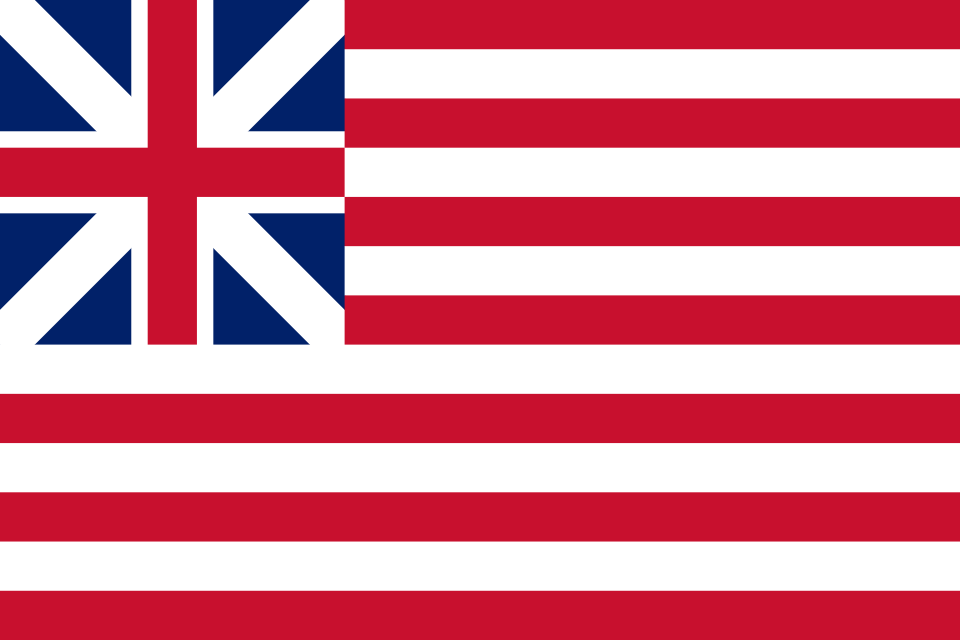 Grand Union
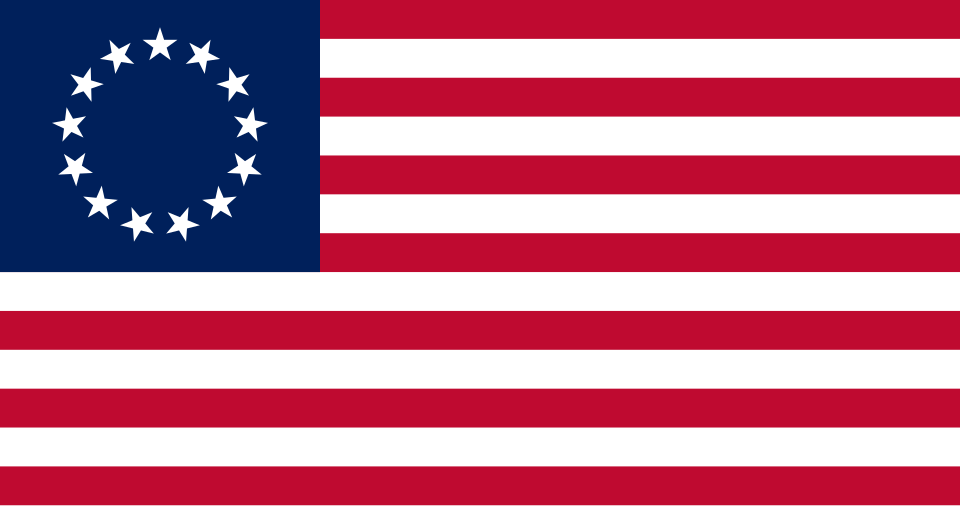 Betsy Ross style
Early American flags can look deceptively similar. Most use red, white and blue and many show thirteen stripes, but they do not all represent the same period or carry the same level of historical documentation. Some are designs specified by Congress; others are traditions, military banners, or later interpretations of earlier artwork.
This guide compares the differences you can actually see and explains what is supported by surviving sources. It complements our overview of U.S. flag history and the complete star-count timeline; neither of those pages focuses on the authenticity and visual distinctions of these early variants.
Compare five early American flags at a glance
These examples are not five consecutive official national flag laws. The dates below describe the historical period, tradition or legal count associated with each image. Before 1912 there was no single required star layout, so a reconstructed illustration is not necessarily a photograph of a surviving period flag.
The canton shows the older British Union flag—the crosses of St. George and St. Andrew—rather than stars.
The star circle is famous today, but the 1777 resolution did not legally prescribe it or name Betsy Ross.
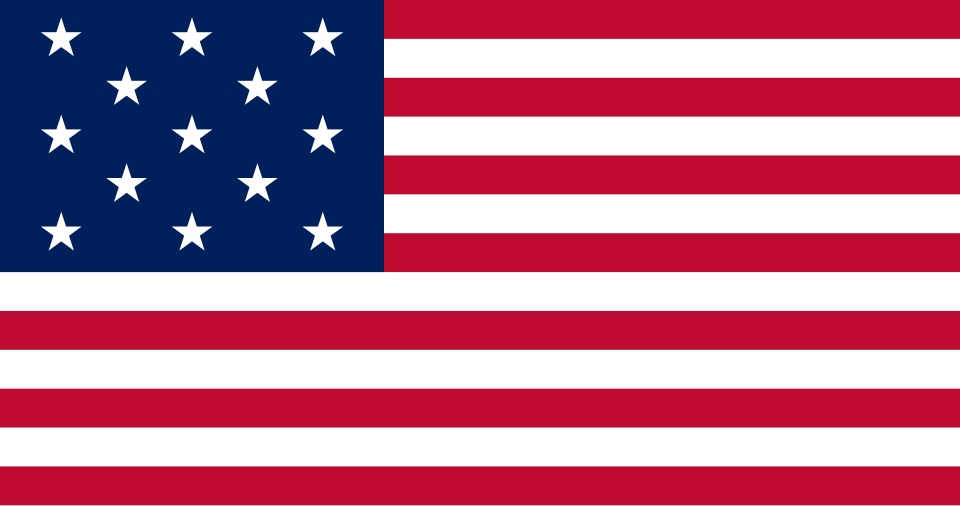
The same 13-star requirement could be met by a noncircular arrangement; flagmakers used multiple patterns.
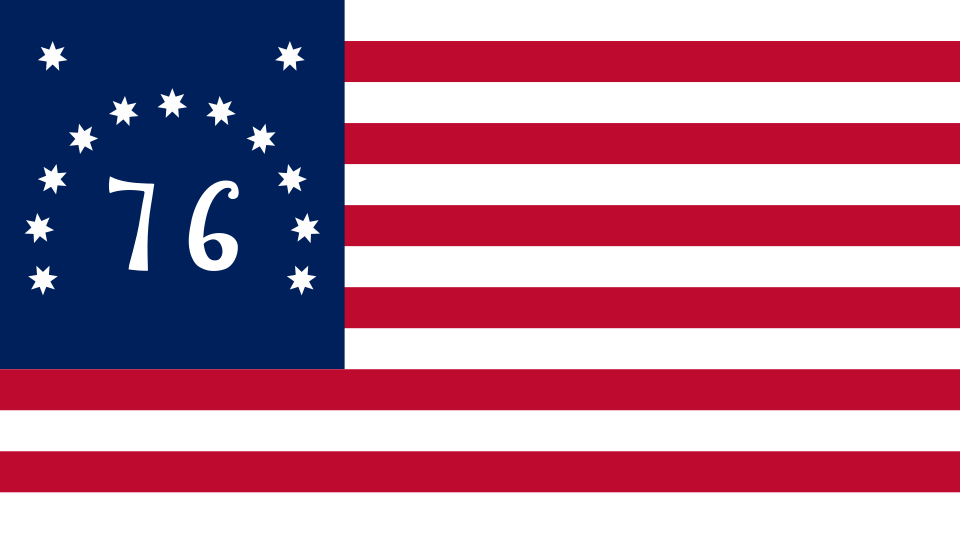
The large ’76’ signifies independence in 1776, but contemporary proof of its use in the 1777 battle is lacking.
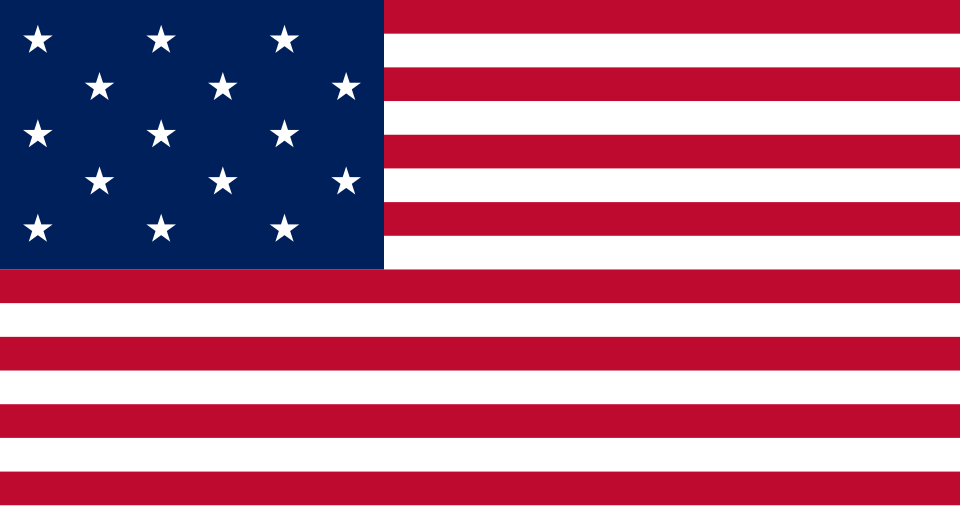
This is the only official era when the number of stripes grew beyond the original thirteen.
| Flag design | Stars | Stripes | Historical status |
|---|---|---|---|
| Grand Union flag | No white stars | 13 | Continental-era banner |
| Betsy Ross–style flag | 13 in a circle | 13 | Traditional star arrangement |
| Thirteen stars in staggered rows | 13 in rows | 13 | Another 13-star arrangement |
| Bennington ’76’ flag | 13 with ’76’ | 13 (with reversed red-white ordering in some renderings) | Commemorative or contested historical attribution |
| 15-star Star-Spangled Banner | 15 | 15 | Documented national star-and-stripe count |
Which flag came before the first Stars and Stripes?
The Grand Union flag, also called the Continental Colors, is one of the most recognizable banners of the American Revolution’s opening period. It combined thirteen red-and-white stripes with the British Union flag in its upper-left corner. This was a distinct design from the later Stars and Stripes, because its canton contained crosses, not stars. George Washington’s Continental Army displayed the striped Union banner around Cambridge, Massachusetts, in early 1776.
The symbolism reflects a complicated political transition. The colonies were in open conflict with British forces, but independence had not yet been declared at the start of 1776. A banner retaining the British Union emblem suited that transitional setting. It was used by American forces and on ships, rather than being the product of the later June 1777 national flag resolution.
When comparing drawings, check the canton carefully. The historical British Union flag did not yet contain the red diagonal cross of St. Patrick, which was added to the modern Union Jack in 1801. A Grand Union reconstruction with today’s British Union Jack is an anachronism. The thirteen stripes, however, already anticipated the most recognizable element of the future American national flag.
What did Congress actually require in 1777?
On June 14, 1777, the Continental Congress adopted a brief flag resolution establishing thirteen alternating red-and-white stripes and thirteen white stars in a blue union. The resolution described the stars as representing a new constellation. That gave the United States a shared national pattern that was visually separate from the Grand Union flag’s British canton.
Importantly, Congress did not specify a single star arrangement, nor did it fix the stars’ number of points, spacing or orientation. It also omitted exact construction dimensions. As a result, the same legal instruction could produce a circle of stars, several staggered rows or other layouts. Historical examples and later representations are therefore not interchangeable with a single mandatory template.
This is the main distinction between an official flag specification and an illustrated historical style. The thirteen-star count was official; one familiar thirteen-star pattern was not singled out as the sole official flag. The U.S. House of Representatives history collection and National Park Service flag histories make this distinction explicit.
Betsy Ross flag vs. other thirteen-star flags
The flag most people call the Betsy Ross flag uses thirteen white stars forming a circle in a blue canton, alongside thirteen stripes. Its graphic simplicity has made it an enduring schoolbook image. Yet it should be labeled a traditional or Betsy Ross–style arrangement, not as a proven reconstruction of the exact first flag carried by the United States.
The well-known narrative credits Philadelphia flagmaker Betsy Ross with suggesting five-pointed stars and sewing a design after a visit from George Washington and others. Ross was a real maker of flags and other textile goods during the Revolution. But the specific account of that meeting gained public attention decades later, through family testimony around 1870, and lacks corroborating contemporary records.
Another thirteen-star design uses staggered rows, such as three stars, then two, then three, then two, then three. Other versions have four-five-four or other spacing. Those are meaningful historical alternatives, not mistakes made by modern digital artists. When two thirteen-star pictures differ, count the stars and stripes before deciding whether either image violates the 1777 resolution.
For the full sequence of star-count changes that followed the early republic, see the U.S. flag stars-by-year chart. That reference explains all 27 official star counts without treating decorative arrangements as separate national designs.
Was the Bennington flag really flown in 1777?
The Bennington flag is easy to spot because its blue union contains a large white ’76’ surrounded by thirteen stars. It is widely associated with the Battle of Bennington, fought in August 1777 during the Saratoga campaign. The ’76’ commemorates the Declaration of Independence rather than naming a year of manufacture or the star count.
The difficulty is its provenance. National Park Service historical research notes that no contemporary record confirms the flag’s Revolutionary War use. A later family tradition connects it with the battle, but a tradition is not proof that the modern familiar design was carried there. Some reproductions have a distinctive stripe order or arrangement unlike the conventional national flag.
An article or classroom chart should consequently call it a Bennington-associated flag with a disputed early history—not one of the legally defined star-count revisions of the U.S. national flag. It is valuable as a patriotic and commemorative design in its own right. Its place in popular memory explains why collectors and educators continue to include it in galleries of Revolutionary-themed flags.
What changed when the American flag gained 15 stars?
After Vermont joined the United States in 1791 and Kentucky in 1792, Congress enacted a new flag law on January 13, 1794. It required fifteen stars and fifteen stripes beginning May 1, 1795. The thirteen-stripe convention was temporarily expanded to reflect two new states, unlike the modern practice of keeping the stripe count constant.
This flag is closely associated with the defense of Fort McHenry during the War of 1812. Baltimore flagmaker Mary Pickersgill and her helpers made the giant 1813 garrison flag that inspired Francis Scott Key’s words for The Star-Spangled Banner in September 1814. That surviving artifact is now cared for by the Smithsonian’s National Museum of American History.
The original flag had fifteen stars and fifteen stripes. One star and other portions were later removed from the surviving fabric; those losses should not be mistaken for a flag law ordering fourteen stars. The 1795 design remained legal even as the United States admitted additional states, until Congress revised the system in 1818.
How to identify early American flags in a picture
Begin with the upper-left canton. Crosses instead of stars point toward the Grand Union flag or another British-influenced banner. A circle of thirteen stars suggests the Betsy Ross style. Rows of thirteen stars point to another permitted early Stars and Stripes arrangement. A conspicuous ’76’ identifies the Bennington design, although its precise early history must be checked.
Then count the stripes. The common rule is thirteen, but the 1795–1818 national flag officially used fifteen. The width and ordering of colored bands can vary in period artwork, so first determine whether the image is an original artifact, a later reconstruction, or an educational drawing. Captions should explain what is actually documented about the object.
Finally, avoid guessing a flag’s creation date from its star pattern alone. A contemporary reproduction of an eighteenth-century design can look pristine. An authentic nineteenth-century object could preserve an older star count. Museum provenance, accession records, and dated photographs provide stronger evidence of an object’s actual history than its geometric design.
Three common misconceptions about Revolutionary flags
First, the phrase ‘first American flag’ is ambiguous. It may refer to any banner used by colonial forces, the Grand Union flag displayed by Washington’s army, or the first flag described by Congress in June 1777. These are different historical claims. A credible history article must state which definition it is using.
Second, a thirteen-star circle was not Congress’s only prescribed design. The 1777 lawmakers approved thirteen stars on blue, but not a compulsory circle. Popular images may still use the Betsy Ross arrangement as a visual shorthand, provided their captions do not turn folklore into an established fact.
Third, flags with names such as Bennington, Cowpens or Serapis should not be treated automatically as successive official national flags. Some names attach to local, naval, commemorative or disputed artifacts and reconstructed patterns. They add historical texture, but they do not replace the national flag laws that governed star and stripe counts.
A useful way to teach this comparison
Show the Grand Union, circle-of-stars, rows-of-stars, Bennington and fifteen-star flags without their labels. Ask viewers to note the presence of a British canton, the arrangement of the stars, the numeral ’76’, and the stripe count. Only then reveal their names and dates. This encourages direct observation rather than relying on recognition of an illustration seen in a textbook.
Next, divide claims into three groups: firmly documented, plausible but unresolved, and later tradition. The 1777 congressional resolution and the 1794 statute belong in the documented group. Whether Betsy Ross designed the first flag remains unproven; claims about Bennington’s battle use are disputed. This small exercise demonstrates how historians distinguish a contemporary law from a story told much later.
For older students, compare the images with the actual 1813 Fort McHenry artifact and ask why its surviving star count can be misleading. For younger children, simply look for stars, crosses and stripes. The activity can then lead to the site’s complete star-count timeline, which deals with later national flag changes without repeating the early-flag comparison.
Frequently asked questions
Was the Grand Union flag the first American flag?
It was an important early Continental banner, but ‘first’ depends on whether the question means a colonial military flag, the Grand Union, or the first Stars and Stripes specified by Congress in 1777.
What is the difference between the Grand Union flag and the Betsy Ross flag?
Grand Union combines thirteen stripes with the older British Union design in its canton. The traditional Betsy Ross-style flag replaces that canton with thirteen white stars arranged in a circle.
Did Betsy Ross design the first U.S. flag?
No reliable contemporary documentation proves the celebrated design story. Betsy Ross was a Revolutionary-era flag maker, but the detailed story emerged from family testimony much later.
Were thirteen stars legally required to form a circle?
No. Congress specified thirteen white stars on blue in June 1777 without prescribing their shape or arrangement. Various circles and rows could meet the requirement.
Why does the Bennington flag have 76 on it?
The numeral refers to 1776 and the Declaration of Independence. The flag’s traditional association with the 1777 Battle of Bennington is not established by contemporary documentation.
How many stars and stripes were on the flag flown at Fort McHenry?
The official 1795-era design had fifteen stars and fifteen stripes. The Smithsonian’s surviving flag made by Mary Pickersgill originally had that count, though one star and portions of fabric were later removed.
What came after the 15-star, 15-stripe flag?
In 1818 Congress restored thirteen stripes and authorized twenty stars, establishing the rule that future state admissions would add stars rather than stripes.
Is the Bennington flag an official replacement for the 1777 national flag?
No. It is a named patriotic design with disputed Revolutionary provenance, not a separate flag-law revision of the national banner.
Three other prominent Revolutionary-era banners used completely different symbols: a rattlesnake, a pine tree and a crescent. See the illustrated Gadsden, Pine Tree and Moultrie flag comparison for the primary evidence behind those designs.
Another group of early designs includes the Culpeper Minutemen’s rattlesnake, Taunton’s 1774 Liberty and Union banner, and the traditional green thirteen-star Vermont flag. See our Culpeper, Taunton and Green Mountain Boys flag comparison for historical evidence and images.
The Sons of Liberty, Bedford and Cowpens historical flag comparison looks at a nine-stripe protest banner, a preserved Massachusetts militia flag and a disputed early star arrangement. It complements the Grand Union and Betsy Ross designs shown here.
For the flagmaker and surviving artifact behind the 1795–1818 design shown above, explore our Fort McHenry Star-Spangled Banner flag guide, including original photographs and a reconstruction of all fifteen stars.
Historical sources and image credits
U.S. House, History, Art & Archives — Flag Day Program
Colonial Williamsburg — What Was the First American Flag?
U.S. National Park Service — Grand Union and Revolutionary flags
U.S. National Park Service — National flag history
National Park Service — Fort Stanwix historic study (Bennington)
National Museum of American History — Star-Spangled Banner
U.S. Statutes at Large — 1794 Flag Act
Wikimedia Commons — Grand Union Flag artwork
Wikimedia Commons — Betsy Ross-style artwork
Wikimedia Commons — Bennington flag artwork
Images: Grand Union flag, Betsy Ross pattern and Bennington flag from Wikimedia Commons public-domain historical flag artwork. The 13-star rows and 15-star national flag illustrations were already imported from Commons into the FlagExplorers media library. Reconstructed images are identified as such and are not claimed as photographs of specific surviving eighteenth-century fabrics. Research checked November 2026.