Florida State Flag: Red Saltire, State Seal & History
Discover what the current flag depicts, why its symbols matter, how the design developed and how to identify it accurately.
Flag at a glance
| Feature | Details |
|---|---|
| Current design adopted | 1900 |
| Field | White, with red diagonal saltire |
| Center | Florida state seal |
| Red band width | One-fifth of flag height, by statute |
What does Florida’s state flag look like?
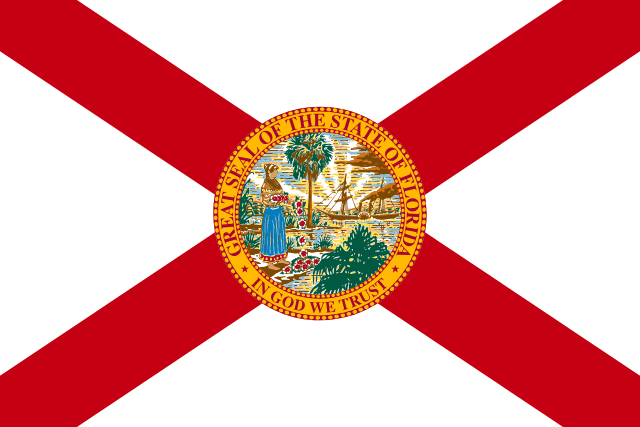
A red diagonal cross runs from each corner toward the center of a white rectangular flag. The arms of this saltire stop at the edge of the large circular Florida state seal, which occupies the central space. The overall effect is a red X behind a seal, not a red upright cross or the Union Jack.
The legal design uses a seal with diameter equal to one-half the flag’s height. Each red diagonal bar has width equal to one-fifth the height. Unlike a simple geometric flag, the seal includes detailed artwork that should be reproduced using an official source rather than drawn from memory.
Why does Florida have a red diagonal cross?
Florida’s state flag consisted of the seal on a white field from 1868 to 1900. Governor Francis P. Fleming argued that a white banner could resemble a truce or surrender flag when hanging without wind. The legislature proposed adding the diagonal red bars, and voters approved the change in 1900.
The form resembles a St. Andrew’s cross, often called a saltire. Historical discussions also examine its resemblance to other southern and Confederate-era symbols, but the Florida Department of State specifically documents the official rationale about a plain white flag and identifies the 1900 referendum. That explanation should be distinguished from unsupported claims that the state legally declared a single alternative symbolism.
What is in the center of the Florida flag?
The central emblem is Florida’s Great Seal. It represents themes from the state’s landscape and institutions, including a waterway, vegetation and a human figure, with additional details defined in the seal artwork. Since the seal is a formal emblem separate from the flag, it has its own history and standards.
A small flag icon may make the seal look like a colored circle with indistinct writing. For accuracy, a full-size government image is necessary. Do not replace it with a modern tourism logo or a map of Florida and call the result the state flag.
How did Florida’s state flag change?
Florida used a succession of flags during the nineteenth century, reflecting statehood, secession and the Civil War. The 1868 design simplified matters by putting the seal on white. The 1900 amendment introduced the red diagonal cross without removing the seal, creating the arrangement still used today.
The Florida Department of State maintains a useful visual history of earlier official flags, including nineteenth-century variants. When writing a historical timeline, identify those as past designs rather than treating every old banner displayed in a museum as simultaneously official.
Florida flag dimensions and drawing steps
On a 900 by 600 pixel classroom canvas, begin with white. The seal should have a diameter of 300 pixels, equal to half the 600-pixel flag height. The red diagonal bands have a legal width of one-fifth the height, or 120 pixels; their intersections are concealed by the centered seal.
Draw diagonal bands from the four corners toward the seal and use the exact official seal image on top. This worked example follows the law’s relative sizes; any aspect-ratio requirements and artwork tolerances should be checked against current state documentation. Avoid thickening the red bars simply to fill unused space around the seal.
How Florida differs from Alabama and other flags
Alabama uses a red diagonal saltire on white without Florida’s central seal. Florida’s seal is therefore the quickest way to tell the two apart. Georgia has bands and a blue canton, while South Carolina uses an indigo field with palmetto and crescent. These distinctions are easy to compare in the state flag directory.
For educational activities, a useful challenge is to compare how flags with similar red cross geometry can carry different histories. A matching shape is not proof of identical legal symbolism.
Frequently asked questions
When was Florida’s current flag adopted?
1900.
Why is the red X on the flag?
It was added following a proposal to distinguish the old white seal flag from a white truce flag.
What is the middle picture?
Florida’s official Great Seal.
How wide are the red bars?
Each is one-fifth of the flag’s height under the legal specification.
Florida’s state seal distinguishes it from Alabama’s similarly colored flag. View the side-by-side comparison of look-alike U.S. state flags to see the difference clearly.
Florida Department of State — state flag
Florida historic flags
Flagpedia/FlagCDN state flag illustration, hosted in the FlagExplorers media library; verified against government or archival sources where available. Reviewed November 2026.