Ohio State Flag: Why Is It Not Rectangular? Meaning & 17 Stars
The story of Ohio’s swallowtail burgee, its unusual shape, 17 stars, designer John Eisenmann, exact construction and official symbolism.
Why is Ohio’s flag not rectangular?
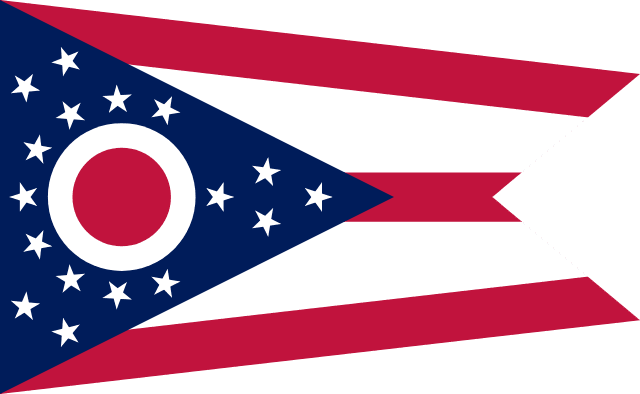
The Ohio state flag has a swallowtail burgee outline. The straight edge at the flagpole is called the hoist; the opposite fly edge ends in two long points, separated by a V-shaped notch. The notch is cut from the flag’s actual outline, rather than printed as a white triangle on a rectangle.
Ohio is the only one of the 50 U.S. states whose current official flag is not rectangular. State flags elsewhere may use triangles or stars within their designs, but their fabric outlines are rectangular. Ohio’s unusual shape is written into Revised Code §5.01, which specifically requires a burgee-shaped flag.
The shape traces back to the 1901 Pan-American Exposition in Buffalo, New York. Ohio architect John Eisenmann designed a flag for the state’s exhibition building. Its swallowtail outline resembled a traditional burgee, a type of pennant historically associated with boating and other identifying flags. That original design was adopted by Ohio in 1902, and the nonrectangular form survived as part of the state flag.
Ohio’s Ohio History Connection preserves images and details of the exhibition-era flag. It is useful evidence for understanding why the state’s flag looks different today, instead of assuming the shape came from a more recent redesign.
What does the Ohio state flag look like?
The flag has five alternating red and white striped sections: three red and two white. They extend outward from a large blue triangular union at the hoist. The blue triangle’s tip reaches the center of the middle red stripe. Its blue field holds seventeen white five-pointed stars, a red disc and a white circular ring shaped like the letter O.
Thirteen white stars are grouped around the central circle. Four more stars appear farther out toward the point of the blue triangle. The ring is white and surrounds a red disc; it should not be mistaken for a large eighteenth star. The total count remains 17 stars.
When identifying this flag from a photograph, look for three features together: the two swallowtail tips, the white O enclosing red, and the blue triangle with 17 stars. None of those alone fully captures the design. The current flag is not a blue sheet with the Ohio state seal pasted onto it, unlike numerous seal-based state banners.
Our 50 U.S. state flag gallery helps compare Ohio with flags that use similar colors but entirely different shapes.
What do Ohio’s 17 stars, circular O and colors mean?
The 17 stars identify Ohio as the seventeenth state admitted to the Union. The group of 13 nearest the central circle stands for the thirteen original states; the additional four near the point of the triangle bring the total to seventeen. This exact breakdown appears in Ohio law, not simply in a later popular explanation.
The white circular ring resembles an O for Ohio. With its red center, it also suggests a buckeye nut, recognizing Ohio’s nickname, the Buckeye State. Eisenmann’s original description associated the circle with the historic Northwest Territory as well. The Secretary of State reproduces that historical explanation in its official flag brochure.
The blue triangle represents Ohio’s hills and valleys. The three red and two white stripes represent roads and waterways. Official sources describe the stripes as a group; there is no statutory explanation assigning each individual red stripe to a particular river or highway.
| Element | Meaning or identification |
|---|---|
| Swallowtail form | Distinctive legally required burgee shape |
| Blue triangular field | Ohio’s hills and valleys |
| Five red/white stripes | Roads and waterways |
| 13 stars near the O | Original 13 U.S. states |
| 4 additional stars | Ohio as the 17th state |
| White O and red disc | Ohio’s name; the Buckeye State nickname |
These associations follow Ohio Revised Code §5.01 and Eisenmann’s documented explanation. The American flag instead has 50 stars for today’s states and 13 stripes for the original colonies, as explained in our U.S. flag guide.
Who designed Ohio’s flag, and when was it adopted?
John Eisenmann, an architect based in Cleveland, designed the Ohio flag for the state’s building at the 1901 Pan-American Exposition in Buffalo. Ohio had entered the Union in 1803 but had gone nearly a century without formally adopting a state flag. Eisenmann’s design gave the exposition building an easily recognized emblem.
The burgee flew over the Ohio Building during the event. Eisenmann secured a design patent and later transferred his interest in the flag to Ohio. The Society of Ohio Archivists describes original patent documents and a transfer record now held among the Ohio History Connection’s archives.
Lawmakers formally adopted the state flag on May 9, 1902. That means 1901 is the design/debut year, while 1902 is the year of official state adoption. A much later statutory update effective November 1, 2002 did not create a different flag or change its basic silhouette.
| Date | Historic milestone |
|---|---|
| 1803 | Ohio admitted as the 17th U.S. state |
| 1901 | Eisenmann designs the flag and it flies in Buffalo |
| May 9, 1902 | Ohio legislature adopts it as state flag |
| November 1, 2002 | Updated flag statute takes effect; original design retained |
The Ohio Memory history includes a historic flag photograph and background on the Ohio Building. It provides stronger support for the dates than an unattributed social-media infographic.
Exact Ohio burgee proportions and measurements
Because Ohio’s flag has a V-shaped cutout, an ordinary rectangular aspect ratio does not describe the finished outline. The enclosing construction box in John Eisenmann’s official drawing is 13 units long by 8 units high. The flag must be formed inside that box, with the correct tapered edges and swallowtail, rather than made as a full 13:8 rectangle.
The Ohio Secretary of State’s flag brochure reproduces Eisenmann’s design and proportions. The blue triangle’s base spans 8 units of height at the hoist, and its depth to the point is 8 units. Each of the three red stripes has a nominal thickness of 1 construction unit along its sloping construction; the two white bands share the remaining space equally.
The large red disc has a radius of 1 unit (so its diameter is 2 units), and the white O around it is half a unit thick. Thus the red and white circular emblem is 3 units across in the original plan. The white five-pointed stars fit inside construction circles whose radius is 5/16 of a unit. Their actual positions follow the original drawing, not an arbitrary evenly spaced 17-star ring.
| Construction measurement | Official proportion | Example at 100px per unit |
|---|---|---|
| Enclosing box length | 13 units | 1,300 px |
| Enclosing box height | 8 units | 800 px |
| Blue triangle depth | 8 units | 800 px |
| Red disc diameter | 2 units | 200 px |
| White ring thickness | ½ unit | 50 px |
| Overall circular O diameter | 3 units | 300 px |
| Nominal red stripe thickness | 1 unit each | 100 px along drawing geometry |
Do not confuse the enclosing dimensions with the actual cloth shape. The Secretary of State’s construction sheet also gives the exact swallowtail-notch geometry and individual star placement. For a manufactured flag or mathematically exact print, copy or trace the technical drawing; an educational description alone is not a substitute for it.
How to draw the Ohio burgee
For a school worksheet, begin with graph paper or a digital canvas. Use an 13-by-8-unit construction grid, keep the background outside the finished flag transparent or blank, and work through the shapes in this order:
- Mark the enclosing rectangle. Draw 13 units horizontally and 8 units vertically. On a 1,300 × 800 pixel artboard, each unit is 100 pixels.
- Outline the blue triangle. Its base runs up the hoist edge; the point lies 8 units to the right of the hoist and halfway down the box.
- Draw the two outer swallowtail tips. Following the Secretary’s construction diagram, cut a deep V into the fly side. Do not leave a full rectangle around the cutout.
- Add the bands. Color the five sections red, white, red, white, red, following the sloping edges in the approved drawing.
- Add the O emblem. Use a white ring around a centered red disc. Check the relative 2-unit disc and ½-unit ring measurements.
- Position 17 white stars. Thirteen go around the O, with four more toward the blue triangle’s point. They have five points each, and their positions should match the official illustration.
- Remove construction lines. Check that the flag ends in two points, the blue triangle and circle remain readable, and the star count is exactly seventeen.
The most common errors are a rectangular finished outline, a missing swallowtail notch, only thirteen stars, or four extra stars misplaced outside the blue field. The original design in the Ohio Secretary of State’s brochure is the best final accuracy check. It includes the star placement and tapered stripe boundaries that are hard to reproduce from memory.
How to display and care for Ohio’s flag
Ohio has separate display and maintenance provisions in Revised Code §5.012. These rules concern how the flag should be flown, stored and maintained; the design itself is described in §5.01.
The state encourages displays at government buildings and public institutions. When flown, its flag may be displayed during suitable weather, and the law sets sunrise-to-sunset rules on national and state holidays and gubernatorial proclamation days. Nighttime display is permitted with proper lighting. An outdoor flagstaff must be at least two and one-half times the length of the state flag.
When Ohio’s flag shares a single halyard with the United States flag, the state flag goes below the U.S. flag. When the two flags are carried in a procession, Ohio’s state flag is to the marching left of the national flag. The state flag must not be larger than the U.S. flag when displayed alongside it.
The law permits washing or dry cleaning and repairing the state flag. If damaged beyond repair, it describes ways to dispose of the flag privately. These are Ohio’s own rules and should not be replaced with a generic list of etiquette claims about every flag in the world. For the national flag’s separate history, read the U.S. flag reference guide.
Ohio flag versus other state flags
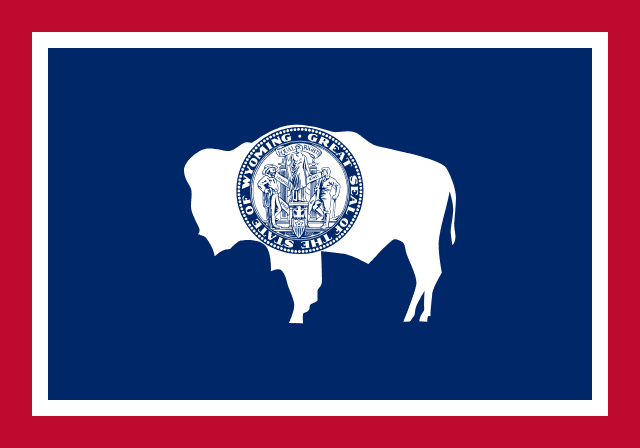
Ohio is identifiable by its V-shaped swallowtail and the 17-star blue triangle. The Texas state flag also uses red, white and blue, but it is rectangular and contains one large white star. Minnesota’s current flag has one white eight-pointed star on a two-tone blue rectangle, with neither stripes nor a swallowtail.
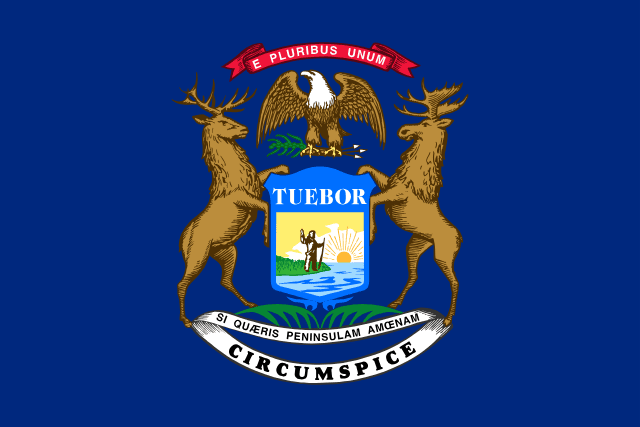
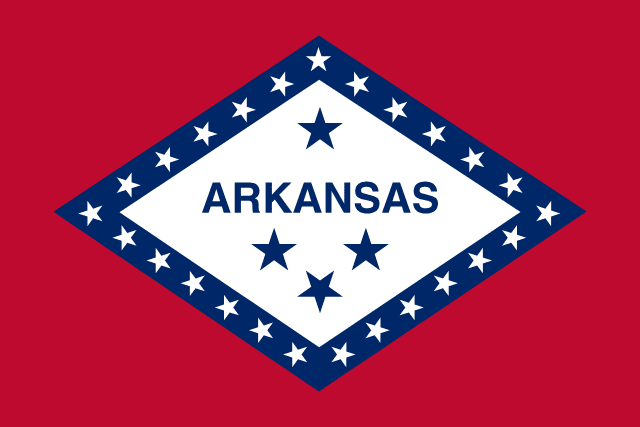
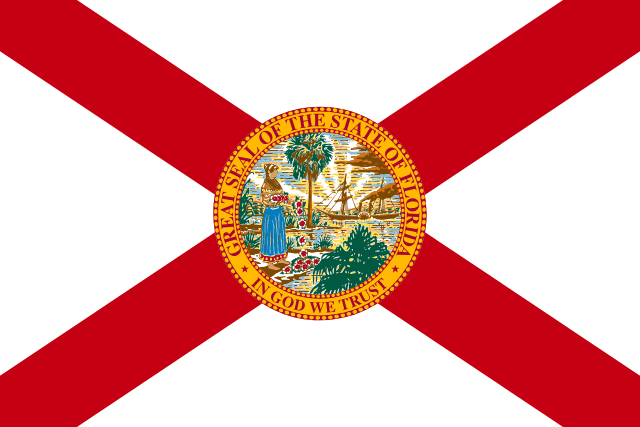
Maryland, Utah and New Mexico use other distinctive patterns, but their outer borders remain rectangular. Ohio’s flag is not simply a banner with unusually shaped artwork: its outline is unusual too. That makes the shape itself a useful first clue in any visual state-flag quiz.
The All 50 U.S. State Flags directory brings the designs together in one gallery. Compare Ohio’s shape first, then its stripes and stars, rather than trying to memorize 50 separate flag descriptions.
Frequently asked questions
Why is Ohio’s flag the only nonrectangular state flag?
John Eisenmann designed the swallowtail burgee for the 1901 Pan-American Exposition. Ohio adopted it in 1902, and the unusual shape remains required by state law.
What is a swallowtail burgee?
It is a distinctive flag or pennant with two tapered outer points separated by a V-shaped notch. Ohio’s hoist edge is straight and its fly end has the notch.
How many stars are on Ohio’s state flag?
Seventeen. Thirteen symbolize the original U.S. states; four more signify Ohio as the 17th state.
What does the letter O mean on Ohio’s flag?
The white circle stands for Ohio’s name, while the red center also suggests a buckeye nut.
What do Ohio’s red and white stripes represent?
Its roads and waterways. The flag has three red stripes and two white ones.
Who designed the Ohio flag?
John Eisenmann, the architect who designed Ohio’s building for the 1901 Pan-American Exposition.
When did Ohio adopt the state flag?
May 9, 1902, after the design had flown at the Buffalo exposition in 1901.
What is the correct Ohio flag ratio?
Its enclosing construction rectangle is 13 units long and 8 high. Because the flag has a swallowtail, that is not the ratio of a full rectangular cloth. Use the official technical drawing for the actual outline.
Does the Ohio state flag contain the Great Seal of Ohio?
No. It uses a red disc, white circular O, seventeen stars, stripes and a blue triangular field, not the full state seal.
Ohio Revised Code §5.01 — flag design
Ohio Revised Code §5.012 — display and care
Ohio Secretary of State — historical construction diagram and flag history (PDF)
Ohio History Connection — 1901–1902 origin story
Society of Ohio Archivists — original patent records
Flag illustration: preexisting public-domain flag artwork sourced from Flagpedia/FlagCDN and hosted in the FlagExplorers media library. Editorial review: November 13, 2026.