Maryland State Flag: Calvert, Crossland, History & Meaning
Explore why Maryland’s famous four-quarter flag combines the Calvert and Crossland family arms, its Civil War-era history, adoption in 1904 and the rules for displaying it correctly.
What does the Maryland state flag look like?
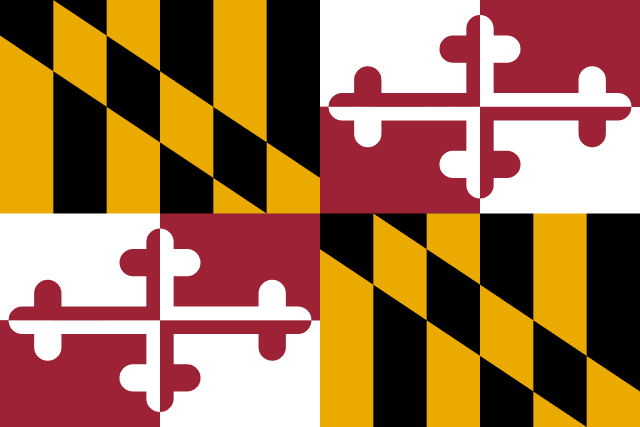
Maryland’s state flag is divided into four rectangular quarters, each containing historic family heraldry. The upper-left and lower-right quarters show alternating gold-and-black stripes crossed by a diagonal band. The upper-right and lower-left quarters show a distinctive red-and-white cross with trefoil-shaped tips against a quartered red-and-white field.
The design looks very different from a typical American state flag bearing a government seal on a plain blue background. There are no stars, no words and no state abbreviation. Instead, every part of the rectangular flag is filled with alternating heraldic patterns, making it identifiable at a distance.
The pattern follows the arms of the historic Calvert and Crossland families. Maryland’s Secretary of State explains that George Calvert, the first Lord Baltimore, combined his paternal family colors and his maternal Crossland family arms. This is why the design alternates between two dramatically different styles.
What do Maryland’s black-and-yellow quarters mean?
The gold-and-black design comes from the paternal family arms of George Calvert, first Lord Baltimore, whose family received the colonial proprietorship associated with Maryland. Its pattern is an example of heraldry, a system of identifying families and institutions using formal combinations of colors, stripes, crosses and other shapes.
Each Calvert quarter includes six alternating vertical bands of black and gold, crossed by a diagonal band on which the colors are reversed. The diagonal’s alternating colors are not an accidental printing error; the “counterchanged” arrangement is explicitly stated in Maryland’s flag legislation and display protocol.
Gold can be represented as yellow when producing the flag. In traditional heraldry, the gold tincture is called or, while black is sable. These terms explain the unusual patterns better than assigning generic meanings such as “gold equals sunshine” or “black equals courage,” which Maryland’s official flag history does not state.
The Calvert design occupies the first and fourth quarters, rather than the whole left half. If you are looking at a horizontally displayed flag, those are the upper-left and lower-right panels.
What is the red-and-white Crossland cross?
The remaining quarters are based on the arms of the Crossland family, relatives of Lord Baltimore on his mother’s side. They contain a Greek cross whose four arms terminate in three-lobed decorative forms. This shape is called a cross bottony, and the arm tips are one of the state flag’s identifying features.
In the red-and-white panels, the cross and its background exchange colors. Red portions appear against white areas and white against red areas. This is another form of counterchanging in heraldry. Do not replace it with a plain red cross on a uniform white square; that would lose the distinctive Crossland design.
The cross bottony is not a modern symbol added when Maryland joined the United States, nor does it indicate that the state flag is the flag of England. It is part of the older Calvert family coat of arms that Maryland adapted to modern state use.
Maryland’s official flag protocol specifies the exact arrangement of the Crossland design, while the State Archives traces the families and their heraldic origins.
How did the Maryland flag relate to the Civil War?
Maryland’s flag has a complicated history connected to the American Civil War. Maryland remained in the Union, but people within the state were sharply divided. The older black-and-gold Calvert colors had become widely associated with Marylanders who favored the Union, while the red-and-white Crossland colors were used by some Confederate sympathizers and Maryland-born Confederate soldiers.
According to the Maryland Secretary of State’s detailed history, these colors carried opposing political associations during the war. The combined four-part flag became more widespread after the war, when Marylanders sought ways of expressing a common state identity despite the conflict.
The design’s emergence has often been interpreted as a symbol of reconciliation, but that does not erase the reality that Maryland was a slaveholding border state and that the war was fought over slavery and related political conflicts. A clear history should describe the divisions without romanticizing them or implying that both wartime movements pursued the same goals.
The specific four-quarter state flag was not the official Maryland banner used continuously from colonial times. The families’ arms are centuries older, but the modern flag emerged in its recognizable form during the postwar nineteenth century.
When did Maryland adopt its flag?
The modern combined design was known in public use by October 11, 1880, when it appeared during a parade celebrating the 150th anniversary of Baltimore’s founding. It was also displayed during the dedication of Maryland monuments at Gettysburg in 1888 and became a regimental color for the Fifth Regiment, Maryland National Guard, in 1889.
The Maryland General Assembly officially adopted the state flag on March 9, 1904. The legislation did not invent a wholly new pattern. Instead, it legalized an already familiar banner whose design was related to the longstanding Calvert family shield.
| Date | Flag milestone |
|---|---|
| Seventeenth century | Calvert and Crossland arms associated with colonial proprietors |
| 1861–1865 | Black-gold and red-white colors acquire divided wartime associations |
| October 11, 1880 | Combined banner documented at Baltimore parade |
| October 25, 1888 | Used at Gettysburg monument events |
| 1889 | Fifth Regiment adopts the design as a regimental color |
| March 9, 1904 | General Assembly officially adopts flag |
| 1945 | Gold cross bottony designated flagpole ornament |
Historical dates and the flag’s political context are documented by the Maryland Secretary of State and the Maryland State Archives.
What is the correct orientation and flagpole ornament?
Maryland’s flag is easy to rotate incorrectly because every quadrant has complex geometry. The proper horizontal arrangement puts a Calvert gold-and-black panel in the upper hoist corner. The state requires the black stripe in the diagonal band of that first quarter to be at the top of the staff.
The Secretary of State’s proper-display instructions show the correct orientation and explain that Maryland’s flag should be raised briskly and lowered slowly. When displayed with the U.S. flag, the national flag has precedence and Maryland’s flag must not be displayed higher or larger in a way that violates the applicable protocol.
If an ornament is attached to the top of the pole carrying Maryland’s flag, state law specifies a gold cross bottony. This is an unusual legal detail that reflects the same Crossland heraldic symbol found in the flag itself. The requirement applies to the pole ornament when present, not to every classroom drawing of the rectangular banner.
For events and public buildings, official display guidance includes rules for daytime flying, illumination at night, respectful handling and half-staff occasions. These rules should be distinguished from the original family symbolism: flag protocol governs how the symbol is treated, not why the two quarter patterns were created.
Maryland flag color specifications and visual details
The official Maryland flag uses black, yellow (heraldic gold), red and white (heraldic silver). Maryland’s Secretary of State publishes the following Pantone printing references for the two bright colors, which are useful when a school or designer wants something more reliable than colors sampled from a photograph.
| Color | Official printing reference | Location |
|---|---|---|
| Red | PMS 201 on coated stock; PMS 193 uncoated | Crossland quarters |
| Yellow/gold | PMS 124 on coated or uncoated stock | Calvert quarters |
| Black | Solid black | Calvert quarters |
| White | White | Crossland quarters |
The official protocol focuses on the formal heraldic pattern, correct colors and orientation rather than assigning a separate statutory motto to each colored stripe. The design should therefore be described as a family-armorial flag, rather than a sun, mountain or agricultural landscape flag.
For high-quality reproduction, begin with a trusted government flag image. The diagonal counterchanged bands and trefoil-shaped cross tips can become blurred or misaligned in small raster images. Vector artwork maintains the sharp edges of both designs.
How to draw the Maryland flag step by step
Drawing Maryland’s flag accurately takes more work than drawing a simple striped flag. Rather than inventing an unverified numerical ratio, use a rectangular canvas matching official Maryland artwork or the dimensions specified for your project. Begin by dividing it into four equal quadrants with a central vertical and horizontal guide.
- In the upper-left quadrant, draw six narrow alternating vertical yellow and black stripes. Add the diagonal band from the official artwork, reversing the colors inside it.
- Repeat the gold-and-black Calvert pattern in the lower-right quadrant, using the corresponding orientation shown in an official reference.
- In the upper-right and lower-left quadrants, create alternating red and white background sections.
- Add the Crossland cross bottony in each of those quarters, with its three-lobed arm tips and red-white counterchanged colors.
- Erase guide lines, then check that the upper hoist quarter is Calvert and that the top of its diagonal has the proper black stripe.
- Compare all four panels with the official Maryland flag illustration.
Common mistakes include swapping the location of the Calvert and Crossland quarters, using a plain red cross, turning the flag upside down or replacing the gold/black pattern with a checkerboard. These changes significantly alter the original heraldry.
Maryland state flag FAQs
Why does Maryland’s flag have four different quarters?
They alternate between the family arms of the Calverts and the Crosslands, relatives of the colonial proprietors of Maryland.
When did Maryland adopt its current flag?
The Maryland General Assembly adopted it on March 9, 1904, after the design was already used in public ceremonies.
What does the cross on Maryland’s flag mean?
It is a cross bottony from the Crossland family arms, with a trefoil-shaped end on each arm.
Is Maryland’s flag connected to the Civil War?
Yes. Black-and-gold and red-and-white colors had different wartime political associations; the combined flag became popular in the postwar reconciliation period.
What are Maryland’s state flag colors?
Black and gold/yellow for the Calvert quarters; red and white/silver for the Crossland quarters.
What belongs on the top of a Maryland flagpole?
When an ornament is used, state law specifies a gold cross bottony.
Which flag quadrant should be at the upper left?
The gold-and-black Calvert quarter, oriented as specified in the Maryland Secretary of State’s official protocol.
Maryland Secretary of State — The State Flag
Maryland Secretary of State — Complete Flag History
Maryland Flag Protocol — Description & Care
Maryland Flag Protocol — Correct Display
Maryland State Archives — Historic milestones
Flag image: public-domain Maryland state flag design via Flagpedia/FlagCDN, locally hosted on FlagExplorers. Consult official Maryland artwork for printing and ceremonial use.