New Jersey State Flag: Buff Color, Liberty & Ceres
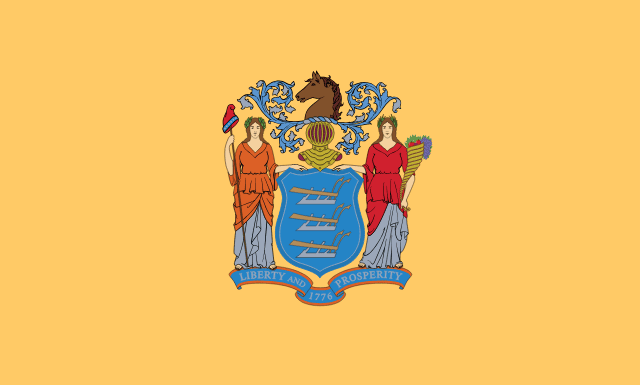
New Jersey’s state flag has a distinctive buff-colored field with the state’s coat of arms, including Liberty, Ceres, a horse’s head, three plows and the motto Liberty and Prosperity.
New Jersey flag facts at a glance
| Feature | Answer |
|---|---|
| State | New Jersey, United States |
| Adopted / updated | 1896 |
| Key identifying symbols | Buff Color, Liberty & Ceres |
| Image | Current design, vector-derived reference illustration |
What does the New Jersey flag look like?
The background is buff, a pale yellowish-tan shade, with the full-color New Jersey coat of arms centrally displayed. On either side of the blue shield stand two classical female figures, while a horse’s head appears above the shield.
Three plows decorate the shield itself. The ribbon beneath the figures says LIBERTY AND PROSPERITY and includes the year 1776. A plain buff field without the arms is not the official state flag.
Who are Liberty and Ceres?
Liberty, on the viewer’s left, holds a staff topped with a liberty cap. The cap is an old emblem of freedom, used widely in Revolutionary-era imagery. Ceres, the Roman goddess of grain, stands on the right and carries a cornucopia filled with produce.
This second figure represents abundance and prosperity. New Jersey’s Secretary of State and legislative materials often describe her more generally as Prosperity; the classical identification as Ceres helps explain the agricultural imagery.
What do the three plows stand for?
The plows on the central blue shield refer to the state’s agricultural heritage. Farming historically supported settlement, local markets and commerce across New Jersey, even though its economy is much broader today.
Above the shield are a helmet and a horse’s head. The helmet is associated with self-government and sovereignty, while the horse was an important working animal in agriculture and transport.
Why is the background buff instead of blue?
Buff and Jersey blue were colors chosen for New Jersey troops during the American Revolutionary War, associated with George Washington’s orders in 1779. Their use gives the state flag an unusual pale background among the many American flags on dark blue.
Buff should not be confused with bright canary yellow or pure white. It is a light, warm tan, which makes the colorful arms stand out.
When was New Jersey’s state flag adopted?
The New Jersey state flag was formally adopted in 1896. The coat of arms itself is much older: Pierre Eugène du Simitière designed the seal that was presented in 1777, shortly after independence.
The year 1776 on the emblem therefore describes the Revolutionary-era founding of state government, not the adoption of the 1896 flag. Older seals may differ slightly in the drawing of the figures, but the main iconography remains consistent.
How New Jersey compares with Delaware
New Jersey has a complete buff field. Delaware uses a colonial-blue field with a buff diamond inside it, and its arms include a farmer and soldier rather than Liberty and Ceres.
The pair is useful for an identification exercise: spotting a buff color is not enough on its own; determine whether buff fills the background or only the central diamond. The distinct figures and written date add further clues.
How to draw the coat of arms correctly
Draw a rectangular buff background and leave space for the central arms. Put a blue shield with three plows in the center, then add Liberty and Ceres as supporters.
A helmet and horse’s head belong above; the motto ribbon sits beneath the shield and figures. The entire coat of arms is detailed, so a teacher might use a close-up for labeling while keeping the full official illustration for the flag itself.
Common misconceptions about the state flag
The year 1776 is not a claim that the modern banner was adopted that year. The central shield is not a picture of three towns or counties, and Ceres is not a portrait of a specific New Jersey governor.
A simplified clip-art horse or an icon showing Liberty alone does not replace the full coat of arms. For official uses, always follow the state-approved colors and design.
Frequently asked questions about the New Jersey flag
Why is the New Jersey flag yellow?
Its official field is buff, a pale yellowish-tan Revolutionary-era state color, not ordinary bright yellow.
Who are the two women on the flag?
Liberty and Ceres, also interpreted as Prosperity.
When was the flag adopted?
New Jersey adopted its buff-field state flag in 1896.
New Jersey state government — Symbols
New Jersey Legislative Services — State Seal and Flag
Flag image: FlagCDN / Flagpedia vector-derived state flag illustration imported into the FlagExplorers media library. Check the linked official state references for legal descriptions. Article reviewed November 2026.