North Dakota State Flag: Eagle, 13 Stars & Meaning
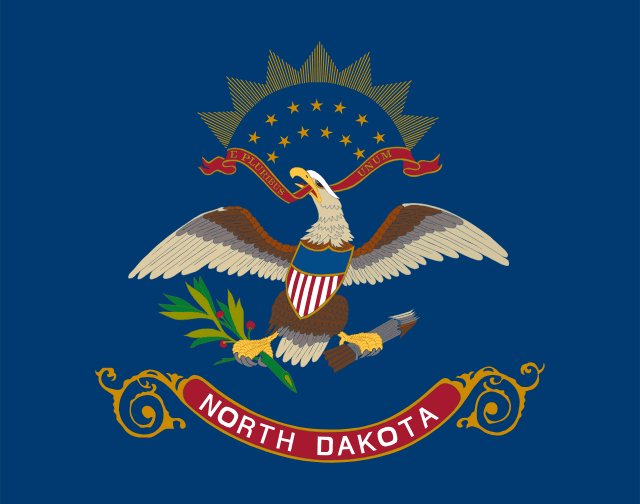
North Dakota’s state flag features a spread-winged eagle carrying arrows and an olive branch, thirteen stars above and the words North Dakota on a red scroll.
North Dakota flag facts at a glance
| Feature | Answer |
|---|---|
| State | North Dakota, United States |
| Adopted / updated | March 3, 1911 |
| Key identifying symbols | Eagle, 13 Stars & Meaning |
| Image | Current design, vector-derived reference illustration |
What is pictured on the North Dakota flag?
The dark-blue flag shows an American bald eagle with wings outstretched. Its talons grip a bundle of arrows and an olive branch with three red berries, representing a balance of readiness and peace.
The eagle’s breast carries a shield with thirteen red and white stripes. A scroll passing through the bird’s beak reads E PLURIBUS UNUM; above are thirteen stars and a sunburst. A red scroll below states NORTH DAKOTA.
Why are there 13 stars above the eagle?
The thirteen stars and stripes refer to the original states of the United States. The composition derives from American national heraldic symbolism rather than the number of North Dakota counties.
The eagle’s olive branch and arrows are widely understood as peace and the ability to defend the nation. The motto E Pluribus Unum translates as Out of many, one, emphasizing union.
What is the connection with the Spanish-American War?
North Dakota’s flag design is closely based on a regimental banner carried by the First North Dakota Infantry in the Spanish-American War and the Philippine campaign of the late 1890s.
Lawmakers adopted the modified design on March 3, 1911, changing the lower inscription from a unit designation to NORTH DAKOTA. The result was a state symbol with a direct link to the state’s military history.
When did North Dakota become a state?
North Dakota entered the Union on November 2, 1889. That is not the flag’s adoption date, which came more than two decades later in 1911.
The state’s 1911 act preserved the regimental banner’s central eagle design, and the flag remained in use despite later debates over whether it was distinctive enough. This distinction between statehood and flag adoption is important for chronological worksheets.
Were any redesigns proposed?
In 1951 a state commission studied whether the eagle flag suited North Dakota. It recommended a green-and-gold alternative incorporating a wheat sheaf and sunset.
The 1953 effort to replace the official banner failed, and the original eagle design remained. An old drawing of a wheat-and-sun flag is therefore a proposal, not evidence that North Dakota once officially changed its flag to green.
How is the flag different from Iowa’s?
Iowa also displays a prominent eagle holding a motto ribbon, but the bird appears on the wide white center panel of a blue-white-red vertical tricolor.
North Dakota’s eagle sits on an uninterrupted dark-blue field, with a red state-name scroll below and thirteen stars above. Those details make the flags distinguishable from a distance even when the feather pattern is not clear.
Instructions for making a classroom drawing
Start with a dark-blue rectangle and center a broad eagle with its wings spread. Add thirteen stars above, the E Pluribus Unum ribbon through the beak, olive branch and arrows below, and a red NORTH DAKOTA ribbon at the bottom.
For exact reproductions, the State Historical Society provides colors, proportions and detailed instructions; a casual bird silhouette cannot fully preserve the official design.
Do not confuse the flag with the U.S. Great Seal
The eagle, national shield and E Pluribus Unum resemble the Great Seal of the United States. But North Dakota’s flag is a specific state arrangement with a red name scroll, state-prescribed measurements and details connected to its earlier regimental banner.
A standalone federal eagle artwork is not an interchangeable substitute. This is why identifying the lower scroll is particularly useful in flag galleries.
Frequently asked questions about the North Dakota flag
What do the 13 stars represent?
They refer to the original thirteen U.S. states.
Why is there an eagle?
It comes from the First North Dakota Infantry’s historic regimental banner and uses national symbols.
When was the flag adopted?
March 3, 1911.
State Historical Society of North Dakota — official flag specifications
North Dakota Studies — history of the flag
Flag image: FlagCDN / Flagpedia vector-derived state flag illustration imported into the FlagExplorers media library. Check the linked official state references for legal descriptions. Article reviewed November 2026.