Moldova Flag: Eagle, Aurochs, Colours, Meaning & History
Understand Moldova’s blue-yellow-red flag, the central eagle and aurochs shield, 1990 adoption dates, 1:2 ratio and differences from Romania.
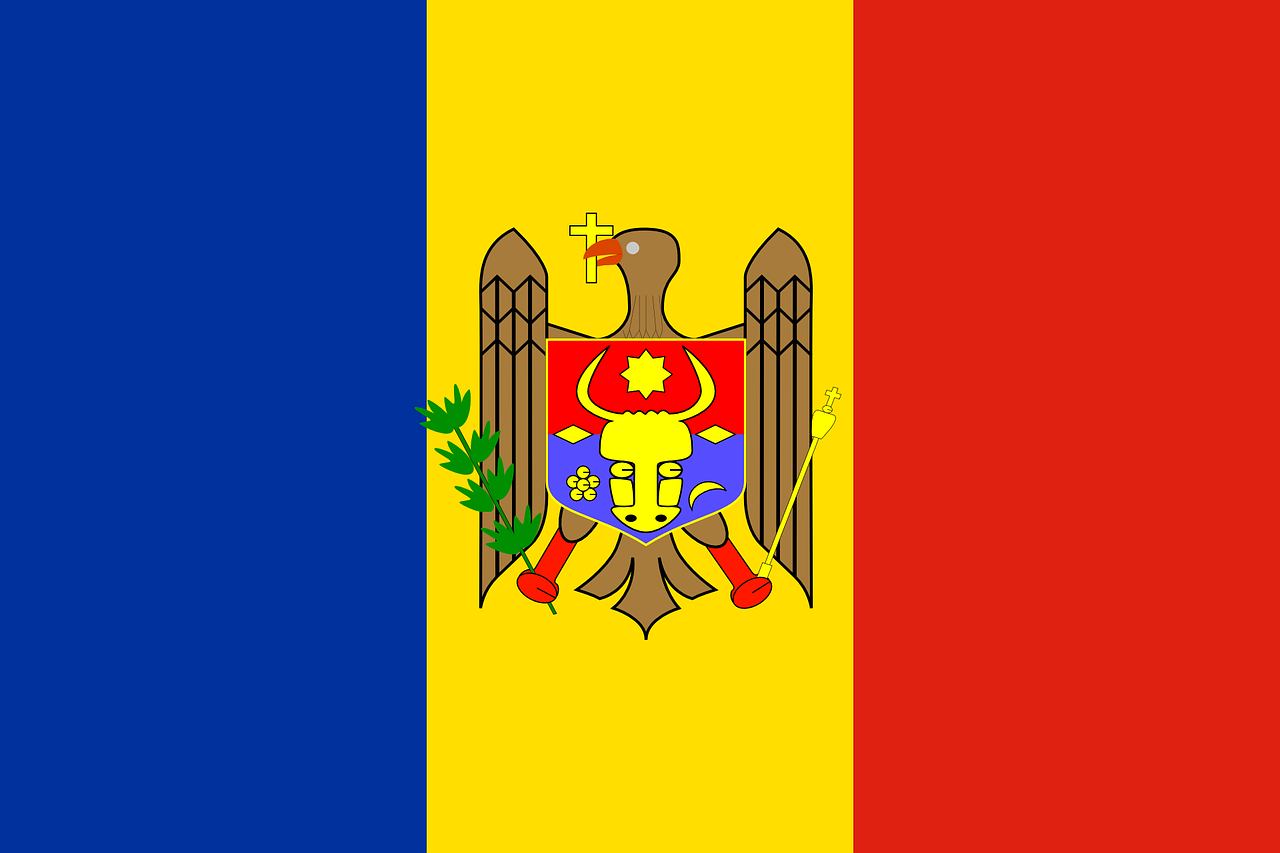
Moldova’s national flag is a vertical blue-yellow-red tricolour with the country’s coat of arms in the middle of the yellow stripe. The colours are closely related to Romania’s national flag, while the eagle and aurochs shield make Moldova’s design distinctive.
The flag became an official symbol during Moldova’s national revival in 1990, before independence in August 1991. The government subsequently adopted detailed rules defining the flag’s dimensions and its proper reproduction. This guide explains the coat of arms, different adoption dates, legal specifications, National Flag Day and how to distinguish the Moldovan tricolour from Romania’s.
What does Moldova’s national flag look like?
Moldova’s national flag has three equal vertical bands: blue nearest the pole, yellow in the middle and red at the fly. The country’s coat of arms is displayed at the centre of the yellow stripe. This emblem is an important distinguishing feature because Romania uses the same three-colour stripe arrangement without a coat of arms on its ordinary national flag.
The state flag is defined in Moldova’s official legislation and described on the Presidency of the Republic of Moldova website. The legal description is not simply a flag with an eagle somewhere on it: the detailed shield, aurochs’ head, star, flower and crescent all belong to the recognised design.
For flag identification, start with the blue-yellow-red vertical layout and then look at the central golden-brown eagle and shield. A plain tricolour photographed without its emblem might be Romanian or an incomplete Moldovan illustration, so the full image is the most reliable reference.
What are Moldova’s official flag proportions?
Moldova’s state flag has a 1:2 height-to-length ratio. In practical terms, a flag 20 centimetres high should be 40 centimetres long, and each of the three vertical colour bands should occupy one-third of that length. The emblem is centred on the yellow band.
A drawing can use a 1,200 × 600-pixel canvas, creating three 400-pixel-wide stripes. The coat of arms must then be added according to the approved specifications, including its relative size and location. A generic eagle, an image of the Romanian coat of arms or a symbol taken from an old Soviet flag is not an acceptable substitute.
The presidency’s state-symbols guide states the overall proportions and design. The flag’s artwork also includes details of the reverse side addressed by modern law. If a diagram is intended for formal use, consult the technical specimen instead of relying on the simplified version shown by a flag emoji.
What does the eagle on Moldova’s coat of arms represent?
Moldova’s central coat of arms features an eagle with a cross held in its beak, an olive branch in one claw and a sceptre in the other. On its breast sits a heraldic shield. The eagle links the design with regional heraldic traditions and the national symbolism that emerged during Moldova’s transition away from Soviet rule.
The cross, olive branch and sceptre are distinct objects with different historical and symbolic associations. The olive branch is widely associated with peace, while the sceptre expresses authority. An accurate description should identify what the bird actually carries rather than claiming it holds a sword or a bundle of arrows.
The official coat-of-arms specification provides the authoritative elements. The flag’s central eagle is not a free-standing decoration invented for the tricolour; it is a rendering of the country’s separately recognised state coat of arms.
Why is there an aurochs’ head on the shield?
The smaller shield on the eagle’s chest displays an aurochs’ head, a horned bovine emblem associated with the historic Principality of Moldavia. It is a heraldic link to the wider region’s earlier political history, long before the modern Republic of Moldova existed.
Above the animal’s head appears an eight-pointed star, while a rose and crescent flank it. These figures are part of the legally defined arms. In small reproductions, they may be difficult to distinguish, but a detailed flag guide should identify them correctly rather than treating the entire centre as an indistinct gold blotch.
The aurochs has different meanings from the eagle supporting the shield. One refers to historic Moldavian heraldry; the other belongs to the composition of the modern state emblem. Readers benefit from understanding that these layers of symbolism were assembled into a contemporary legal design rather than having originated simultaneously.
What do the shield’s star, rose and crescent mean?
The eight-pointed star, rose and crescent are historically associated with the heraldic imagery of Moldavia and appear around the central aurochs’ head. Their exact artistic forms are defined in the state’s approved coat of arms, and they are essential details for accurate reproduction.
Some secondary explanations assign very precise meanings to each component, but those interpretations vary. The more dependable starting point is the documented history of Moldavian heraldry and the official law listing the elements. A national flag guide should distinguish that legal identification from individual folklore or modern symbolism.
For a detailed illustration, use a recognised government drawing showing the shield clearly. It is easy for low-resolution images to lose a point of the star or obscure the difference between the rose and crescent. Repeatedly copying an inaccurate image makes errors harder to correct across educational websites.
What do the Moldovan flag’s three colours mean?
Moldova’s blue-yellow-red tricolour reflects strong historical connections with the colours used by Romania and earlier regional national movements. Popular explanations link blue with freedom or loyalty, yellow with prosperity or justice and red with courage or sacrifice. These are cultural interpretations rather than a single universally binding legal definition.
The most important verified facts concern the three vertical bands and their order, the central coat of arms and the independence-era decisions that established the modern flag. The state-symbols legislation defines the design without requiring a visitor to interpret each stripe through one specific moral virtue.
The three-colour arrangement also makes clear why the coat of arms is important: without it, the flag would look almost identical to Romania’s ordinary national banner. The emblem links Moldova’s national colours with the republic’s specific heraldic identity.
Why did Moldova adopt the tricolour in 1990?
During the late 1980s and early 1990s, Moldova experienced political and cultural movements that challenged Soviet institutions and advocated recognition of national language, history and state symbols. The historic blue-yellow-red tricolour became prominent in public demonstrations and legislative debate.
Moldovan official anniversary messages identify 27 April 1990 as the date on which the tricolour was officially adopted as a state symbol. The presidency’s flag page also cites a parliamentary regulation dated 12 May 1990. These are related but different legal milestones and should not be collapsed into one contradictory date.
The flag’s adoption preceded the country’s declaration of independence on 27 August 1991. Thus the tricolour was already established before the republic’s full transition from Soviet rule. This chronology illustrates how a national flag can be restored during a political movement before a separate independence decision is made.
When was Moldova’s coat of arms adopted?
Moldova’s state coat of arms was adopted through Law No. 337-XII of 3 November 1990, according to the presidency. This occurred after the April 1990 adoption of the tricolour and during the wider process of defining new state symbols.
The coat of arms combines the eagle with the shield depicting the aurochs’ head, star, rose and crescent. The complete emblem subsequently became the distinguishing feature of the flag. A timeline should therefore distinguish the introduction of the three-colour banner from the later formalisation of the heraldic device placed in its centre.
In educational charts, presenting both the flag and coat of arms helps explain why national symbols are sometimes adopted through different laws. They work together visually but have separate legal histories and different uses on official documents, seals and ceremonial objects.
What did independence in August 1991 change?
On 27 August 1991, Moldova declared independence from the Soviet Union. The blue-yellow-red national colours had already been adopted, so the newly independent state continued using a banner associated with the preceding national revival. The flag became an internationally recognised marker of Moldova’s separate statehood.
The transition involved more than an image change. It affected diplomatic representation, public institutions, language policy and constitutional arrangements. The flag’s central coat of arms helped differentiate the republic from neighbouring Romania even while preserving a familiar colour tradition.
Moldova’s subsequent legislation refined the national flag’s technical and legal framework. This is another reason not to treat 1991, 1990 and 2010 as competing answers to one simple question. They represent the adoption of colours, the independence of the state and later statutory specifications, respectively.
What does the 2010 State Flag Law establish?
Law No. 217 of 17 September 2010 on the State Flag of Moldova sets out the flag’s design and rules on use, including technical issues of reproducing its national coat of arms. The act belongs to the ongoing regulation of an existing state symbol rather than the original invention of the tricolour.
One important technical point concerns reproducing the emblem on both sides of the cloth. Official specifications address how the coat of arms is rendered in the correct orientation rather than simply allowing a reversed or incorrect eagle to result from printing on the back.
The Presidency’s official state flag page links to the legislation. For government procurement, ceremonial display or commercial manufacture, the current law and approved graphic annexes should be used. A general web illustration can simplify small details for visibility but must not misstate the colour order or replace the national arms.
When is Moldova’s National Flag Day?
27 April is commemorated as Moldova’s State Flag Day, recalling the 1990 decision to make the tricolour an official national symbol. The holiday was established by the Moldovan parliament in 2010, and official presidency statements regularly mark the occasion.
The date should not be confused with 27 August, Moldova’s Independence Day. The two celebrations are related through the country’s transition from Soviet rule but commemorate different legal and historical events.
Flag Day ceremonies provide opportunities to discuss the history of the tricolour, the heraldic aurochs and the eagle and the flag’s role in public life. Such occasions also explain why the national emblem is not just a decorative graphic: it is a formally protected representation of the state used in institutions and civic events.
How is Moldova’s flag different from Romania’s?
The two countries both use vertical blue-yellow-red tricolours, making the designs look almost identical when the central emblem is hidden. Moldova’s flag contains its coat of arms on the yellow band, while Romania’s ordinary national flag does not.
There are also differences in their official proportions. Moldova uses 1:2 height to length, whereas Romania uses 2:3. At small sizes, however, the coat of arms is usually the clearest visual clue; a photograph of a waving flag may make precise proportions impossible to judge.
The similarities reflect intertwined historical and cultural traditions, but Moldova and Romania are distinct sovereign states with their own symbols and legal rules. The Romania flag guide explains the other tricolour in more detail. Readers should avoid interpreting a common colour order as evidence that the national flags are legally interchangeable.
What are the historical roots of the Moldovan emblem?
The aurochs’ head belongs to the heraldic tradition of the historic Principality of Moldavia, a political entity whose territory and history extend beyond the borders of today’s Republic of Moldova. The eagle and other elements place this regional motif within a modern state emblem adopted in 1990.
Understanding this distinction matters because a medieval heraldic symbol and a modern national flag do not necessarily share an uninterrupted design history. The current flag is a product of the country’s national revival and late twentieth-century legislation, even as it borrows imagery from older regional traditions.
Historic maps, princely seals and coats of arms can help explain the origins of the aurochs, star and crescent. They should be correctly dated and not used as if every earlier Moldavian ruler flew Moldova’s current blue-yellow-red vertical tricolour with exactly the same emblem.
How to draw Moldova’s national flag correctly
Begin with a rectangle 40 centimetres wide and 20 centimetres high. Divide its length into three equal vertical bands. Colour the band nearest the pole blue, the centre yellow and the outer band red. Place the official Moldovan coat of arms in the middle of the yellow stripe.
Use the approved design for the eagle, cross, olive branch, sceptre and aurochs shield. A generic golden bird can leave out legally required features or put the symbols in the wrong positions. For a digital version, a 1,200 × 600-pixel canvas has suitable proportions and space for a detailed central emblem.
When producing a formal double-sided flag, consult the 2010 technical specification for the correct rendering of the reverse. On a website, preserve the 1:2 ratio and provide alt text describing the tricolour with a central eagle and aurochs shield.
Moldova flag quick facts
| Country | Republic of Moldova |
|---|---|
| Colours from hoist | Blue, yellow, red |
| Stripes | Three equal vertical bands |
| Flag ratio | 1:2 height to length |
| Central emblem | Eagle with aurochs shield |
| Flag adoption | 27 April 1990 |
| Parliamentary regulation | 12 May 1990 |
| Coat of arms law | 3 November 1990 |
| Independence | 27 August 1991 |
| Modern flag law | 17 September 2010 |
| National Flag Day | 27 April |
Moldova flag FAQs
What colours are on Moldova’s flag?
Blue, yellow and red in three equal vertical bands, starting at the pole.
What is in the centre of Moldova’s flag?
The state coat of arms, showing an eagle carrying a shield with an aurochs’ head.
How is the flag different from Romania’s?
Moldova adds a central coat of arms and uses different official proportions.
When was the flag adopted?
The official tricolour was adopted on 27 April 1990, with further regulation on 12 May 1990.
What is the official flag ratio?
1:2 height to length.
When is Moldova’s Flag Day?
27 April, marking the 1990 adoption of the tricolour.