Malta Flag: George Cross, White and Red, Meaning & History
The Maltese national flag explained: the George Cross awarded in 1942, its separate Maltese Cross, 1964 independence and official flag specifications.

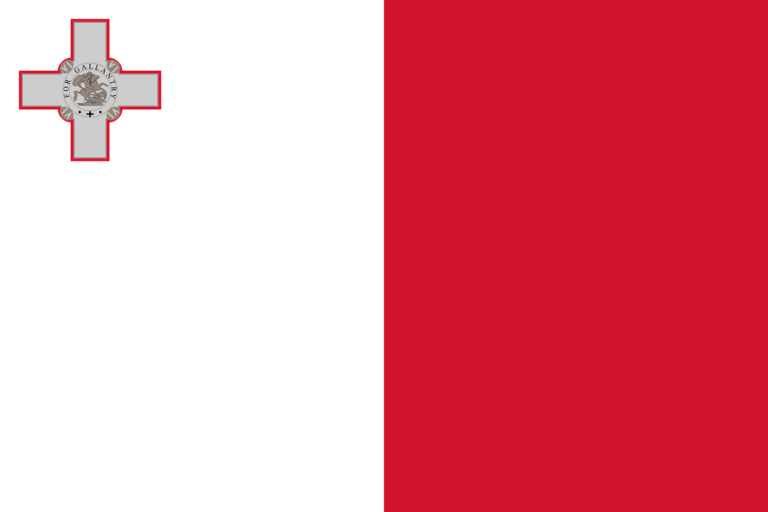
Malta’s national flag has two equal vertical fields, white next to the pole and red at the fly. A small George Cross edged in red appears in the upper-left part of the white field. The decoration commemorates the courage of Malta’s people during the Second World War and was awarded collectively to the islands on 15 April 1942.
The national flag retained this historic decoration when Malta became independent in 1964. It should not be confused with the eight-pointed Maltese Cross associated with the Knights of St John. This guide explains the design, the wartime award, the history of the red-and-white colours, legal requirements and the different flags and crosses connected with Malta.
What does Malta’s national flag look like?
Malta’s national flag consists of two equal vertical bands: white at the hoist, next to the flagpole, and red at the fly, on the outer half. A small representation of the George Cross, outlined in red, sits in the upper-left corner of the white stripe. There are no additional stars, central coat of arms or inscriptions on the ordinary national flag.
This arrangement is defined in Article 3 of Malta’s Constitution, making the appearance a constitutional requirement rather than simply a design convention. The cross occupies a specific position and should not be moved to the centre of the flag.
Malta’s government guidance explains the flag and its display rules. On small icons, the George Cross can be hard to see, so an accessible description should identify the emblem explicitly instead of referring only to a white-red bicolour.
What are the official Malta flag proportions?
The official national flag is 2:3 in height to length. A flag 20 centimetres high should be 30 centimetres long. Each vertical band occupies half the width, so the white and red sections are each 15 centimetres wide. The George Cross must remain in the canton, the upper hoist corner of the white section.
The Maltese government publishes detailed national flag graphical specifications. These are particularly important because an approximate clip-art cross may be recognisable but not technically correct. The emblem’s outline, position and internal design should come from an approved specimen.
For a classroom illustration, the two-band construction is simple. Digital artwork can use a 900 × 600-pixel canvas with a 450-pixel-wide white half and 450-pixel-wide red half. Accurate formal reproduction requires the official George Cross drawing and the proper measurements within the white canton.
What is the George Cross on Malta’s flag?
The George Cross is a British decoration awarded for extraordinary gallantry. It was created by King George VI during the Second World War and has a distinctive silver cross design. The decoration was awarded collectively to Malta in recognition of the courage shown by its population during wartime attacks.
On the national flag, the award appears small in the upper-left white field and is edged in red. Although the main design is a simple red-white bicolour, this additional decoration distinguishes Malta from other national flags with two vertical colour fields.
It is important to identify the object as an honour awarded to the islands, rather than a Christian cross chosen solely for religious symbolism. The George Cross and the separate Maltese Cross have different origins, appearances and cultural associations. The site’s dedicated George Cross guide explains the award and its placement in more detail.
Why was Malta awarded the George Cross in 1942?
During the Second World War, Malta occupied a strategically important location in the Mediterranean. The islands endured intense aerial bombing, shortages and prolonged siege conditions while their residents and defenders continued to resist. Their role affected shipping and military operations across the central Mediterranean.
King George VI awarded the George Cross to Malta on 15 April 1942, recognising the collective bravery and endurance of the Maltese people. The award was unusual because it honoured an entire population rather than a single individual.
The date and the meaning of the award are explicitly reflected in the Constitution’s description of the national flag. This makes the small emblem an enduring historical memorial on an otherwise simple national design. It should not be described merely as a royal gift unrelated to the war or as a decoration awarded at the moment of independence.
How did Malta’s wartime experience shape the national flag?
The islands’ wartime experience gave the George Cross exceptional significance in Maltese public memory. Bombing and hardship affected civilians as well as military forces, and the collective award commemorated a shared national ordeal. By placing the decoration on the flag, Malta made that history visible in everyday national representation.
The award was made while Malta was still under British colonial rule. Its later retention on the national flag after independence shows that an emblem can carry historical meaning beyond the political system under which it was first awarded.
It is useful to distinguish wartime history from the later constitutional decision to retain the cross. The first concerns the 1942 recognition of bravery; the second concerns the independent state’s choice of its national design. Both are important, but they happened at different times and should not be collapsed into a single “1942 independence flag” narrative.
Is the George Cross the same as the Maltese Cross?
No. The small decoration on Malta’s national flag is the George Cross. The famous Maltese Cross is a separate emblem with eight points, strongly associated with the Knights of St John and later with Maltese history, institutions and culture.
The Maltese Cross commonly appears as a white eight-pointed emblem on a red background. It is visible in symbols connected with the Order of St John and in contemporary logos, but it is not the decoration shown in the upper corner of Malta’s present national flag.
The distinction matters for images and search results. A red flag with a large white Maltese Cross represents a different emblem or flag from the current white-red national bicolour bearing a George Cross. An educational article should name the two crosses correctly and explain their relationship to different chapters of the islands’ history.
What do Malta’s red and white colours mean?
Red and white have long been associated with Malta and appear in a variety of historical accounts and symbols. Modern explanations commonly connect white with peace or purity and red with courage or sacrifice, but those associations are not the complete history of the national flag.
The Constitution defines the national colours and the George Cross rather than requiring every stripe to have a single legally fixed moral meaning. The stronger historical explanation is the continuity of red and white within Maltese identity and the later addition of the 1942 award.
Because Malta’s history includes medieval powers, the Knights of St John and British administration, symbols can have overlapping origins. A precise guide should explain that there are traditions about how the colours first appeared but avoid presenting an unsupported story as an established government decision from the eleventh century.
Did Count Roger give Malta its red and white flag in 1091?
A well-known legend claims that Count Roger I of Sicily gave Malta a red-and-white banner after his expedition to the islands in 1091. It is an appealing story and is often repeated in popular flag histories, sometimes as an account of cloth cut from the count’s own banner.
However, Malta’s own educational material cautions that this is an ancient tradition that cannot be historically confirmed. The tale therefore belongs in a section about legends, not in a sentence asserting that a medieval ruler definitely created today’s flag.
The distinction does not make the story culturally irrelevant. It shows how communities connect familiar colours with memorable episodes in their past. Good historical writing can preserve the legend while clearly separating it from verifiable documentary evidence. For a precise timeline, focus on the recorded 1942 award, constitutional decisions and independence in 1964.
What is the connection between Malta’s flag and the Knights of St John?
The Knights of St John, or Order of Malta, played a major role in the islands’ early modern history, including the famous Great Siege of 1565. The order’s symbols frequently use red, white and the eight-pointed Maltese Cross, helping explain why these colours and shapes are familiar in Maltese heraldic traditions.
However, the present national flag’s small cross is the George Cross, not the order’s emblem. The Knights’ flags and standards are historically significant but should not be used as substitutes for Malta’s current national banner.
A history gallery should distinguish a religious-military order’s flag from a modern state flag. The visual similarities can reveal shared colour traditions, but exact designs and legal meanings differ. This is why an article that simply calls the national decoration “the Maltese cross” would misidentify one of the country’s most important national symbols.
What changed when Malta became independent in 1964?
Malta became independent from the United Kingdom on 21 September 1964. The new independent state’s flag preserved the familiar white and red vertical bands and retained the George Cross awarded during the Second World War. The constitution formally described the decoration with a red border in the white canton.
Earlier colonial-era renderings sometimes placed the George Cross on a blue square. Under the post-independence design, the cross is outlined in red without that blue backing square. This detail helps historians identify flags from the years before and after 1964.
The islands later became a republic in 1974, but the national flag continued in its established form. The sequence illustrates that the flag can remain recognisable even as the constitutional relationship with the British monarchy changes. For full detail see the separate Malta flag history article.
What does Malta’s Constitution say about the flag?
Article 3 of Malta’s Constitution gives a detailed description: two equal vertical stripes, white at the hoist and red at the fly, with a representation of the George Cross awarded on 15 April 1942 placed in the canton of the white stripe and edged in red.
This constitutional wording is important because it separates the ordinary national banner from other emblems, including the Maltese Cross, state seal and coat of arms. It also identifies the wartime award rather than merely referring to an unspecified religious cross.
The government provides both constitutional context and practical flag-use instructions. An individual making a small flag chart may only need the basic design, but authorities and manufacturers should consult the exact official graphical specification. The position and appearance of the award are part of the legal design, not optional embellishments.
What are Malta’s official flag-display rules?
Malta’s government publishes detailed guidance on displaying the national flag, including how to orient it, its precedence relative to other flags and requirements for official use. One especially distinctive rule is that the flag should not normally be displayed with the George Cross at the bottom, except as a signal of dire distress.
Formal displays involving government buildings, foreign visitors or the armed forces may require additional protocol. The country’s national symbols page provides practical examples, including ceremonies and funerals.
For a classroom drawing, the fundamental instruction is simply to put the white band toward the hoist and the George Cross at its upper corner. For an official event, organisers should check the current government guidance rather than assuming that informal flag etiquette from another country applies without change.
Which other national flags resemble Malta’s?
Malta’s white-red vertical bicolour can resemble the national flag of Indonesia or Poland only when details and orientation are ignored; those countries actually use horizontal red-white bands. The flag of Peru has vertical red-white-red stripes, so it uses a different number of fields and a different colour order.
The clearest identifying feature is Malta’s George Cross in the top corner of the white field. Even if the emblem is tiny, the white-left and red-right two-band design helps separate the flag from others.
Malta’s flag is also distinct from the white Maltese Cross on red, an emblem commonly associated with the Knights of St John. In a quiz or educational chart, show the full national design and label the George Cross correctly. A photograph with the canton folded over may hide the decoration and make identification harder.
How to draw and reproduce Malta’s flag
Draw a rectangle 30 centimetres wide by 20 centimetres high. Divide it vertically into two equal sections, making the left white and the right red. In the upper-left part of the white section, add the official George Cross with a red outline. Use the Maltese government’s graphic specifications to reproduce the cross, its distance from the edges and its internal detail accurately.
For digital art, use a 900 × 600-pixel canvas, with each vertical stripe 450 pixels wide. A small emblem can become blurred if it is taken from a low-resolution photo, so use an authorised high-quality source when possible. Do not substitute the eight-pointed Maltese Cross.
Accessible alt text should describe the white and red vertical halves, the upper hoist and the small George Cross. This gives non-visual readers enough information to identify the flag and understand the emblem’s role.
Malta flag quick facts
| Country | Malta |
|---|---|
| Colours | White and red |
| Stripes | Two equal vertical bands |
| Official ratio | 2:3 height to length |
| Distinctive emblem | George Cross edged in red |
| George Cross awarded | 15 April 1942 |
| Independence | 21 September 1964 |
| Republic established | 1974 |
| Constitutional reference | Article 3 |
| Separate historic motif | Eight-pointed Maltese Cross |
Malta flag FAQ
Which side of Malta’s flag is white?
The white half is nearest the flagpole; the red half is at the fly.
What is the cross in the upper-left corner?
The George Cross, a gallantry award given collectively to Malta in 1942.
Is that the same as the Maltese Cross?
No. The eight-pointed Maltese Cross is a separate emblem associated with the Knights of St John.
What are Malta’s official flag proportions?
2:3 height to length.
When did Malta become independent?
21 September 1964, retaining the white-red flag with the George Cross.
Did Count Roger definitely create the colours in 1091?
No. That story is a longstanding tradition rather than a securely verified historical account.