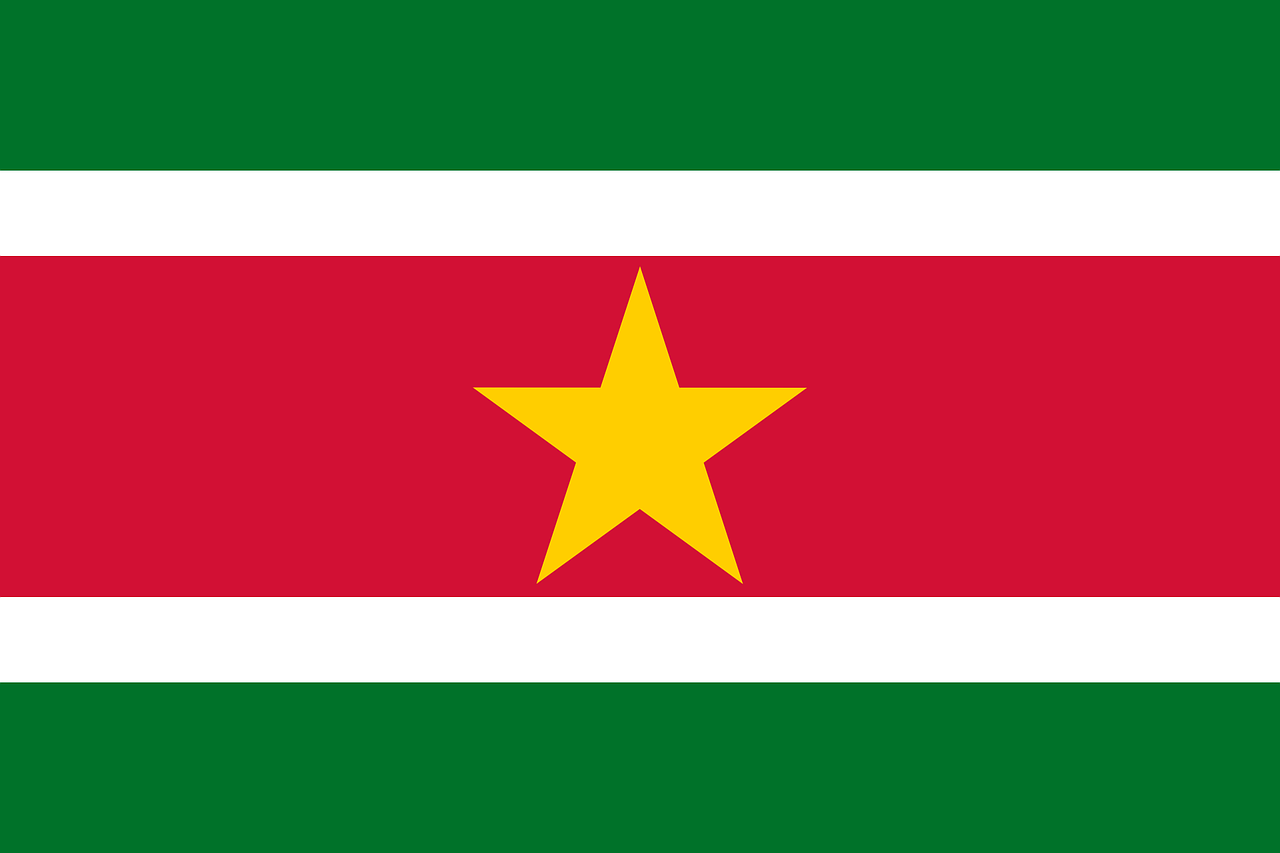
Suriname’s national flag has five horizontal bands of green, white, red, white and green, with a large yellow five-pointed star centred on the red band. It became the national flag at independence in 1975.
What does the Suriname flag look like?
The stripes have official height proportions of 2:1:4:1:2. This makes the central red stripe twice as deep as either green stripe and four times as deep as either white stripe. The flag’s overall height-to-length ratio is 2:3.
Official meaning of the colors
Suriname’s government gives formal symbolic meanings to the design. Green represents the country’s fertility and its possibilities for the future. White represents justice and freedom. Red represents renewal, progress and the love that motivates action. The yellow star represents national unity, sacrifice and orientation toward a “golden future.”
History of the flag
The current flag was introduced when Suriname became independent from the Netherlands on November 25, 1975. Its single central star was intended as a unifying national symbol rather than an emblem of any one ethnic or cultural group.
Suriname flag facts
- Colors: green, white, red and yellow
- Stripe ratio: 2:1:4:1:2
- Overall ratio: 2:3
- Central symbol: yellow five-pointed star
- Adopted: November 25, 1975
Source
Primary reference: Government of Suriname — national flag specifications and symbolism.